Automotive 1984
Volkswagen
Volkswagen introduces a new sedan for families in a hurry.
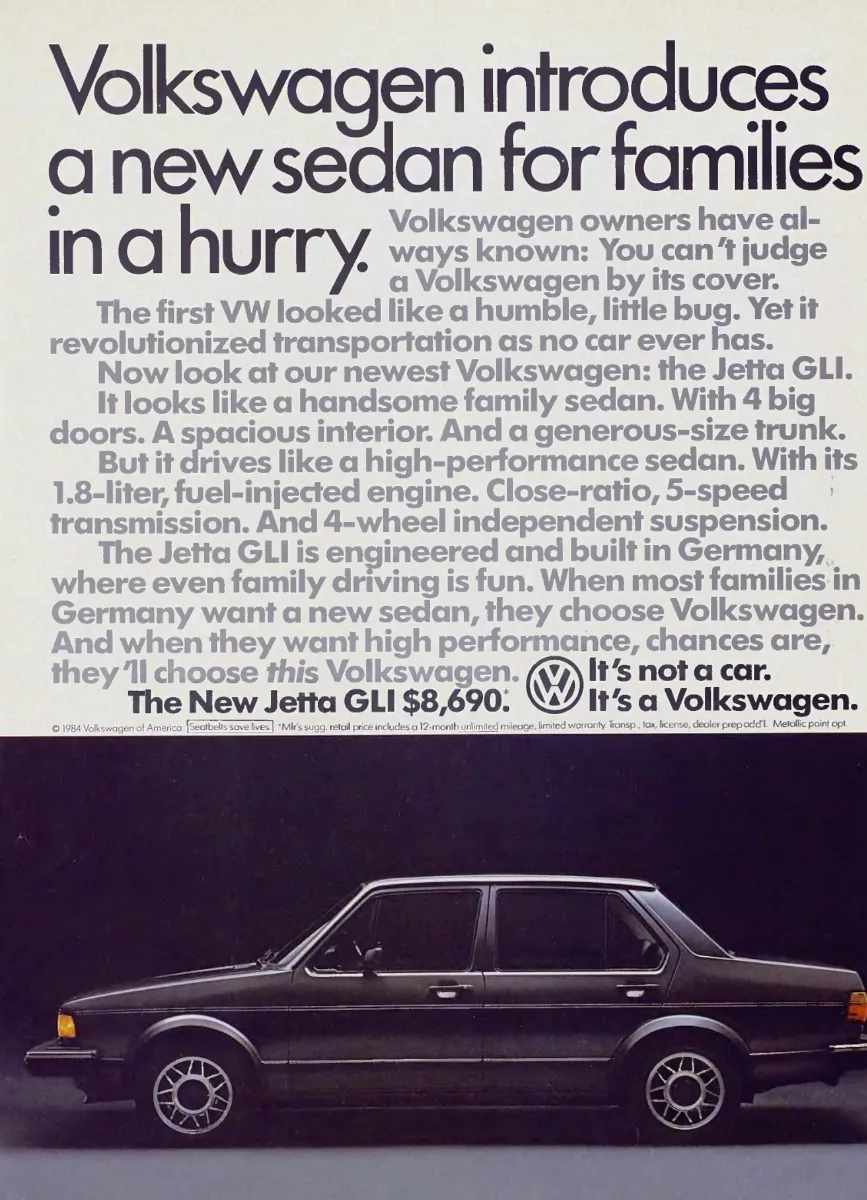
FROM THE PRINTED PAGEOriginal ad copy
OCR transcription from the archived page. Scanning and reading-order errors may remain.
Volkswagen introduces a new sedan for families in a hurry. Volkswagen owners have always known: You can’t judge a Volkswagen by its cover. The first VW looked like a humble, little bug. Yet it revolutionized transportation as no car ever has. Now look at our newest Volkswagen: the Jetta GLI. It looks like a handsome family sedan. With 4 big doors. A spacious interior. And a generous-size trunk. But it drives like a high-performance sedan. With its 1.8-liter, fuel-injected engine. Close-ratio, 5-speed transmission. And 4-wheel independent suspension. The Jetta GLI is engineered and built in Germany, where even family driving is fun. When most families in Germany want a new sedan, they choose Volkswagen. And when they want high performance, chances are, they’ll choose this Volkswagen. The New Jetta GLI $8,690.* It’s not a car. It’s a Volkswagen. © 1984 Volkswagen of America Seatbelts save lives. *Mfr’s sugg. retail price includes a 12-month unlimited mileage, limited warranty. Transp., tax, license, dealer prep add’l. Metallic paint opt.
Commentary
I look for evidence of the hurry and find a car standing perfectly still. No blurred road, racing stripe or driver in gloves interrupts the side profile. Four doors, a substantial trunk and a dark finish establish the family credentials before the copy gives the reader permission to want something livelier.
The headline makes that permission sound practical. A family can be in a hurry without declaring itself interested in performance driving. The body is less coy: fuel injection, a close-ratio five-speed and independent suspension supply the mechanical explanation. The ad constructs a double identity, with conventional usefulness on the outside and an enthusiast’s reasons for buying underneath.
Its route to credibility takes a detour through the Beetle. The little bug becomes a precedent for underestimating a Volkswagen by its appearance. This is a carefully selected piece of brand memory: the visual modesty that might count against the GLI is recast as familiar evidence that the buyer should look closer. Claims about German families then invite the American reader to borrow another market’s presumed judgment. The scan asserts those preferences; it does not document them.
The price sits beside the badge, with transport, tax, license and dealer preparation excluded below. That small line is part of the offer, not visual debris. It reminds a present reader that a prominent advertised number has always required interpretation. The convenience of comparing prices online does not eliminate the distinction between the headline amount and the eventual transaction.
For a beginning copywriter, study the repeated sequence of short feature fragments. Doors, room and trunk make one rhythmic list; engine, transmission and suspension make another. Matching syntax lets the practical and pleasurable cases feel equally substantial. The headline’s everyday idiom lowers resistance, while the body earns the performance suggestion with named hardware.
Volkswagen’s Jetta history places the first model’s debut in 1979. The manufacturer still markets a Jetta GLI sports sedan, giving this family-performance proposition a direct descendant.
That continuity is more interesting than a simple resemblance of badges. The old page sells a car that lets family practicality coexist with driver interest. Its specific engine, five-speed gearbox, German-build claim and $8,690 offer belong to this scan; the underlying negotiation between responsibility and pleasure remains recognizable.