Fashion & Accessories 1984
De Beers
2 months’ salary. For a diamond as valuable as the love you’ve found.
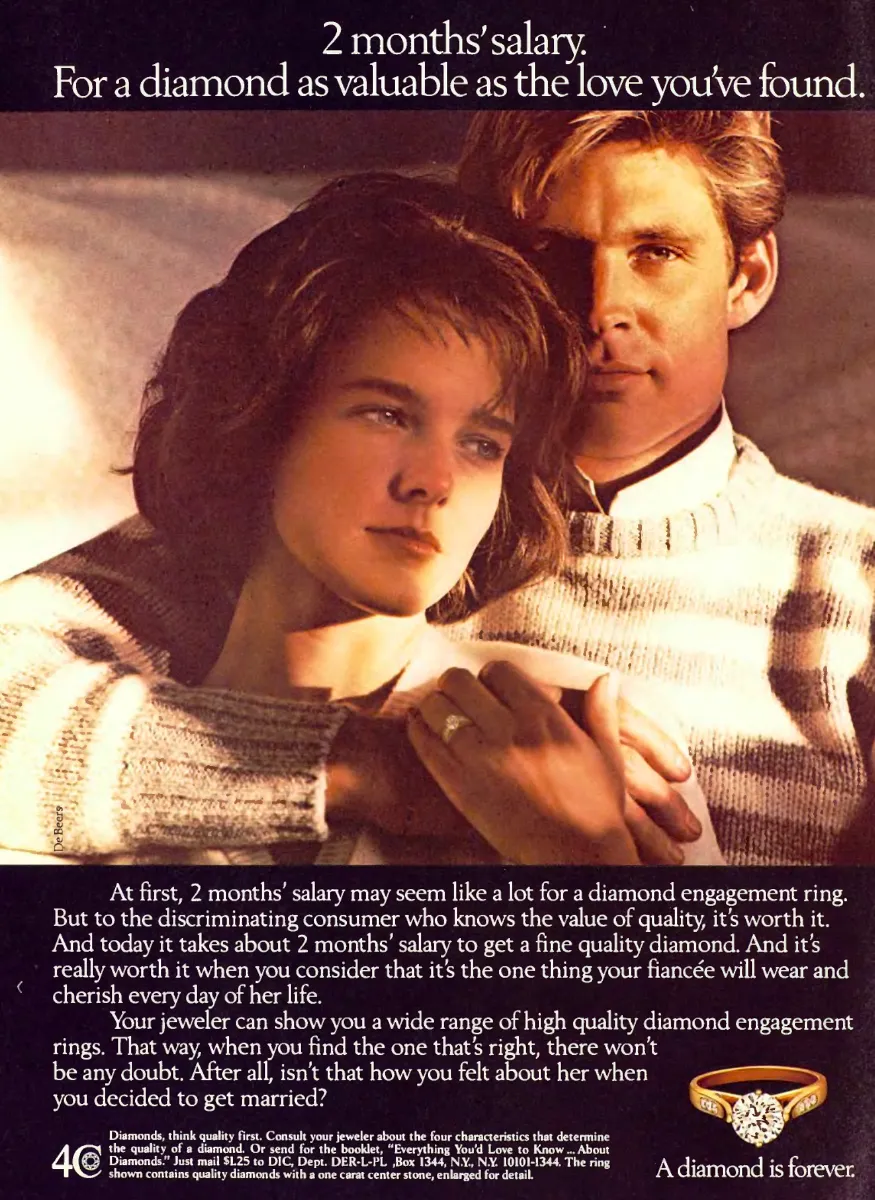
FROM THE PRINTED PAGEOriginal ad copy
OCR transcription from the archived page. Scanning and reading-order errors may remain.
2 months’ salary. For a diamond as valuable as the love you’ve found. De Beers At first, 2 months’ salary may seem like a lot for a diamond engagement ring. But to the discriminating consumer who knows the value of quality, it’s worth it. And today it takes about 2 months’ salary to get a fine quality diamond. And it’s really worth it when you consider that it’s the one thing your fiancée will wear and cherish every day of her life. Your jeweler can show you a wide range of high quality diamond engagement rings. That way, when you find the one that’s right, there won’t be any doubt. After all, isn’t that how you felt about her when you decided to get married? Diamonds, think quality first. Consult your jeweler about the four characteristics that determine the quality of a diamond. Or send for the booklet, “Everything You’d Love to Know ... About Diamonds.” Just mail $1.25 to DIC, Dept. DER-L-PL, Box 1344, N.Y., N.Y. 10101-1344. The ring shown contains quality diamonds with a one carat center stone, enlarged for detail. 4C A diamond is forever.
Commentary
I start with the hands. Her ring is visible where his arm closes around her, while the larger product photograph waits at the bottom. The matching softness of their sweaters makes the purchase seem already absorbed into domestic life. Above them sits a financial instruction with the finality of a fact: two months of earnings.
Reading downward, I find the objection already anticipated. The first sentence admits that the amount may seem large; the next assigns acceptance to the discerning buyer. That is a subtle narrowing of the reader’s options. Doubt about expenditure can start to feel like doubt about one’s ability to recognize quality. The ad then distributes the price across a projected lifetime of wearing the ring. It supplies no independent basis for the salary figure: this is the advertiser’s proposed spending norm.
The jeweler serves as the local authority. A mailed booklet costing $1.25 offers further instruction, and its fine print finally introduces the four quality characteristics. The order is revealing. The budget arrives in large type before the education arrives in small type. I read this as an attempt to establish the scale of the purchase before the reader begins comparing stones.
The page also makes a particular relationship script visible: a male buyer, a female recipient and confidence expressed through choosing correctly. A contemporary reader can search for information before entering a shop and may approach the purchase as a shared decision. The contrast exposes what this execution takes for granted, rather than proving how every couple behaved in 1984.
For a new copywriter, watch the movement from salary to quality to certainty about a partner. The final question borrows emotional confidence from the marriage decision and transfers it to merchandise. Repetition makes the figure familiar, while the lifetime argument changes the unit of comparison. It is useful to understand the mechanism and equally useful to notice that persuasive arithmetic is not financial evidence.
De Beers began in 1888. Its present business spans diamond exploration, mining, sorting, trading, brands and jewellery expertise. The company’s history also dates the forever slogan to 1947.
The connection between a durable object and enduring attachment still supports the product story. The salary formula and gendered buying script are this ad’s assumptions, not timeless requirements. Studying the page means separating that commercial prescription from the affection it recruits.