Back to the collection248 / 281
Consumer Goods 1984
Johnnie Walker
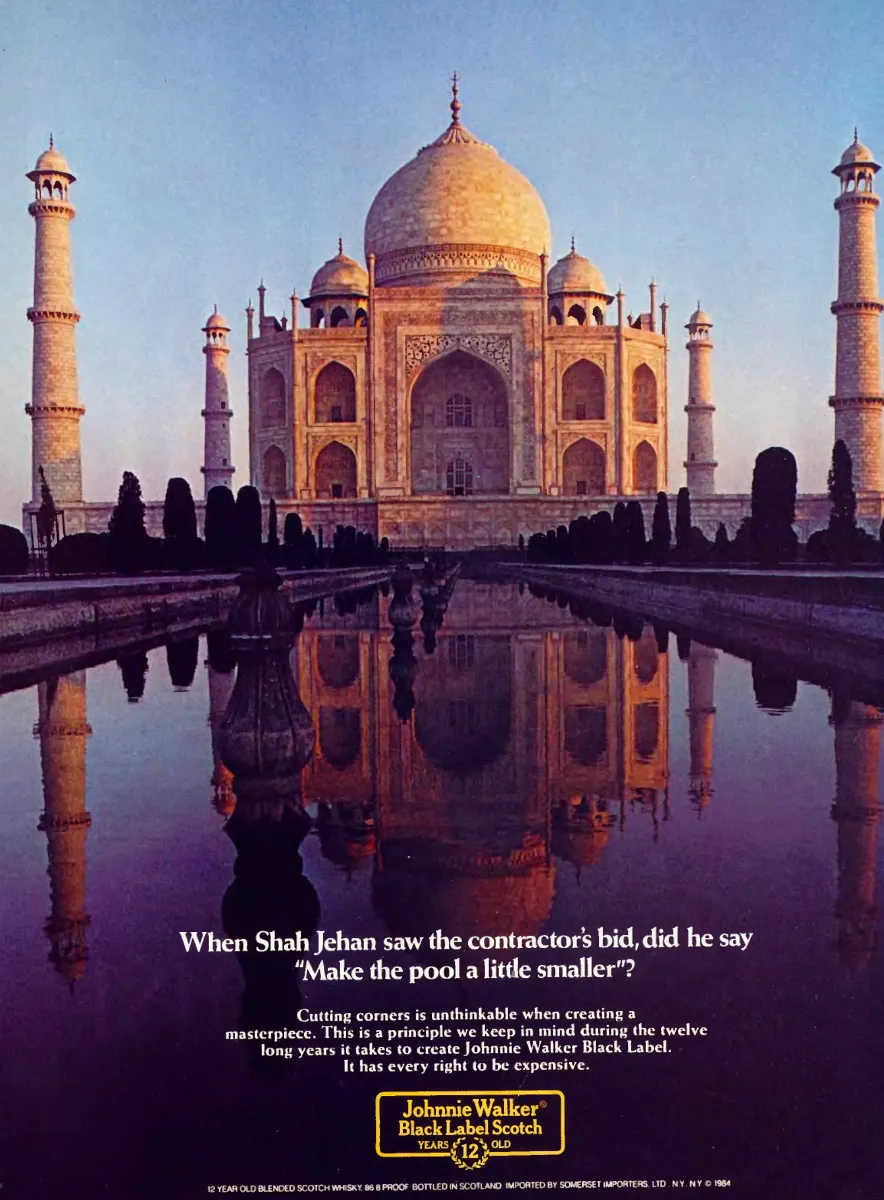
When Shah Jehan saw the contractor’s bid, did he say “Make the pool a little smaller”?
FROM THE PRINTED PAGEOriginal ad copy
OCR transcription from the archived page. Scanning and reading-order errors may remain.
When Shah Jehan saw the contractor’s bid, did he say “Make the pool a little smaller”? Cutting corners is unthinkable when creating a masterpiece. This is a principle we keep in mind during the twelve long years it takes to create Johnnie Walker Black Label. It has every right to be expensive. Johnnie Walker® Black Label Scotch 12 YEARS OLD 12 YEAR OLD BLENDED SCOTCH WHISKY. 86.8 PROOF. BOTTLED IN SCOTLAND. IMPORTED BY SOMERSET IMPORTERS, LTD., N.Y., N.Y. © 1984
Commentary
I spend most of my first look on the water. The Taj Mahal has an almost equally imposing second life in the reflection, and the long pool carries the eye toward the building. Only then does the headline ask me to imagine making that pool smaller. The proposed economy would literally diminish the photograph I have just admired.
This is an unusually patient way to defend a price. There is no bottle on the page and no quoted amount to negotiate. Instead, a hypothetical conversation puts the reader on the side of the person who understands why certain costs must be accepted. The imagined contractor’s bid is the bridge between monumental architecture and a retail purchase. It is a joke constructed by the advertiser, not a documented exchange involving Shah Jehan.
The transfer becomes explicit in the body. Refusing to compromise on a masterpiece is offered as the principle behind twelve years of whisky-making. Architecture supplies the grandeur; the age statement supplies a product-specific reason for patience. The analogy cannot prove whisky quality, but it gives the reader a language in which expense can signify care rather than extravagance.
That argument also reveals a view of time. Here, years are an ingredient that cannot be hurried, and waiting confers distinction. Against modern expectations of immediate purchase and delivery, the page asks the buyer to value a delay that occurred before shopping began. The interesting distinction is between quick access to a finished product and the time supposedly embedded in it.
For young copywriters, notice the modest household language inside the majestic setting. A contractor, a bid and a smaller pool make the historical monument conversational. The final sentence gives expense a moral-sounding entitlement, compressing the whole case into a verdict. The lesson is to choose an analogy whose visible detail supports the argument; the pool makes the cost-cutting joke specific enough to remember.
Diageo’s brand account traces Johnnie Walker to John Walker’s grocery shop in 1820. The company remains a Scotch whisky brand in Diageo’s portfolio, and Black Label remains a twelve-year-old blend.
The age-based reason to pay more therefore remains intelligible. What belongs to this execution is the imperial monument recruited as an apparently unquestionable model of expenditure. A present reader can appreciate the visual argument while recognizing how much cultural authority the whisky borrows from a building it did not create.