Automotive 1978
Volkswagen
The ’78 Dasher Wagon.
FROM THE PRINTED PAGEOriginal ad copy
OCR transcription from the archived page. Scanning and reading-order errors may remain.
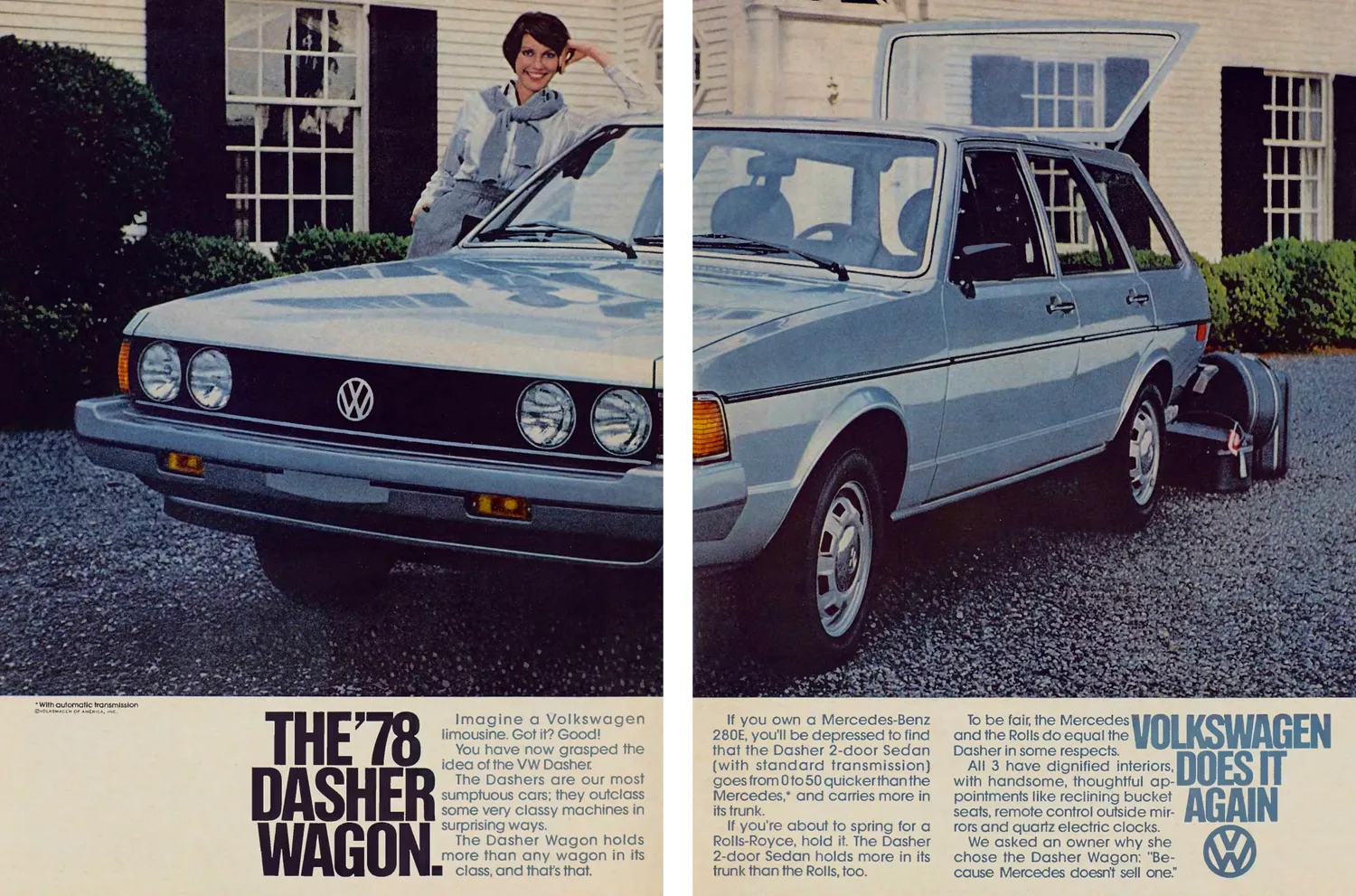
THE ’78 DASHER WAGON. Imagine a Volkswagen limousine. Got it? Good! You have now grasped the idea of the VW Dasher. The Dashers are our most sumptuous cars; they outclass some very classy machines in surprising ways. The Dasher Wagon holds more than any wagon in its class, and that’s that. If you own a Mercedes-Benz 280E, you’ll be depressed to find that the Dasher 2-door Sedan (with standard transmission) goes from 0 to 50 quicker than the Mercedes,* and carries more in its trunk. If you’re about to spring for a Rolls-Royce, hold it. The Dasher 2-door Sedan holds more in its trunk than the Rolls, too. To be fair, the Mercedes and the Rolls do equal the Dasher in some respects. All 3 have dignified interiors, with handsome, thoughtful appointments like reclining bucket seats, remote control outside mirrors and quartz electric clocks. We asked an owner why she chose the Dasher Wagon: “Because Mercedes doesn’t sell one.” VOLKSWAGEN DOES IT AGAIN *With automatic transmission © VOLKSWAGEN OF AMERICA, INC.
Commentary
“Imagine a Volkswagen limousine” asks the reader to perform a small act of category stretching. The photograph does much of the work: a pale blue Dasher occupies a broad spread in front of a substantial house, with a relaxed owner, an open tailgate and luggage waiting beside it. The setting lends the wagon a comfortable social position before the copy starts measuring it against much grander names.
Volkswagen’s comparison is deliberately selective. The Dasher does not need to equal a Rolls-Royce in every respect; it needs to carry more luggage. A claim about the two-door sedan’s acceleration against a Mercedes-Benz 280E supplies another surprising measure, qualified by transmission details and a footnote. For someone studying the ad, that distinction matters: the photographed wagon and the sedan used in the comparison are not interchangeable evidence.
The tone keeps these claims conversational. “Got it? Good!” makes the opening feel like a quick exchange, and “hold it” interrupts an imagined Rolls-Royce purchase with cheerful presumption. The copy then concedes that all three cars have dignified interiors and useful appointments. This mock generosity reverses the expected hierarchy, treating the prestige cars as products that sometimes manage to equal the Volkswagen.
The closing owner’s remark completes the reversal: she chose the Dasher Wagon because Mercedes does not sell one. Within the ad’s argument, having the right body style becomes a more decisive luxury than having the right badge. The huge condensed model headline and equally emphatic sign-off frame that joke with confidence. Practicality is made socially desirable, while the open hatch gives the abstract cargo claims a visible anchor.
The Dasher belongs to Volkswagen’s move toward modern family cars during the 1970s; its related first-generation Passat arrived in 1973 with water cooling and front-wheel drive. Volkswagen documents that transition in its Passat B1 history. The company remains a passenger-car manufacturer with combustion and electric models, as described in its 2026 business update.
Choosing comparison criteria around a customer’s actual task remains a useful strategy. The exact acceleration, luggage and rival-availability claims here are tied to the models and market addressed by this 1978 ad. Its transferable idea is the invitation to define an upgrade through usefulness; its specific competitive claims cannot simply be carried into a modern Volkswagen advertisement.