Automotive 1983
Saab
If a car is really an extension of one’s personality, what kind of person would drive a Saab?
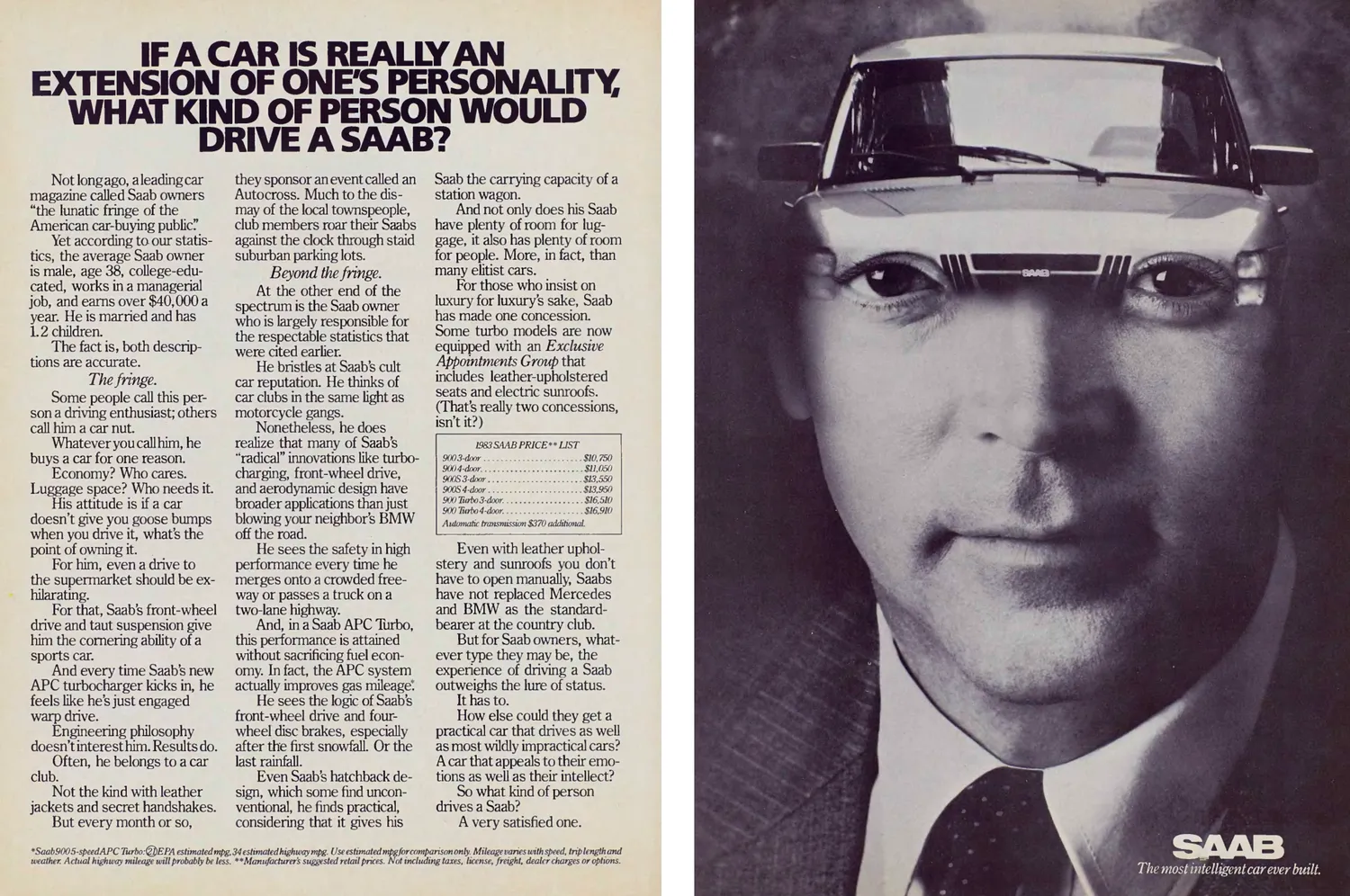
FROM THE PRINTED PAGEOriginal ad copy
OCR transcription from the archived page. Scanning and reading-order errors may remain.
IF A CAR IS REALLY AN EXTENSION OF ONE’S PERSONALITY, WHAT KIND OF PERSON WOULD DRIVE A SAAB? Not long ago, a leading car magazine called Saab owners “the lunatic fringe of the American car-buying public.” Yet according to our statistics, the average Saab owner is male, age 38, college-educated, works in a managerial job, and earns over $40,000 a year. He is married and has 1.2 children. The fact is, both descriptions are accurate. The fringe. Some people call this person a driving enthusiast; others call him a car nut. Whatever you call him, he buys a car for one reason. Economy? Who cares. Luggage space? Who needs it. His attitude is if a car doesn’t give you goose bumps when you drive it, what’s the point of owning it. For him, even a drive to the supermarket should be exhilarating. For that, Saab’s front-wheel drive and taut suspension give him the cornering ability of a sports car. And every time Saab’s new APC turbocharger kicks in, he feels like he’s just engaged warp drive. Engineering philosophy doesn’t interest him. Results do. Often, he belongs to a car club. Not the kind with leather jackets and secret handshakes. But every month or so, they sponsor an event called an Autocross. Much to the dismay of the local townspeople, club members roar their Saabs against the clock through staid suburban parking lots. Beyond the fringe. At the other end of the spectrum is the Saab owner who is largely responsible for the respectable statistics that were cited earlier. He bristles at Saab’s cult car reputation. He thinks of car clubs in the same light as motorcycle gangs. Nonetheless, he does realize that many of Saab’s “radical” innovations like turbocharging, front-wheel drive, and aerodynamic design have broader applications than just blowing your neighbor’s BMW off the road. He sees the safety in high performance every time he merges onto a crowded freeway or passes a truck on a two-lane highway. And, in a Saab APC Turbo, this performance is attained without sacrificing fuel economy. In fact, the APC system actually improves gas mileage.* He sees the logic of Saab’s front-wheel drive and four-wheel disc brakes, especially after the first snowfall. Or the last rainfall. Even Saab’s hatchback design, which some find unconventional, he finds practical, considering that it gives his Saab the carrying capacity of a station wagon. And not only does his Saab have plenty of room for luggage, it also has plenty of room for people. More, in fact, than many elitist cars. For those who insist on luxury for luxury’s sake, Saab has made one concession. Some turbo models are now equipped with an Exclusive Appointments Group that includes leather-upholstered seats and electric sunroofs. (That’s really two concessions, isn’t it?) 1983 SAAB PRICE** LIST 900 3-door — $10,750 900 4-door — $11,050 900S 3-door — $13,550 900S 4-door — $13,950 900 Turbo 3-door — $16,510 900 Turbo 4-door — $16,910 Automatic transmission $370 additional. Even with leather upholstery and sunroofs you don’t have to open manually, Saabs have not replaced Mercedes and BMW as the standard-bearer at the country club. But for Saab owners, whatever type they may be, the experience of driving a Saab outweighs the lure of status. It has to. How else could they get a practical car that drives as well as most wildly impractical cars? A car that appeals to their emotions as well as their intellect? So what kind of person drives a Saab? A very satisfied one. *Saab 900 5-speed APC Turbo: 21 EPA estimated mpg, 34 estimated highway mpg. Use estimated mpg for comparison only. Mileage varies with speed, trip length and weather. Actual highway mileage will probably be less. **Manufacturer’s suggested retail prices. Not including taxes, license, freight, dealer charges or options. SAAB The most intelligent car ever built.
Commentary
Saab makes the familiar claim that a car expresses its owner almost uncomfortably literal. The right-hand page fuses a man’s face with the front of a Saab: the windscreen occupies his forehead and his eyes take the place of headlights. The sober suit and tie supply the respectable exterior that the copy spends the opposite page complicating. The image answers the headline before the reader reaches the argument: the driver and the machine belong together.
The copy then gives this single face two personalities. One is the enthusiast who wants goose bumps on a supermarket trip; the other is the manager who wants secure overtaking, fuel economy, passenger room and a useful hatchback. “The fringe” and “Beyond the fringe” make an apparently awkward customer stereotype into a structure for selling the same engineering twice. Turbocharging means excitement to one reader and a margin of safety to another. Front-wheel drive serves both cornering enthusiasm and confidence in bad weather.
That dual reading lets Saab defend its cult appeal without making membership compulsory. The quoted demographic profile, complete with 1.2 children, carries a knowing absurdity. The luxury appointments and price box bring the argument back to purchase details, while the jokes about country clubs and electric sunroofs challenge the idea that prestige badges should settle the decision. The voice invites a prosperous professional to feel independent-minded while still buying a practical family car.
There is also a revealing tension in the positioning. An ad that dismisses status devotes considerable space to income, education, Mercedes and BMW. It offers its own form of distinction: the satisfaction of considering yourself too discerning to follow the usual hierarchy. The final “very satisfied” owner resolves the personality question through experience rather than a demographic definition.
Saab began as a Swedish aircraft manufacturer and unveiled its first car in 1947. The automobile operation later became separate; Saab Automobile filed for bankruptcy in 2011. Today’s Saab is a defence and security company, not a current seller of these passenger cars. Saab’s account of its automotive history explains that distinction.
The lasting advertising idea is the translation of one feature into different human benefits. The narrower assumptions are the default male customer, the managerial income profile and the equation of particular badges with social success. The scan preserves those assumptions alongside the historical prices and performance claims; they belong to this sales argument, not to a present-day buying guide.