Consumer Goods 1987
Trojan
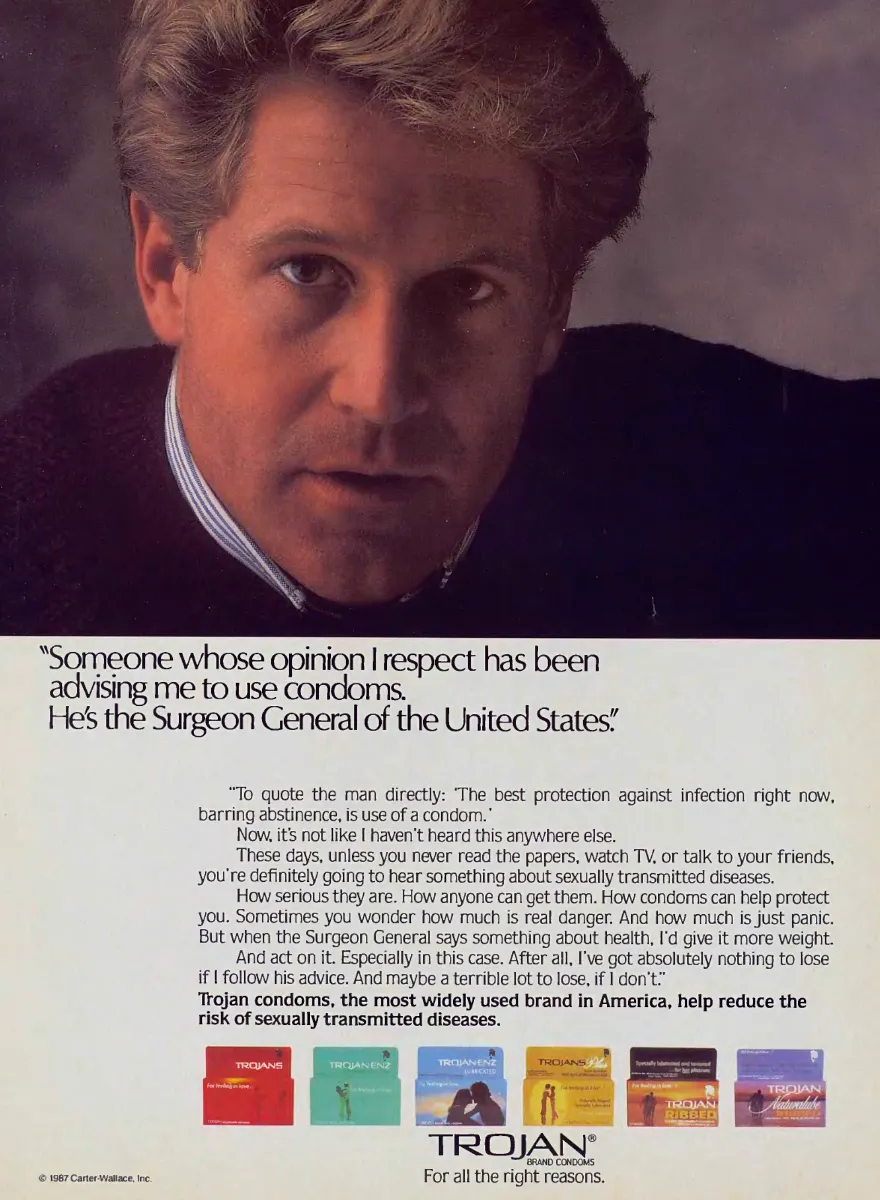
Someone whose opinion I respect has been advising me to use condoms. He's the Surgeon General of the United States.
FROM THE PRINTED PAGEOriginal ad copy
OCR transcription from the archived page. Scanning and reading-order errors may remain.
“Someone whose opinion I respect has been advising me to use condoms. He's the Surgeon General of the United States.” “To quote the man directly: ‘The best protection against infection right now, barring abstinence, is use of a condom.’ Now, it's not like I haven't heard this anywhere else. These days, unless you never read the papers, watch TV, or talk to your friends, you're definitely going to hear something about sexually transmitted diseases. How serious they are. How anyone can get them. How condoms can help protect you. Sometimes you wonder how much is real danger. And how much is just panic. But when the Surgeon General says something about health, I'd give it more weight. And act on it. Especially in this case. After all, I've got absolutely nothing to lose if I follow his advice. And maybe a terrible lot to lose, if I don't.” Trojan condoms, the most widely used brand in America, help reduce the risk of sexually transmitted diseases. TROJANS For feeling in love TROJAN-ENZ TROJAN-ENZ LUBRICATED TROJANS TROJAN RIBBED Specially lubricated and textured condoms for her pleasure TROJAN Naturalube [illegible] TROJAN® BRAND CONDOMS For all the right reasons. © 1987 Carter-Wallace, Inc.
Commentary
I started with the man’s face, which occupies more than half the page and offers very little reassurance of its own. No grin, no partner, no bedroom. Then the headline supplies the missing relationship: someone has been advising him. The delayed identification of the Surgeon General makes an apparently private conversation public. Buying condoms becomes something a sensible man does after listening carefully.
The historical clue is the office, not the model. The National Library of Medicine documents how C. Everett Koop’s 1986 AIDS report advocated condoms and frank public education. Trojan borrows that authority through a consumer’s reported response. The page does not establish a government endorsement of this brand; the quoted advice concerns condoms generally. Only after the testimonial finishes does the advertiser introduce its own market-leadership claim and a row of brightly coloured packages. Authority gets the reader to the category; the shelf display gets him to Trojan.
What interests me is the allowance made for confusion. Newspapers, television and friends have already supplied information, yet the speaker cannot separate danger from panic. The ad sells a way to decide whom to trust. Compared with the abundance of searchable advice today, its three-channel information world looks small, but the difficulty of judging competing voices feels familiar. That is an interpretation of the monologue, not evidence that audiences responded as intended.
For a young copywriter, the useful lesson is in the fragments: “How serious they are. How anyone can get them.” Their accumulating rhythm sounds like thoughts being sorted rather than a medical leaflet being recited. “And act on it” abruptly ends the deliberation. The final contrast between nothing to lose and a terrible lot to lose supplies urgency without changing the conversational register. The bold brand sentence then uses the qualified phrase “help reduce,” which must not be flattened into an absolute promise.
The copyright identifies Carter-Wallace as the advertiser behind Trojan here. Church & Dwight’s company history records its later acquisition of Carter-Wallace’s consumer business and Trojan’s expansion beyond condoms into lubricants and vibrators.
The enduring idea is that reassurance can come from taking responsibility rather than avoiding an uncomfortable subject. The specific appeal belongs to the public-health conversation surrounding Koop’s intervention; these historical quotations and claims are part of the ad’s argument, not a substitute for present-day health information.