Electronics 1979
Memorex
Which new high bias tape wins with Mahler's Fourth Symphony?
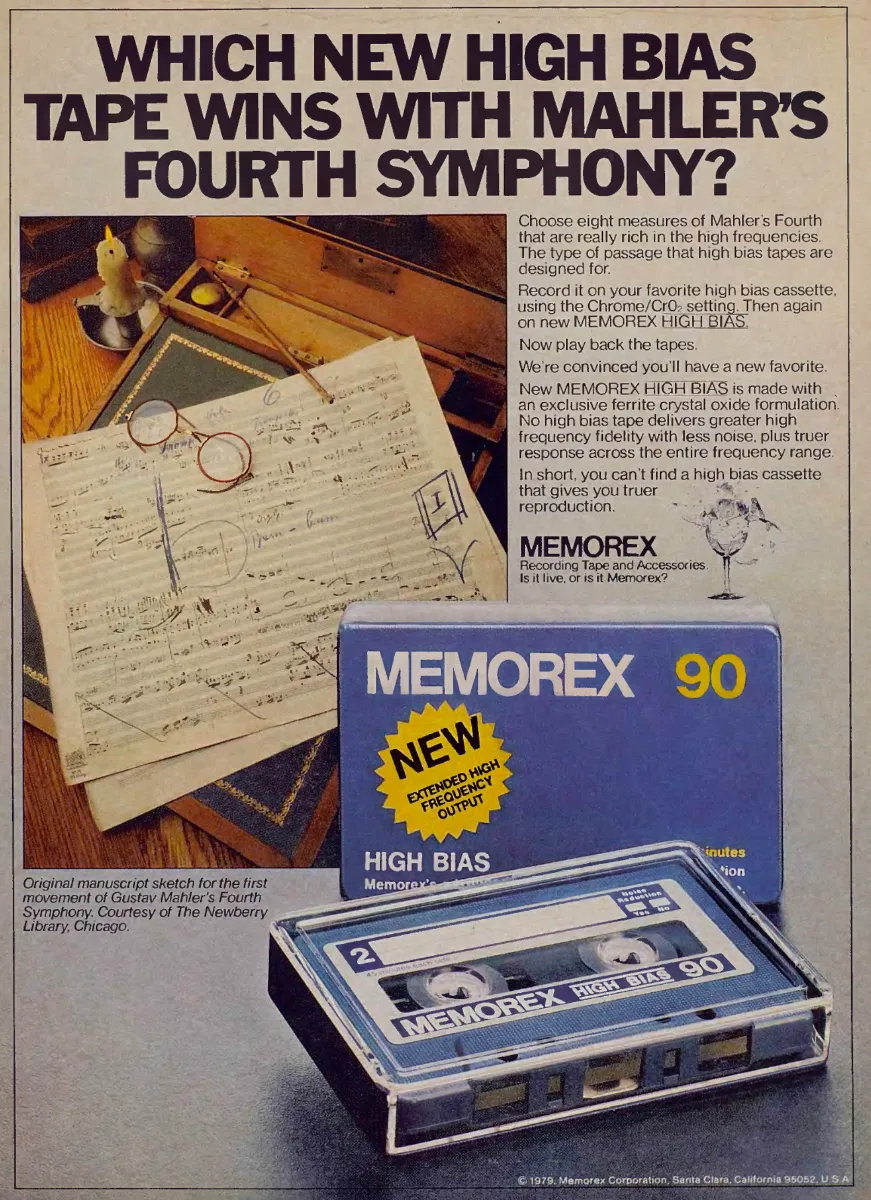
FROM THE PRINTED PAGEOriginal ad copy
OCR transcription from the archived page. Scanning and reading-order errors may remain.
WHICH NEW HIGH BIAS TAPE WINS WITH MAHLER'S FOURTH SYMPHONY? Choose eight measures of Mahler's Fourth that are really rich in the high frequencies. The type of passage that high bias tapes are designed for. Record it on your favorite high bias cassette, using the Chrome/CrO₂ setting. Then again on new MEMOREX HIGH BIAS. Now play back the tapes. We're convinced you'll have a new favorite. New MEMOREX HIGH BIAS is made with an exclusive ferrite crystal oxide formulation. No high bias tape delivers greater high frequency fidelity with less noise, plus truer response across the entire frequency range. In short, you can't find a high bias cassette that gives you truer reproduction. MEMOREX Recording Tape and Accessories. Is it live, or is it Memorex? Original manuscript sketch for the first movement of Gustav Mahler's Fourth Symphony. Courtesy of The Newberry Library, Chicago. MEMOREX 90 NEW EXTENDED HIGH FREQUENCY OUTPUT HIGH BIAS © 1979, Memorex Corporation, Santa Clara, California 95052, U.S.A.
Commentary
The manuscript took me a moment to recognize beneath the packaging. It is credited as a sketch for the first movement of Mahler’s Fourth Symphony, complete with markings and corrections. A blue Memorex carton and a clear cassette case sit in front of it, making an old composition and a contemporary recording medium share one tabletop. The headline asks which tape “wins” with the symphony. The ad is selling blank media, but it puts the work of a composer in the role of demanding test material.
Unlike a simple fidelity claim, the copy proposes a small experiment. Choose eight measures rich in high frequencies, record them on a favorite high bias cassette using the Chrome/CrO₂ setting, then record them again on Memorex and play both back. It is a persuasive choice because the reader supplies the rival tape and the music. The body then attributes the predicted difference to an “exclusive ferrite crystal oxide formulation.” The scan gives no measured results or controlled conditions, so the claim that no competing tape delivers better fidelity remains Memorex’s claim. Still, the procedure lets the buyer imagine making the judgment personally.
That procedure also fixes the ad in a world where a music listener could make a physical recording and evaluate the medium separately from the performance. Much listening now reaches the audience through platforms where codec, connection, and master are less visible choices. The old experiment made the recording surface into a purchase decision. Its appeal to a discerning ear, however, is familiar whenever audio quality is sold.
For a young copywriter, the opening question creates a contest without naming an enemy. “Choose,” “Record,” and “Now play back” are a brisk sequence of actions, while “We’re convinced” sounds confident yet leaves the verdict with the reader. The technical phrase “high frequencies” gains a concrete example in eight measures of Mahler. A test invitation works best when the instructions are specific enough that a buyer could actually try it.
Memorex says it was founded in 1961 and entered consumer recording media in 1970. The brand now sells consumer electronics under later ownership, while its own history still foregrounds its tape advertising.
Its fidelity promise still speaks to people who care about hearing the detail of a performance. High bias, the Chrome/CrO₂ switch, and the need to buy a blank cassette no longer frame most everyday listening. What survives for designers is the ad’s conversion of a technical advantage into a comparison the customer can picture performing.