Electronics 1987
Sony
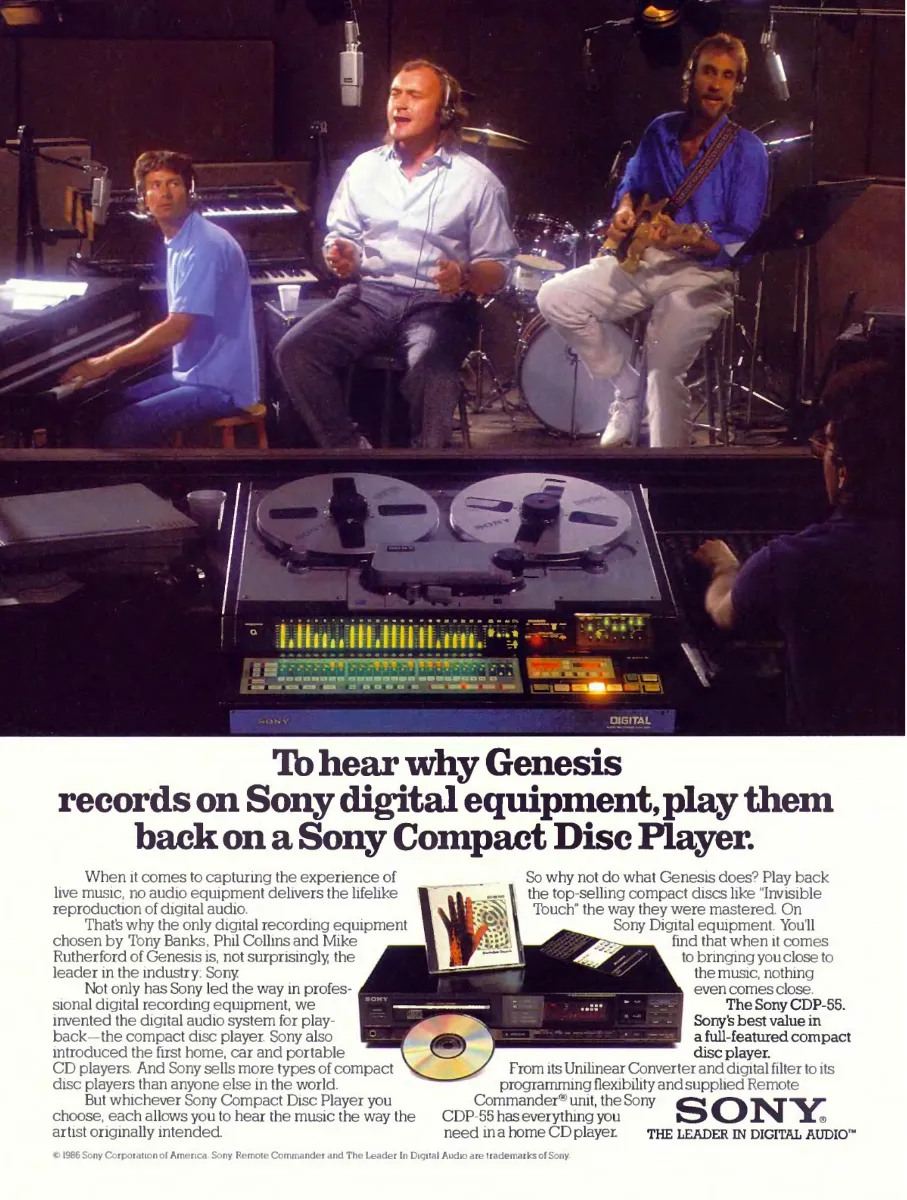
To hear why Genesis records on Sony digital equipment, play them back on a Sony Compact Disc Player.
FROM THE PRINTED PAGEOriginal ad copy
OCR transcription from the archived page. Scanning and reading-order errors may remain.
SONY DIGITAL To hear why Genesis records on Sony digital equipment, play them back on a Sony Compact Disc Player. When it comes to capturing the experience of live music, no audio equipment delivers the lifelike reproduction of digital audio. That's why the only digital recording equipment chosen by Tony Banks, Phil Collins and Mike Rutherford of Genesis is, not surprisingly, the leader in the industry: Sony. Not only has Sony led the way in professional digital recording equipment, we invented the digital audio system for playback—the compact disc player. Sony also introduced the first home, car and portable CD players. And Sony sells more types of compact disc players than anyone else in the world. But whichever Sony Compact Disc Player you choose, each allows you to hear the music the way the artist originally intended. So why not do what Genesis does? Play back the top-selling compact discs like “Invisible Touch” the way they were mastered. On Sony Digital equipment. You'll find that when it comes to bringing you close to the music, nothing even comes close. The Sony CDP-55. Sony's best value in a full-featured compact disc player. From its Unilinear Converter and digital filter to its programming flexibility and supplied Remote Commander® unit, the Sony CDP-55 has everything you need in a home CD player. SONY THE LEADER IN DIGITAL AUDIO™ © 1986 Sony Corporation of America. Sony, Remote Commander and The Leader In Digital Audio are trademarks of Sony.
Commentary
I had to look past Genesis to find the salesman. It is the enormous Sony recorder in the foreground, its meters glowing beneath the studio window. Tony Banks, Phil Collins and Mike Rutherford supply the human attraction; the machine places a branded intermediary between their performance and our ears. Far below, a much smaller CDP-55 waits to finish that journey in the reader’s home.
The photograph makes a complicated production chain look continuous. Sony in the studio, Sony beside the armchair: surely that is how to keep the music intact. The copy names the musicians, places an Invisible Touch disc beside the player and promises the artist’s original intention. These details make professional use function as an endorsement of consumer equipment. They do not demonstrate that matching brands is technically necessary, or that the home player reproduces an entire recording session without mediation.
Following the invention claim led me to a useful complication. Sony’s own history describes joint development of the CD format with Philips and the 1982 launch of the CDP-101. The ad compresses that collaborative history into a solitary “we.” This is worth noticing because its authority depends on making the badge seem to encompass the whole digital process. The Unilinear Converter and supplied remote then give the promise something tangible to rest on.
The little album case also records a different route to music. Here, closeness to the artist requires buying a physical recording and a dedicated player. For a listener accustomed to choosing tracks on a phone, fidelity may still matter, but the separate boxes and the matching manufacturer’s name no longer organise the purchase in quite this way.
For beginning copywriters, watch the verbs in the headline: “hear,” “records,” “play.” They move the reader from curiosity through professional practice to an action within reach. The repetition of “Sony” bridges the two machines. “Close to the music” followed by “nothing even comes close” repeats a word while changing its job, from emotional proximity to competitive superiority. The lesson is to make repetition advance the argument.
Sony’s CD history sits within a continuing business in consumer and professional electronics, alongside music, pictures and games. Its current business overview still places entertainment and the technologies used to make and experience it under the same group umbrella.
That connection between creators and listeners remains the strongest idea on the page. What has aged is the suggestion that one manufacturer’s disc player is the natural final link: the emotional promise survives more easily than the format, hardware hierarchy or claim of solitary invention.