Back to the collection89 / 189
Fashion & Accessories 1970
Timex
How many $50 electronics are there with an automatic calendar?
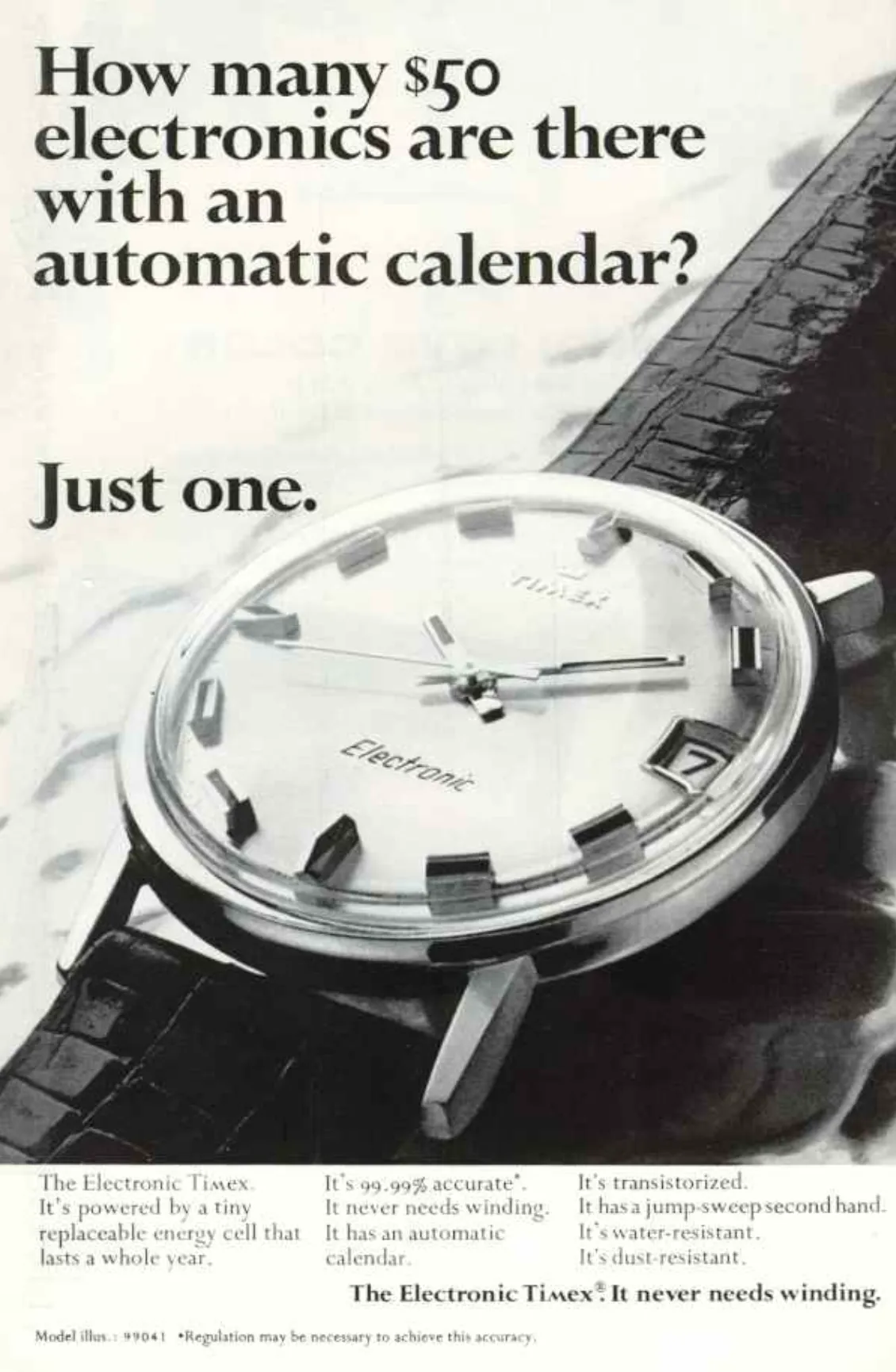
FROM THE PRINTED PAGEOriginal ad copy
OCR transcription from the archived page. Scanning and reading-order errors may remain.
How many $50 electronics are there with an automatic calendar? Just one. The Electronic Timex. It's powered by a tiny replaceable energy cell that lasts a whole year. It's 99.99% accurate.* It never needs winding. It has an automatic calendar. It's transistorized. It has a jump-sweep second hand. It's water-resistant. It's dust-resistant. The Electronic Timex®. It never needs winding. Model illus.: #9041 *Regulation may be necessary to achieve this accuracy.
Commentary
The headline asks for a count and immediately narrows the field: a “$50 electronic” with an automatic calendar. “Just one” occupies its own generous patch of white space, so the answer lands before the watch does. Below it, an enormous black-and-white close-up makes the dial and its date window do the demonstrating. The price is the hook, but the photograph insists this is a real, tangible watch rather than an abstract technical bargain.
The supporting copy assembles a careful stack of reasons to believe. A replaceable energy cell lasts a year; the watch is described as transistorized, water-resistant and dust-resistant; its second hand has a “jump-sweep.” The accuracy figure is the boldest claim and the only one with an asterisk: the footnote allows that regulation may be necessary. That qualification matters. The page wants the authority of a precise number without pretending that the number needs no conditions.
The promise also captures an older idea of saved time. Not winding a watch was once a practical relief worth repeating in the sign-off. Many people now get the date, time, and reminders from a phone, but a wristwatch can still offer the simple pleasure of checking time without opening a screen. The ad’s feature list makes sense as a bridge between those worlds: it sells fewer little chores, one mechanism at a time.
For a young copywriter, the opening is a lesson in controlled suspense. A long question takes several lines; the two-word answer follows after a visual pause. The repeated short “It’s” and “It has” sentences then make the specification list easy to scan. “It never needs winding” returns at the end as the one benefit the reader is meant to keep. Repetition works here because the details have earned it.
Timex traces its beginnings to the Waterbury Clock Company in 1854 and still sells watches, including lines that recall its electronic and quartz history. Its current account of the brand emphasizes accessible, reliable timekeeping.
The accessible price and low-maintenance promise still fit Timex. The unusual part is the claim that an automatic calendar and transistorized movement distinguish one $50 “electronic” from the whole field; such features no longer carry the same sense of frontier technology.