Consumer Goods 1970
Parker
The Parker 75. Because no hand is quite like the next one.
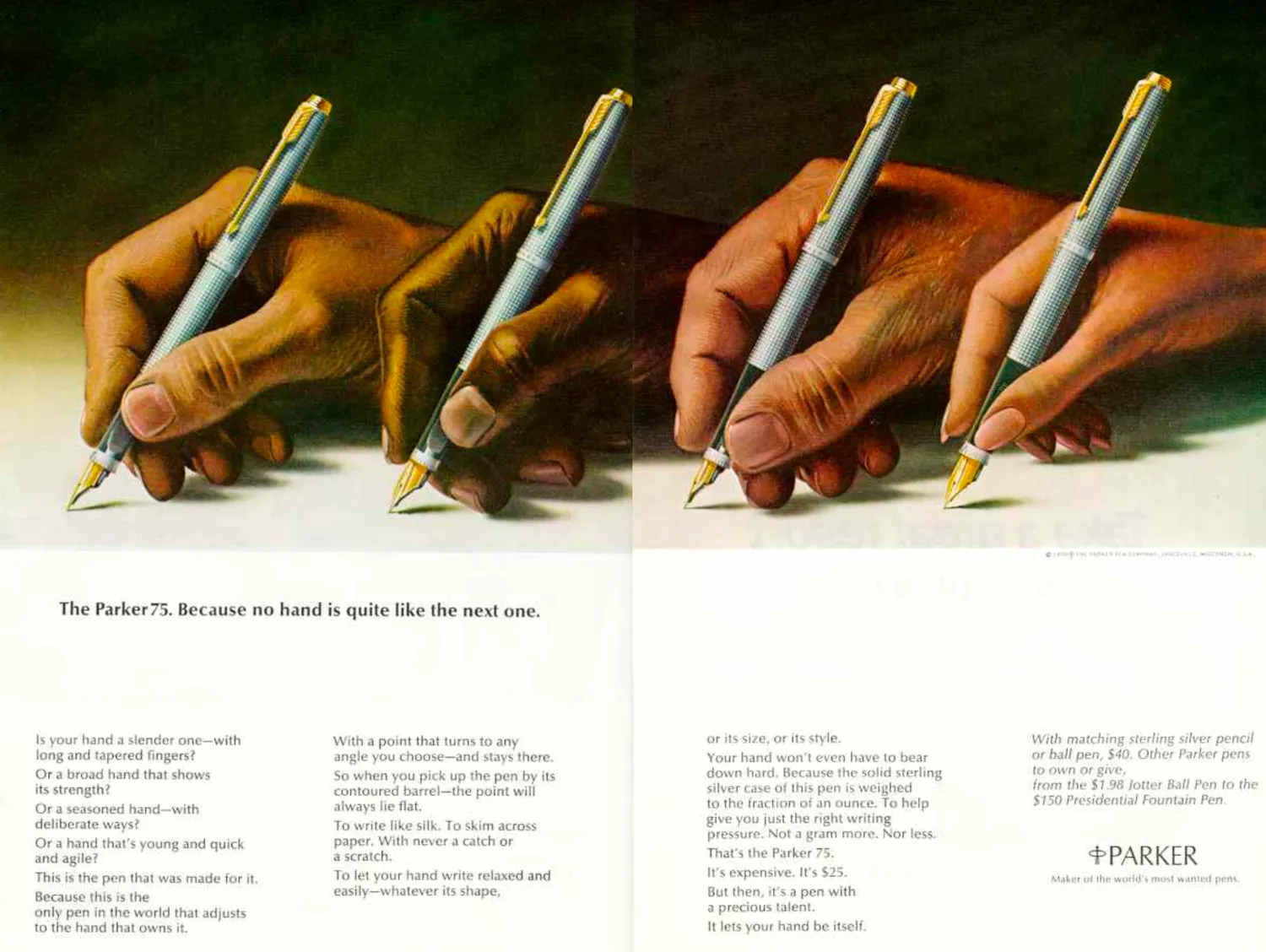
FROM THE PRINTED PAGEOriginal ad copy
OCR transcription from the archived page. Scanning and reading-order errors may remain.
The Parker 75. Because no hand is quite like the next one. Is your hand a slender one—with long and tapered fingers? Or a broad hand that shows its strength? Or a seasoned hand—with deliberate ways? Or a hand that's young and quick and agile? This is the pen that was made for it. Because this is the only pen in the world that adjusts to the hand that owns it. With a point that turns to any angle you choose—and stays there. So when you pick up the pen by its contoured barrel—the point will always lie flat. To write like silk. To skim across paper. With never a catch or a scratch. To let your hand write relaxed and easily—whatever its shape, or its size, or its style. Your hand won't even have to bear down hard. Because the solid sterling silver case of this pen is weighed to the fraction of an ounce. To help give you just the right writing pressure. Not a gram more. Nor less. That's the Parker 75. It's expensive. It's $25. But then, it's a pen with a precious talent. It lets your hand be itself. With matching sterling silver pencil or ball pen, $40. Other Parker pens to own or give, from the $1.98 Jotter Ball Pen to the $150 Presidential Fountain Pen. PARKER Maker of the world's most wanted pens.
Commentary
Four hands cross the spread, each holding what appears to be the same silver pen. The differences are the point: fingers long or broad, young or worn, grips subtly changed. Parker could have photographed the 75 alone and described its materials. Instead it makes the human hand the variable and the pen the constant. The headline, “Because no hand is quite like the next one,” prepares us to look closely at those repetitions.
The body copy then explains how the object answers the pictures. Its nib can be turned to an angle chosen by the owner and will stay there; the contoured barrel and carefully weighted sterling silver body are offered as reasons for an easier line. The claim that it is the “only pen in the world” to adjust this way is the advertiser’s assertion, not something the image proves. What the page does show is a design argument unusually attentive to individual use. Even the $25 price arrives after the ergonomic case has been made, followed by a ladder from the $1.98 Jotter to a $150 Presidential fountain pen.
The ad assumes handwriting is a frequent physical act, worth refining down to grip and pressure. For many readers today, long passages are typed or tapped. That makes the four hands feel almost like a study of a disappearing daily skill. The underlying need is less dated: tools still earn affection when they adapt to a person rather than demand that the person adapt to them.
For a new copywriter, notice the succession of questions at the start. “Slender,” “broad,” “seasoned,” and “young” invite different readers into the same product claim without labeling any hand defective. The short sentence “It lets your hand be itself” is the payoff. It turns mechanical adjustability into permission, and the identical pens above the text make that turn believable.
Parker dates its founding to 1888 and records the 75 among its notable pens. The brand still sells fine writing instruments, including fountain pens, ballpoints and refills.
The 75’s specific rotating-point pitch belongs to this model and its era. The broader idea survives: the writing instrument is presented as a personal fit, with material and mechanism serving the hand rather than acting as decoration alone.