Automotive 1970
Libbey-Owens-Ford
People aren't taking such a dim view of things anymore.
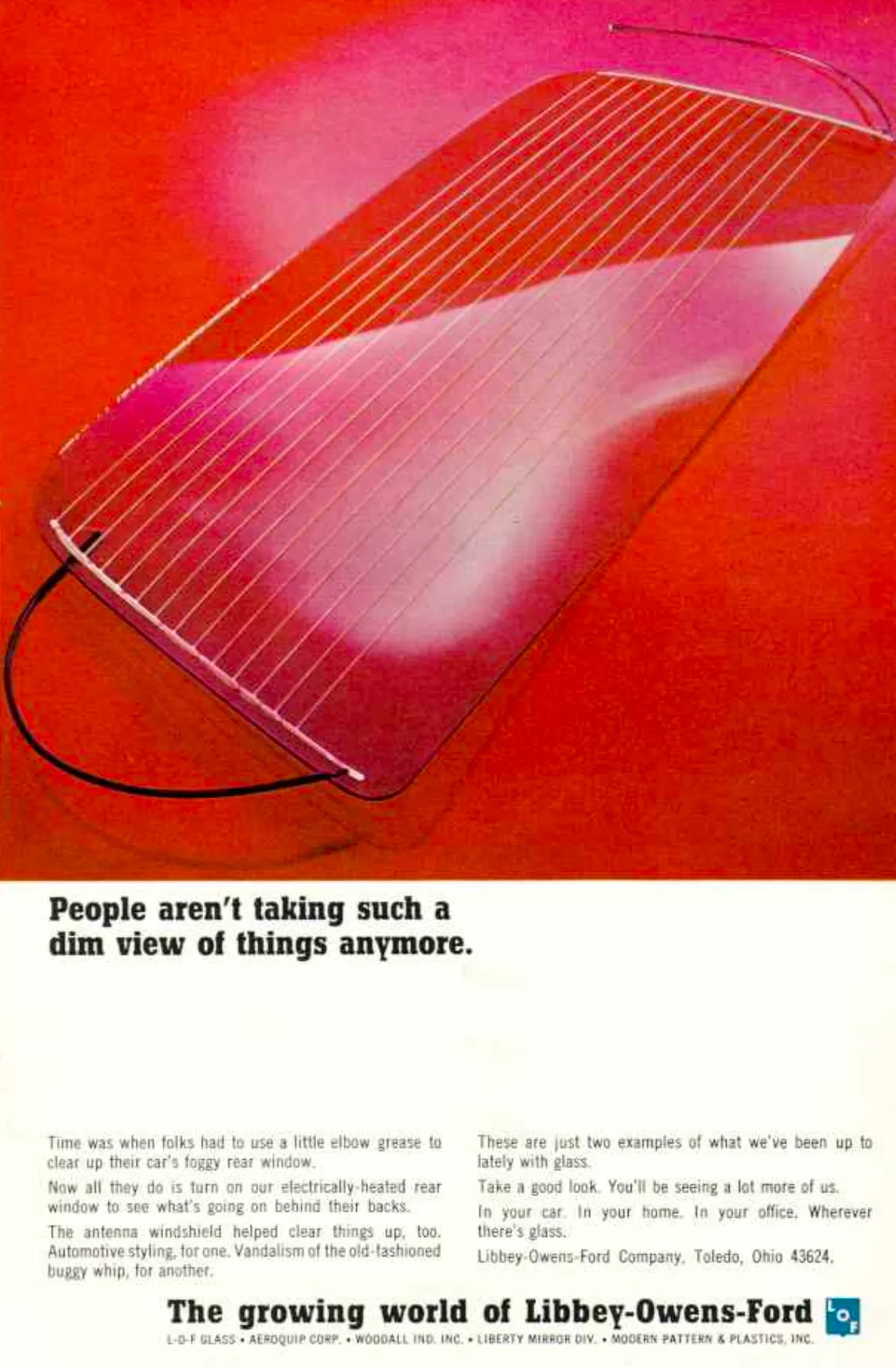
FROM THE PRINTED PAGEOriginal ad copy
OCR transcription from the archived page. Scanning and reading-order errors may remain.
People aren't taking such a dim view of things anymore. Time was when folks had to use a little elbow grease to clear up their car's foggy rear window. Now all they do is turn on our electrically-heated rear window to see what's going on behind their backs. The antenna windshield helped clear things up, too. Automotive styling, for one. Vandalism of the old-fashioned buggy whip, for another. These are just two examples of what we've been up to lately with glass. Take a good look. You'll be seeing a lot more of us. In your car. In your home. In your office. Wherever there's glass. Libbey-Owens-Ford Company, Toledo, Ohio 43624. The growing world of Libbey-Owens-Ford L-O-F GLASS · AEROQUIP CORP. · WOODALL IND. INC. · LIBERTY MIRROR DIV. · MODERN PATTERN & PLASTICS, INC.
Commentary
At first the picture seems almost abstract: a red plane, a pale streak, and dozens of fine diagonal lines. The headline supplies the missing subject. This is a car window clearing, and the streak is the view returning. Libbey-Owens-Ford makes a component most drivers would rarely name into the page’s entire spectacle. Even the orange and magenta heat of the printing helps the electrical claim feel visible.
The text begins with a small domestic inconvenience: rubbing fog from a rear window. An electrically heated pane solves it with a switch. Then the company adds an antenna windshield, arguing for both cleaner automotive styling and the disappearance of a vulnerable external aerial, the “old-fashioned buggy whip.” These are modest changes to daily driving, but the ad joins them into a larger proposition: glass can quietly take on jobs once assigned to the driver or to another visible piece of hardware. The picture never identifies a make of car. That absence lets a supplier claim the innovation rather than borrow glamour from a vehicle brand.
There is a useful shift in what convenience means here. The ad assumes that a driver might clear a window by hand and that a radio antenna is an exposed object someone could vandalize. Today, a heated rear screen is an ordinary control, while a car’s antennas are often integrated into its body or glass. That change makes the advertisement a record of the moment when a small reduction in effort could still feel like news.
For a new copywriter, “dim view” is doing two jobs without straining. It names poor visibility and a pessimistic opinion, then lets the photograph resolve the literal meaning. “Take a good look” and “You’ll be seeing a lot more of us” extend the sight vocabulary into the company signature. The lesson is to keep wordplay close to the product’s actual work: each phrase returns the reader to clearer glass.
NSG Group’s history dates Libbey-Owens-Ford to a 1930 merger in Toledo and records the sale of its glass business and name to Pilkington in 1986. The operation became Pilkington North America; Pilkington still supplies automotive glass.
The need to see clearly behind a car remains. What has aged is the novelty of switching on a heated pane, and the idea that an otherwise invisible glass supplier could announce its expanding role with a single radiant window.