Fashion & Accessories 1965
Timex
Just because a watch is electric, its price doesn’t have to be a shocker.
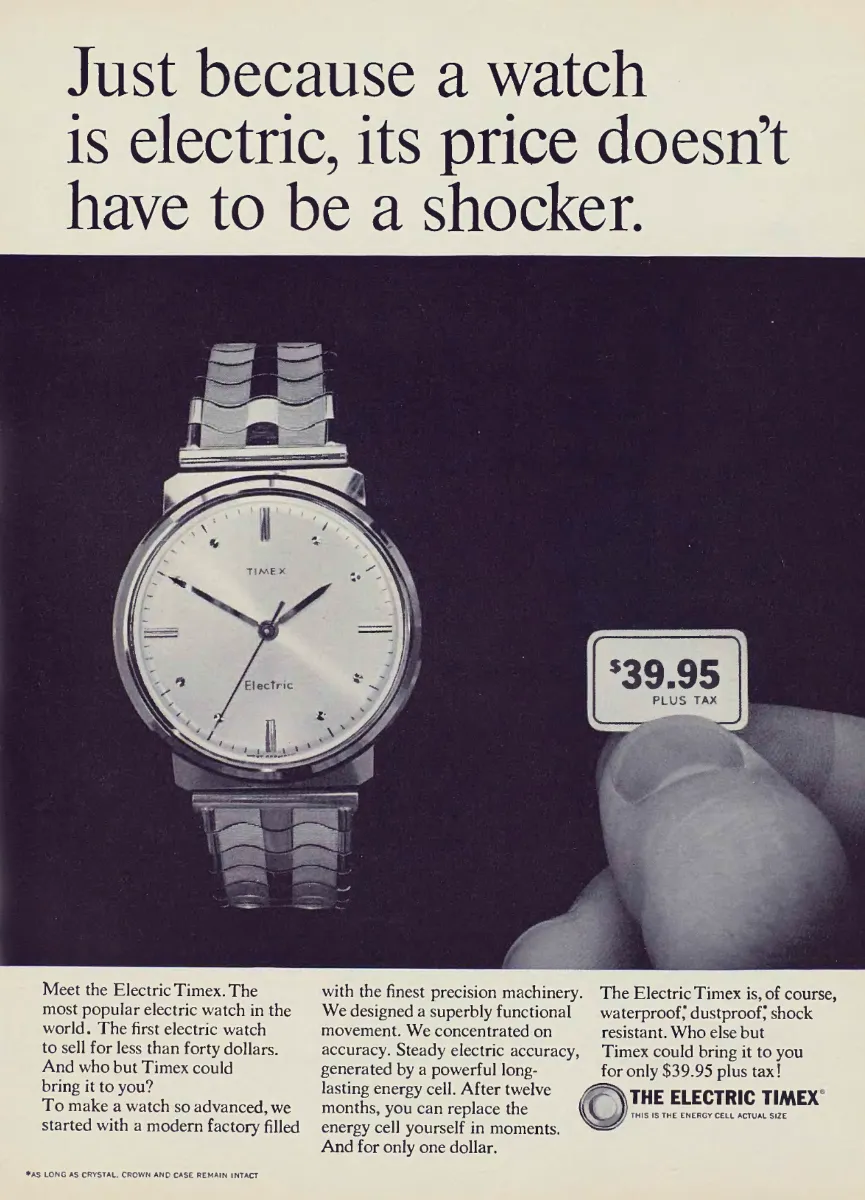
FROM THE PRINTED PAGEOriginal ad copy
OCR transcription from the archived page. Scanning and reading-order errors may remain.
Just because a watch is electric, its price doesn’t have to be a shocker. TIMEX Electric $39.95 PLUS TAX Meet the Electric Timex. The most popular electric watch in the world. The first electric watch to sell for less than forty dollars. And who but Timex could bring it to you? To make a watch so advanced, we started with a modern factory filled with the finest precision machinery. We designed a superbly functional movement. We concentrated on accuracy. Steady electric accuracy, generated by a powerful long-lasting energy cell. After twelve months, you can replace the energy cell yourself in moments. And for only one dollar. The Electric Timex is, of course, waterproof;* dustproof; shock resistant. Who else but Timex could bring it to you for only $39.95 plus tax! THE ELECTRIC TIMEX® THIS IS THE ENERGY CELL ACTUAL SIZE *AS LONG AS CRYSTAL, CROWN AND CASE REMAIN INTACT
Commentary
I find two objects competing for the same dark stage: an enlarged watch and a price card held between fingers. The watch makes the technology substantial; the fingers make the price seem ordinary enough to handle. Above them, the headline has already resolved the supposed conflict. Electric sophistication need not require a frightening bill.
The smaller copy supplies an unusually practical sequel. Timex does not stop at the purchase price. It says the energy cell lasts twelve months, can be replaced by the owner, and costs one dollar. That last detail answers an objection the headline cannot settle: perhaps the inexpensive new technology will become expensive to maintain. A tiny picture of the cell, labeled actual size, makes the maintenance promise tangible alongside the much larger glamour photograph.
The factory and precision machinery offer an explanation for affordability, while “waterproof” receives a qualification in the bottom margin. I keep that qualification attached to the claim; this is historical advertising, not current care advice. Equally, the claims to popularity and priority are assertions made by Timex here, rather than facts established by the photograph.
The maintenance interval now feels as distinctive as the price. Against the recurring charging ritual of many connected devices, the ad imagines electrical convenience as something that can be left alone for a year. Its little cell represents freedom from attention. That is a different kind of modernity from a device continually asking to be consulted.
For a new copywriter, “shocker” earns its place by joining the product’s electrical identity to the buyer’s financial anxiety. The long opening sentence delays that word until the end. The price card then answers the joke with a number. Notice too how “who but Timex” returns after the technical explanation: repetition turns the product argument back into a brand argument, rather than merely repeating the headline.
Timex’s current company account dates its watchmaking heritage to 1854 and continues to emphasize value and reliability. Its present range includes Waterbury, Marlin, Expedition and Q Timex watches, with historical designs remaining part of its offer.
Accessible timekeeping still fits that identity. What has changed is the persuasive burden carried by “electric”: the ad treats its power source as a desirable advance that needs reassurance about cost. Today, the same brand also explicitly promotes the simplicity of an analog life.