Consumer Goods 1965
Budweiser
No additives, please!
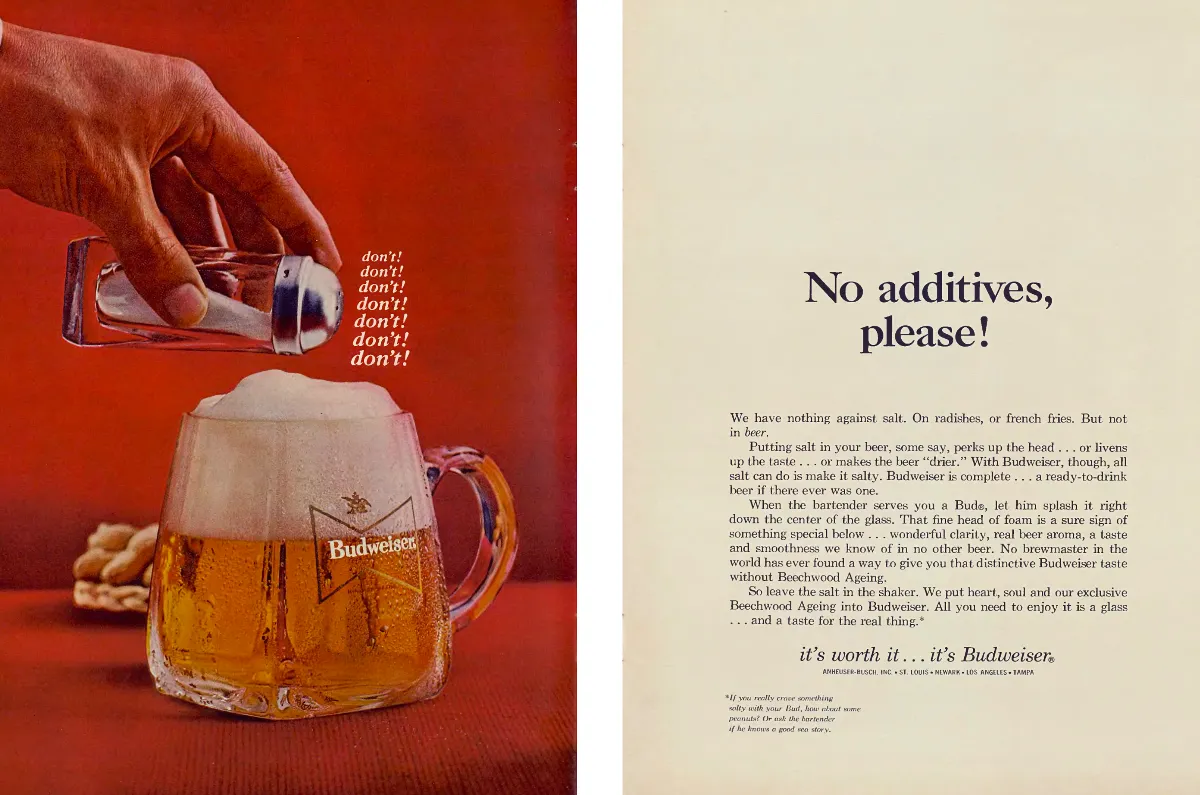
FROM THE PRINTED PAGEOriginal ad copy
OCR transcription from the archived page. Scanning and reading-order errors may remain.
don’t! don’t! don’t! don’t! don’t! don’t! don’t! Budweiser No additives, please! We have nothing against salt. On radishes, or french fries. But not in beer. Putting salt in your beer, some say, perks up the head . . . or livens up the taste . . . or makes the beer “drier.” With Budweiser, though, all salt can do is make it salty. Budweiser is complete . . . a ready-to-drink beer if there ever was one. When the bartender serves you a Bud®, let him splash it right down the center of the glass. That fine head of foam is a sure sign of something special below . . . wonderful clarity, real beer aroma, a taste and smoothness we know of in no other beer. No brewmaster in the world has ever found a way to give you that distinctive Budweiser taste without Beechwood Ageing. So leave the salt in the shaker. We put heart, soul and our exclusive Beechwood Ageing into Budweiser. All you need to enjoy it is a glass . . . and a taste for the real thing.* it’s worth it . . . it’s Budweiser® ANHEUSER-BUSCH, INC. • ST. LOUIS • NEWARK • LOS ANGELES • TAMPA *If you really crave something salty with your Bud, how about some peanuts? Or ask the bartender if he knows a good sea story.
Commentary
The salt has not fallen yet. That is the small suspense holding the left page together: a tilted shaker, a substantial hand, a mug already wearing a generous head of foam. Seven descending objections intervene before the seasoning reaches its target. I read the photograph as a demonstration of sufficiency. The thing the drinker might hope to improve already looks complete.
The facing page explains the threatened ritual. Some people apparently add salt for foam, flavor or dryness; the advertiser acknowledges those reasons before refusing them. This is useful evidence of the behavior the copy addresses, not proof of how widespread it was. Budweiser then converts drinking instructions into product claims: pour down the middle, observe the head, trust the clarity and aroma. Beechwood Ageing gives the confidence a named process, although the page itself cannot substantiate the sweeping claim about every other brewmaster.
The headline can mislead a modern glance. Read alone, “No additives” might sound like an ingredient declaration. Here it is an instruction to the customer with the shaker. The distinction matters: the ad is defending a finished taste, not supplying an ingredient list. Its bartender, peanuts and final sea-story joke place the argument in a social setting where advice can sound like friendly interference.
For young copywriters, watch how the tone moves from the photograph’s repeated “don’t!” to the headline’s softening “please.” The body starts with an apparent concession about salt, then breaks into short fragments that limit where it belongs. That rhythm lets the brand be bossy without sustaining a lecture. The footnote finally redirects “salty” from taste to a sailor’s story, returning the reader to the sociable voice that made the correction bearable.
Budweiser was introduced in 1876 and remains an Anheuser-Busch lager. The company’s 2026 Beechwood Reserve announcement connects that history to a new baseball-themed release, showing that beechwood still supplies material for the brand’s storytelling.
The continuing proposition is a recognizable taste backed by a recognizable brewing process. The older ad’s particular task is more intimate: persuading someone at the bar to put down a condiment. Its certainty belongs to that encounter; it should not be repurposed as a present-day formulation claim.