Automotive 1965
MG
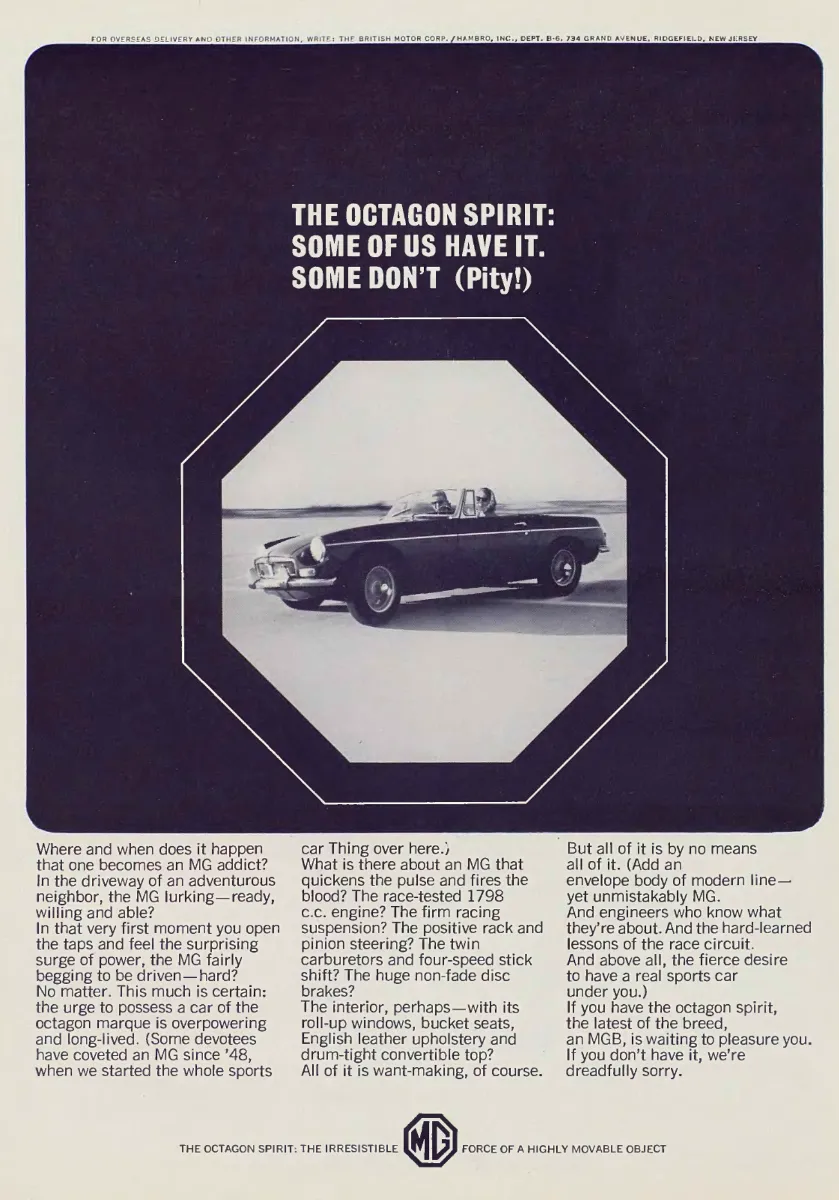
The octagon spirit: Some of us have it. Some don’t (Pity!)
FROM THE PRINTED PAGEOriginal ad copy
OCR transcription from the archived page. Scanning and reading-order errors may remain.
FOR OVERSEAS DELIVERY AND OTHER INFORMATION, WRITE: THE BRITISH MOTOR CORP. / HAMBRO, INC., DEPT. B-6, 734 GRAND AVENUE, RIDGEFIELD, NEW JERSEY THE OCTAGON SPIRIT: SOME OF US HAVE IT. SOME DON’T (Pity!) Where and when does it happen that one becomes an MG addict? In the driveway of an adventurous neighbor, the MG lurking—ready, willing and able? In that very first moment you open the taps and feel the surprising surge of power, the MG fairly begging to be driven—hard? No matter. This much is certain: the urge to possess a car of the octagon marque is overpowering and long-lived. (Some devotees have coveted an MG since ’48, when we started the whole sports car Thing over here.) What is there about an MG that quickens the pulse and fires the blood? The race-tested 1798 c.c. engine? The firm racing suspension? The positive rack and pinion steering? The twin carburetors and four-speed stick shift? The huge non-fade disc brakes? The interior, perhaps—with its roll-up windows, bucket seats, English leather upholstery and drum-tight convertible top? All of it is want-making, of course. But all of it is by no means all of it. (Add an envelope body of modern line—yet unmistakably MG. And engineers who know what they’re about. And the hard-learned lessons of the race circuit. And above all, the fierce desire to have a real sports car under you.) If you have the octagon spirit, the latest of the breed, an MGB, is waiting to pleasure you. If you don’t have it, we’re dreadfully sorry. THE OCTAGON SPIRIT: THE IRRESISTIBLE MG FORCE OF A HIGHLY MOVABLE OBJECT
Commentary
Before I read a specification, I am asked to join a club. The headline divides people into those who possess an invisible quality and those who deserve a little theatrical pity. Below it, the octagonal frame turns the MG badge into an entire viewing apparatus. We see the roadster through the manufacturer’s emblem. Brand membership literally surrounds the product.
I follow the copy looking for a definition of this “spirit,” and find a neighbor’s driveway. Desire begins in an ordinary place, with another person’s car close enough to imagine borrowing. Then the writing moves inside the mechanism: 1798 c.c., rack-and-pinion steering, twin carburetors, four speeds, disc brakes. The questions allow each component to be a possible explanation without making any one of them sufficient. Technical detail earns the right to make an emotional claim.
Even the comforts are carefully chosen. Roll-up windows, leather and a taut convertible top suggest that enthusiasm need not mean putting up with everything. Yet there is no price. The reader is being asked to recognize a temperament before considering a transaction. The overseas-delivery address in the top margin offers a practical exit from this reverie, provided one is willing to write to New Jersey.
That postal instruction measures a different tempo of desire. A reader could admire, enquire and wait; the page did not need to complete the purchase immediately. An online configurator shortens the route to specifications, but cannot by itself supply the imagined life that makes somebody want to investigate them.
For young copywriters, the parenthetical “Pity!” is doing more than adding humor. It establishes a teasing insider voice that the last apology repeats. Between those bookends, the specification questions keep the voice from becoming pure snobbery. The closing play on irresistible force and a movable object finally puts driving back into the club’s abstract identity. A distinctive tone works best when the product keeps interrupting it.
MG traces its origins to 1924; SAIC’s history records the marque entering its ownership in 2007. Today’s range includes the electric Cyberster roadster, alongside a much broader vehicle business than this single MGB suggests.
The emotional possibility of an open sports car survives that change. The twin carburetors and four-speed gearbox do not describe the electric successor. This ad’s enduring idea is that a badge can name a desired identity; its engineering evidence has to be renewed for the car actually being sold.