Fashion & Accessories 1969
Timex
Anything less than an electric watch is just that.
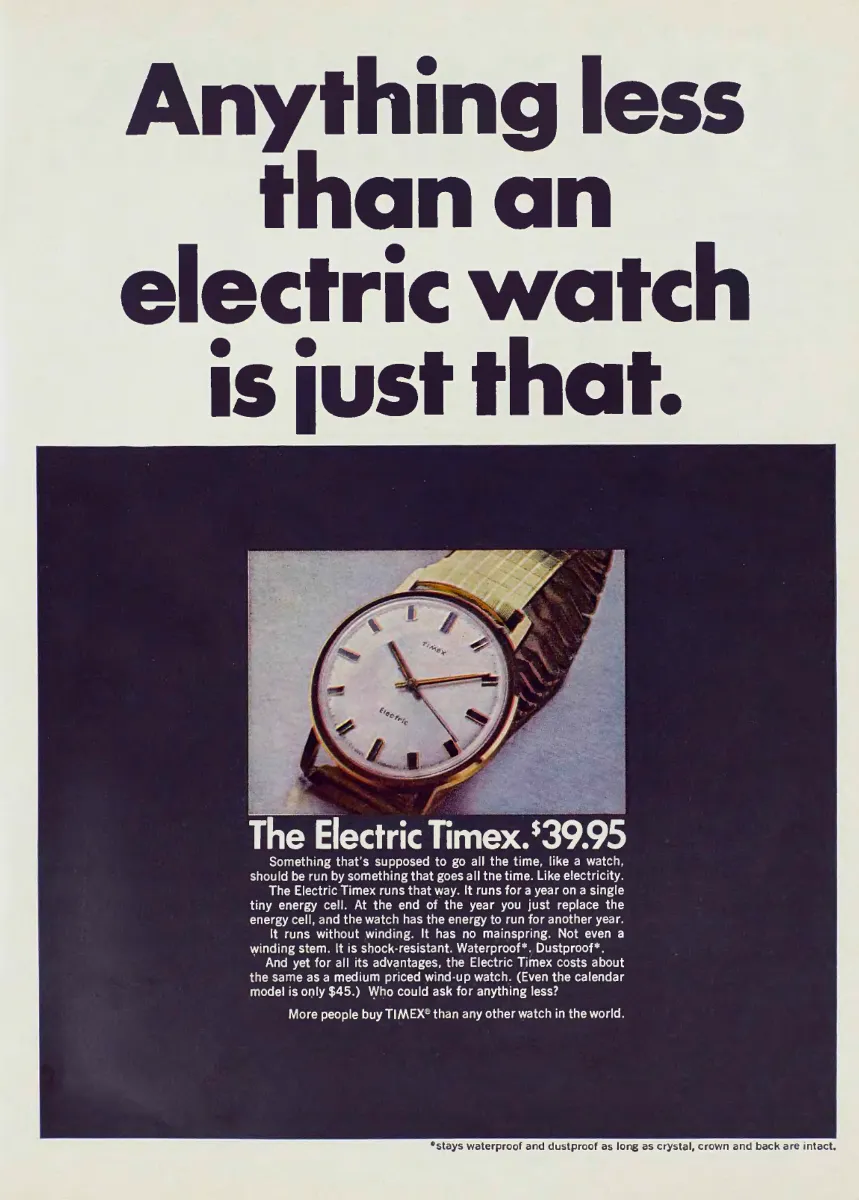
FROM THE PRINTED PAGEOriginal ad copy
OCR transcription from the archived page. Scanning and reading-order errors may remain.
Anything less than an electric watch is just that. TIMEX Electric The Electric Timex. $39.95 Something that's supposed to go all the time, like a watch, should be run by something that goes all the time. Like electricity. The Electric Timex runs that way. It runs for a year on a single tiny energy cell. At the end of the year you just replace the energy cell, and the watch has the energy to run for another year. It runs without winding. It has no mainspring. Not even a winding stem. It is shock-resistant. Waterproof*. Dustproof*. And yet for all its advantages, the Electric Timex costs about the same as a medium priced wind-up watch. (Even the calendar model is only $45.) Who could ask for anything less? More people buy TIMEX® than any other watch in the world. *stays waterproof and dustproof as long as crystal, crown and back are intact.
Commentary
I read the headline twice because its final words seem to withhold the verdict. “Is just that” sends me back to “less.” The watch has not yet made an argument about accuracy or durability; the sentence has already classified competing purchases as a compromise. The enormous black lettering makes that judgment feel settled before the small explanatory copy begins.
Below it, a conventional-looking gold-tone watch sits inside a dark rectangle. Nothing about the dial requires its owner to look like an experimental customer. The innovation is presented as an invisible improvement to an object that remains socially familiar. The $39.95 line gives the category claim an accessible point of entry, and the $45 calendar version quietly creates a second rung on the price ladder.
The argument becomes practical in the paragraph about the energy cell. A year of running replaces the recurrent task of winding. Yet maintenance has not disappeared: the cell must be replaced. I find that admission useful. The copy can promise less daily attention without having to promise perpetual motion. Likewise, the “waterproof” and “dustproof” claims depend on the crystal, crown and back remaining intact, a condition printed outside the dark panel at the very bottom.
This is an advertisement for removing a little ritual from ordinary life. Reading it alongside today’s Timex automatic-watch range reveals how values shift: mechanical movements can now be sold through the pleasure of owning and wearing them. The old page treats winding principally as inconvenience. A mechanism’s meaning depends partly on whether its owner experiences it as compulsory upkeep or chosen involvement.
For beginning copywriters, the opening and ending form a useful loop. “Anything less” returns as “Who could ask for anything less?” Between them, the repeated short “It” sentences turn an abstract superiority claim into a sequence of benefits. “Like electricity” is conversational shorthand, followed by the more precise energy-cell explanation. The lesson is to let the large line provoke, then make the small lines answer the practical questions it creates.
Timex traces its origins to the Waterbury Clock Company in 1854. Its current watch range includes quartz and automatic models, maintaining an accessible-watch identity while offering multiple approaches to timekeeping.
Value and reduced daily fuss still fit the brand. The suggestion that every alternative to an electric watch is inherently lesser no longer describes its own varied range. What survives is the strategic move: sell a new mechanism through the small recurring task it removes, and anchor that promise with a visible price.