Electronics 1969
Sony
With Sony’s short-wave radio even a spy can have a home life.
FROM THE PRINTED PAGEOriginal ad copy
OCR transcription from the archived page. Scanning and reading-order errors may remain.
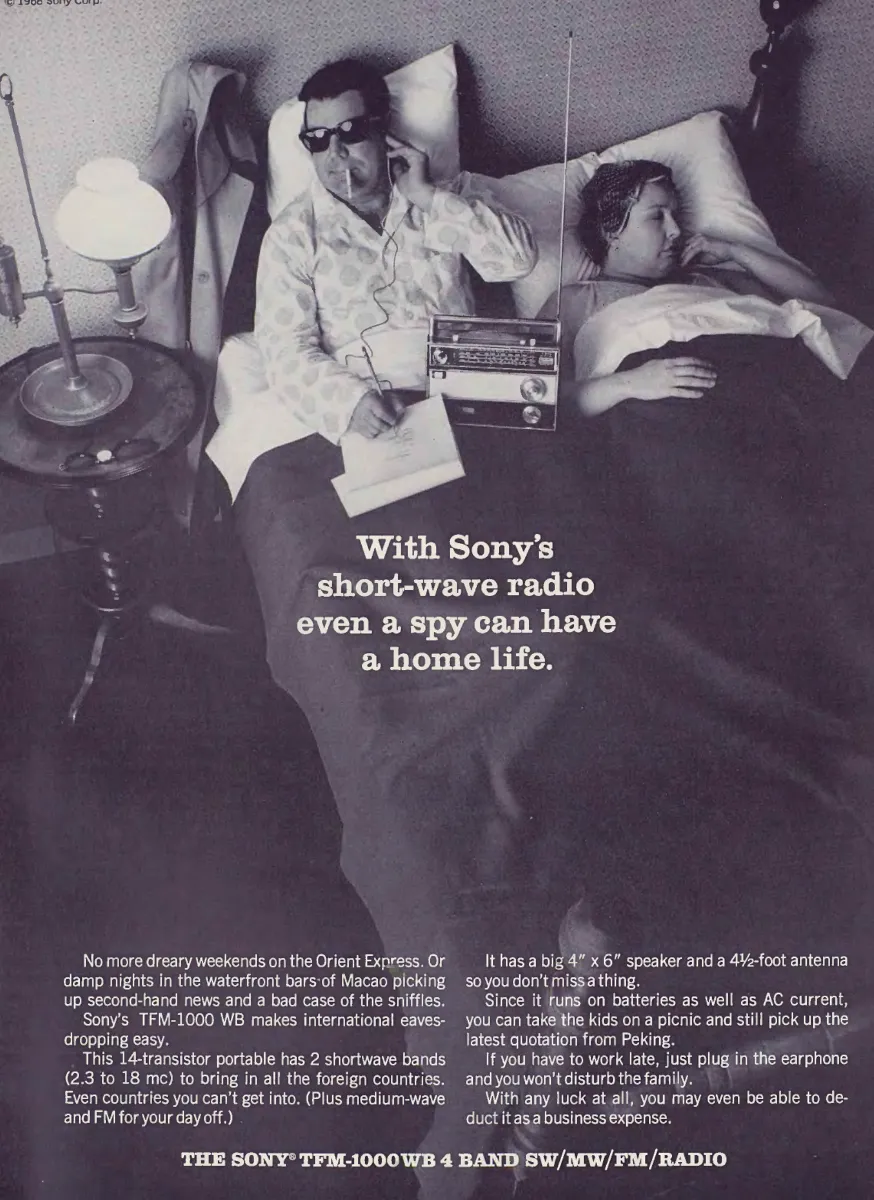
©1968 Sony Corp. With Sony's short-wave radio even a spy can have a home life. No more dreary weekends on the Orient Express. Or damp nights in the waterfront bars of Macao picking up second-hand news and a bad case of the sniffles. Sony's TFM-1000 WB makes international eavesdropping easy. This 14-transistor portable has 2 shortwave bands (2.3 to 18 mc) to bring in all the foreign countries. Even countries you can't get into. (Plus medium-wave and FM for your day off.) It has a big 4” x 6” speaker and a 4½-foot antenna so you don't miss a thing. Since it runs on batteries as well as AC current, you can take the kids on a picnic and still pick up the latest quotation from Peking. If you have to work late, just plug in the earphone and you won't disturb the family. With any luck at all, you may even be able to deduct it as a business expense. THE SONY® TFM-1000WB 4 BAND SW/MW/FM/RADIO
Commentary
The sunglasses are my first clue that this is not an ordinary late-night listener. They are spectacularly unnecessary in bed. A notebook, an earphone and a cigarette complete the assignment, while the woman beside him sleeps through it. Sony has furnished an espionage story with the least glamorous possible headquarters: the marital bedroom.
The joke becomes more interesting when I follow the earphone cable to the radio. The photograph actually demonstrates a feature. Private listening lets one person remain absorbed without obliging the other to participate. The sleeping partner supplies evidence for that benefit, while the sunglasses keep the demonstration from looking like an instruction manual. The headline’s “even a spy” makes an eccentric customer stand in for anyone who wants to hear distant broadcasts without leaving home.
The copy then tours places the listener need not visit: the Orient Express, waterfront bars in Macao, Peking. Its travel is imaginary, but the specifications are concrete: two shortwave bands, medium-wave, FM, battery or household power, and a long antenna. The promise of receiving countries one cannot enter turns reception into a small private freedom. These are the advertiser’s claims, not evidence that every station could be heard under every condition.
I find the picnic more revealing than the espionage. The ad assumes news from abroad is worth carrying special equipment to receive. Today a connected device makes distant reporting readily accessible, while carrying work into bed has become a less uncomplicated convenience. The scene captures both sides of portability: freedom from a location and the temptation to take an obligation everywhere.
For a new copywriter, notice how the fantasy stays attached to functions. “International eavesdropping” names reception; the “day off” introduces ordinary bands; working late introduces the earphone. The paired misfortunes of second-hand news and sniffles puncture the glamorous spy story. A comic premise can organize a specification list, provided each joke leads back to something the product actually does.
Sony’s corporate history begins with Tokyo Tsushin Kogyo in 1946 and records the Sony name change in 1958. Its present organization encompasses entertainment, gaming, electronics, and imaging and sensing businesses.
The portable-access promise remains recognizable across that larger company. This particular radio belongs to a broadcast world of bands, tuning and antennas, rather than searchable streams. The enduring advertising idea is to make a technical capability legible through a household negotiation: one person wants to listen; another wants to sleep.