Electronics 1981
Sony
To find out how flawless a Sony really is, try recording silence.
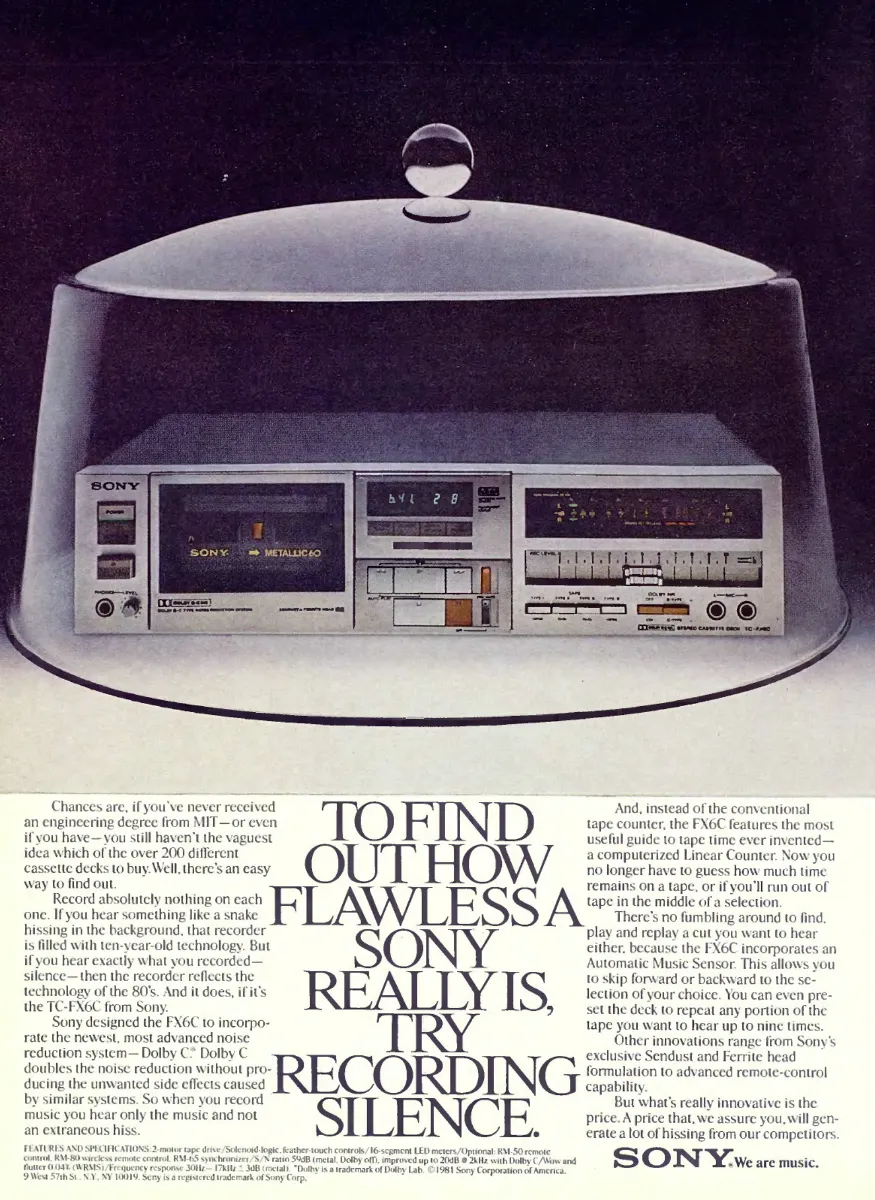
FROM THE PRINTED PAGEOriginal ad copy
OCR transcription from the archived page. Scanning and reading-order errors may remain.
TO FIND OUT HOW FLAWLESS A SONY REALLY IS, TRY RECORDING SILENCE. Chances are, if you’ve never received an engineering degree from MIT—or even if you have—you still haven’t the vaguest idea which of the over 200 different cassette decks to buy. Well, there’s an easy way to find out. Record absolutely nothing on each one. If you hear something like a snake hissing in the background, that recorder is filled with ten-year-old technology. But if you hear exactly what you recorded—silence—then the recorder reflects the technology of the 80’s. And it does, if it’s the TC-FX6C from Sony. Sony designed the FX6C to incorporate the newest, most advanced noise reduction system—Dolby C*. Dolby C doubles the noise reduction without producing the unwanted side effects caused by similar systems. So when you record music you hear only the music and not an extraneous hiss. And, instead of the conventional tape counter, the FX6C features the most useful guide to tape time ever invented—a computerized Linear Counter. Now you no longer have to guess how much time remains on a tape, or if you’ll run out of tape in the middle of a selection. There’s no fumbling around to find, play and replay a cut you want to hear either, because the FX6C incorporates an Automatic Music Sensor. This allows you to skip forward or backward to the selection of your choice. You can even pre-set the deck to repeat any portion of the tape you want to hear up to nine times. Other innovations range from Sony’s exclusive Sendust and Ferrite head formulation to advanced remote-control capability. But what’s really innovative is the price. A price that, we assure you, will generate a lot of hissing from our competitors. SONY. We are music. FEATURES AND SPECIFICATIONS: 2-motor tape drive/Solenoid-logic, feather-touch controls/16-segment LED meters/Optional: RM-50 remote control, RM-80 wireless remote control, RM-65 synchronizer/S/N ratio 59dB (metal, Dolby off), improved up to 20dB @ 2kHz with Dolby C/Wow and flutter 0.04% (WRMS)/Frequency response 30Hz–17kHz ±3dB (metal). *Dolby is a trademark of Dolby Lab. ©1981 Sony Corporation of America. 9 West 57th St., N.Y., NY 10019. Sony is a registered trademark of Sony Corp.
Commentary
I first read the glass cover as a display case, then noticed how well it fits the demand below it: record silence. Sony isolates the cassette deck as if presenting a specimen whose quality deserves close inspection. There is little else to look at. The metallic face, dark background, and broad transparent dome make the ordinary problem of tape hiss feel like a question of laboratory purity.
The body starts by lowering the entrance requirement. Even an MIT engineering degree, it jokes, may not help someone choose among more than two hundred decks. Then it proposes an apparently simple test: record nothing and listen to what comes back. The absence of music makes an unwanted background easier to describe. The snake image gives that background a recognizable voice before Dolby C receives its technical introduction.
I read this as an intelligible demonstration idea, rather than a complete comparative test or proof of literal flawlessness. The page’s own small print qualifies the noise claim with a signal-to-noise figure and a stated improvement at 2 kHz. Other features solve different problems: the Linear Counter helps estimate tape time, the Automatic Music Sensor finds selections, and repeat programming can replay a portion up to nine times. Silence wins attention; control over listening fills out the purchase case.
Those counter and search promises expose the work once embedded in playback. Finding a passage and judging whether enough tape remained could interrupt a recording session. A digital timeline makes both actions look routine, but this ad treats relief from those small uncertainties as an innovation worth explaining. The larger change is the amount of management the listener is expected to perform before enjoying the sound.
For beginning copywriters, the headline’s paradox makes a negative property demonstrable: what is missing becomes the thing to listen for. The closing “hissing from our competitors” returns the snake’s sound as a price joke, even though no price is printed here. That callback is a practical lesson in economy. Reuse a concrete image after its meaning has changed, so the ending feels connected rather than appended.
Sony’s history begins in 1946 and includes tape and audio development. Today its group businesses span electronics and entertainment; the TC-FX6C is historical cassette equipment, rather than evidence of a current deck offering.
The persistent desire is hearing the intended material without the machine drawing attention to itself. Dolby C, tape-time estimates, and the optional remote controls specify the 1981 solution. The durable advertising idea is to give an invisible improvement a plain, memorable demonstration while retaining the qualifications that define the claim.