Electronics 1981
Sony
The Sony that broke the sound barrier.
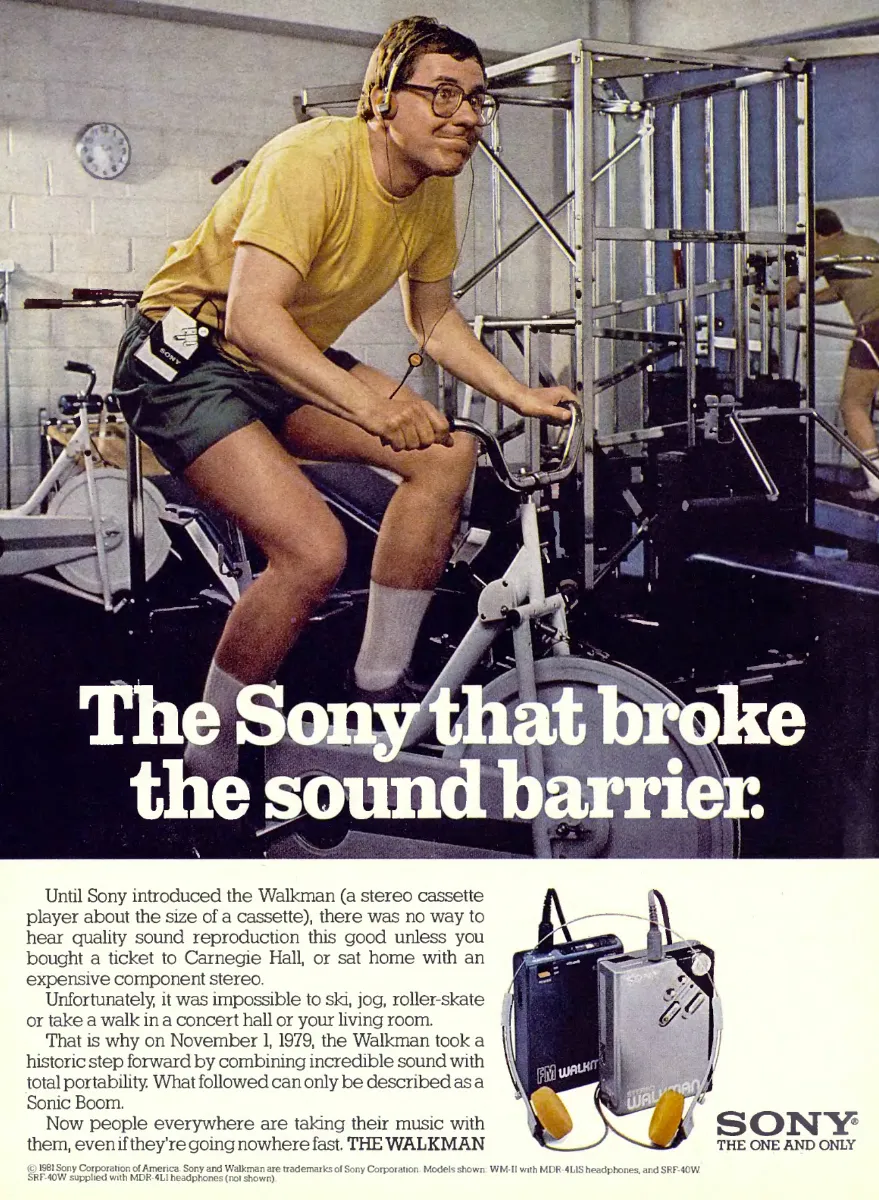
FROM THE PRINTED PAGEOriginal ad copy
OCR transcription from the archived page. Scanning and reading-order errors may remain.
The Sony that broke the sound barrier. Until Sony introduced the Walkman (a stereo cassette player about the size of a cassette), there was no way to hear quality sound reproduction this good unless you bought a ticket to Carnegie Hall, or sat home with an expensive component stereo. Unfortunately, it was impossible to ski, jog, roller-skate or take a walk in a concert hall or your living room. That is why on November 1, 1979, the Walkman took a historic step forward by combining incredible sound with total portability. What followed can only be described as a Sonic Boom. Now people everywhere are taking their music with them, even if they’re going nowhere fast. THE WALKMAN SONY® THE ONE AND ONLY ©1981 Sony Corporation of America. Sony and Walkman are trademarks of Sony Corporation. Models shown: WM-II with MDR-4L1S headphones, and SRF-40W. SRF-40W supplied with MDR-4L1 headphones (not shown).
Commentary
I looked at the wheels and realized that the man is staying exactly where he is. Sony has chosen a stationary exercise bicycle for an advertisement about total portability. The apparent contradiction becomes the last joke in the copy: people take their music along even when they are “going nowhere fast.” The player clipped at his hip makes the benefit visible without requiring him to travel an inch.
The photograph is insistently ordinary. A wall clock, concrete blocks, exercise equipment, glasses, socks, and a yellow T-shirt locate the claim in a working gym. The headline supplies the scale the room lacks: this Sony has broken “the sound barrier.” The body identifies the barrier as the separation between serious listening and movement, contrasting Carnegie Hall and an expensive home component system with skiing, jogging, skating, and walking. Those sweeping quality comparisons are the advertiser’s argument, not listening-test results established by the scan.
The dated origin story also needs to stay attached to its source. This American advertisement names November 1, 1979. Sony’s own historical account dates the first-generation Walkman’s sale to July 1979 and describes different overseas names, including Soundabout. I preserve the ad’s November statement in the transcription without treating it as the universal first-launch date. The page does not explain the difference.
The image records a change in what exercise could sound like. Music can accompany one person’s routine without becoming the soundtrack for the room. Today that arrangement is familiar enough to require little explanation. Here the wire, hip-mounted machine, and conspicuous headphones help make a new personal boundary imaginable, while the user’s amused expression keeps the technology approachable.
For young copywriters, “sound barrier,” “historic step,” and “Sonic Boom” build a shared vocabulary of breakthrough and motion. The final idiom then brings the grand claim back down to the photograph. The lesson is to let a large metaphor resolve into an observed detail: the stationary bicycle makes the closing joke more exact than a generic picture of someone jogging would have done.
Sony’s electronics history reaches back to 1946. The Walkman name continues on digital products such as the NW-A306, which supports networked music alongside local playback.
The continuing promise is choosing one’s own accompaniment to daily movement. Cassette handling, the pictured WM-II and SRF-40W, and the concert-hall comparison belong to this ad. The enduring insight is that portability changes a relationship with a place even when the listener remains in it.