Electronics 1981
Polaroid
The Polaroid Sun Camera. A Revolutionary New Camera and Film System.
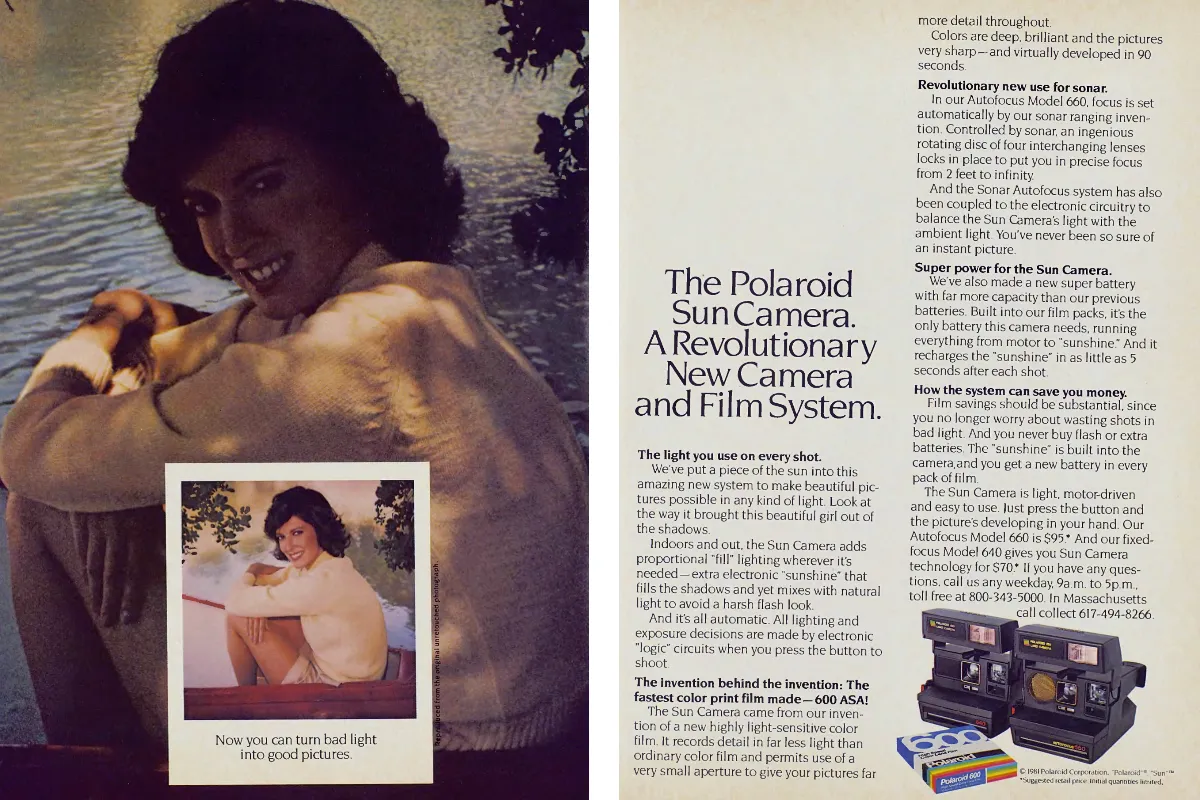
FROM THE PRINTED PAGEOriginal ad copy
OCR transcription from the archived page. Scanning and reading-order errors may remain.
The Polaroid Sun Camera. A Revolutionary New Camera and Film System. Now you can turn bad light into good pictures. Reproduced from the original unretouched photograph. The light you use on every shot. We've put a piece of the sun into this amazing new system to make beautiful pictures possible in any kind of light. Look at the way it brought this beautiful girl out of the shadows. Indoors and out, the Sun Camera adds proportional “fill” lighting wherever it's needed—extra electronic “sunshine” that fills the shadows and yet mixes with natural light to avoid a harsh flash look. And it's all automatic. All lighting and exposure decisions are made by electronic “logic” circuits when you press the button to shoot. The invention behind the invention: The fastest color print film made—600 ASA! The Sun Camera came from our invention of a new highly light-sensitive color film. It records detail in far less light than ordinary color film and permits use of a very small aperture to give your pictures far more detail throughout. Colors are deep, brilliant and the pictures very sharp—and virtually developed in 90 seconds. Revolutionary new use for sonar. In our Autofocus Model 660, focus is set automatically by our sonar ranging invention. Controlled by sonar, an ingenious rotating disc of four interchanging lenses locks in place to put you in precise focus from 2 feet to infinity. And the Sonar Autofocus system has also been coupled to the electronic circuitry to balance the Sun Camera's light with the ambient light. You've never been so sure of an instant picture. Super power for the Sun Camera. We've also made a new super battery with far more capacity than our previous batteries. Built into our film packs, it's the only battery this camera needs, running everything from motor to “sunshine.” And it recharges the “sunshine” in as little as 5 seconds after each shot. How the system can save you money. Film savings should be substantial, since you no longer worry about wasting shots in bad light. And you never buy flash or extra batteries. The “sunshine” is built into the camera, and you get a new battery in every pack of film. The Sun Camera is light, motor-driven and easy to use. Just press the button and the picture's developing in your hand. Our Autofocus Model 660 is $95.* And our fixed-focus Model 640 gives you Sun Camera technology for $70.* If you have any questions, call us any weekday, 9a.m. to 5p.m., toll free at 800-343-5000. In Massachusetts call collect 617-494-8266. Polaroid 600 © 1981 Polaroid Corporation. “Polaroid”® “Sun”™ *Suggested retail price; initial quantities limited.
Commentary
I began with the smaller photograph. Its white border makes it look like evidence laid on top of a problem: the same woman, the same waterside setting, but a face that has emerged from shadow. The enormous dark portrait supplies the difficulty; the little print supplies the promised rescue. Even the sideways assurance that the original photograph was unretouched anticipates suspicion about this demonstration.
The machinery arrives only after that visual argument. “Sun” is a friendly name for a system that combines fill flash, sensitive film, automatic exposure and, in the Model 660, sonar focusing. Polaroid does not leave the reader with a mysterious electronic miracle. It explains how extra light mixes with daylight and why a battery comes inside each film pack. The $95 autofocus and $70 fixed-focus offers turn a broad technological announcement into a choice between two purchases.
The savings argument gave me pause. Avoiding spoiled exposures is presented as an economy, although every attempt still consumes film. The copy carefully says savings “should” be substantial. A phone photographer can inspect and discard an exposure without sacrificing a sheet; here, certainty has a material value. The weekday telephone hours also show that understanding the product might require arranging a conversation before buying it.
For a young copywriter, watch how “sunshine” keeps returning after the technical explanations. It translates circuitry into an experience without replacing the supporting detail. The opening “piece of the sun” supplies a memorable image; the subheads divide the engineering into manageable questions about light, focus, power and money. The practical lesson is to give readers an accessible name for the benefit, then earn it with particulars.
Polaroid was founded by Edwin Land in 1937. Today’s brand continues to offer instant cameras and film; its film guide distinguishes battery-containing 600 packs for vintage cameras from battery-free i-Type packs for newer cameras with their own power supply.
The wish to make an uncertain scene into a picture worth keeping survives. The historical specifications need to stay historical: current Color 600 film lists a 10–15-minute development time, rather than this advertisement’s 90-second claim. A familiar format does not make today’s chemistry identical to the product being sold here.