Electronics 1980
Sony
Sony eliminates the most disturbing variables in turntable performance
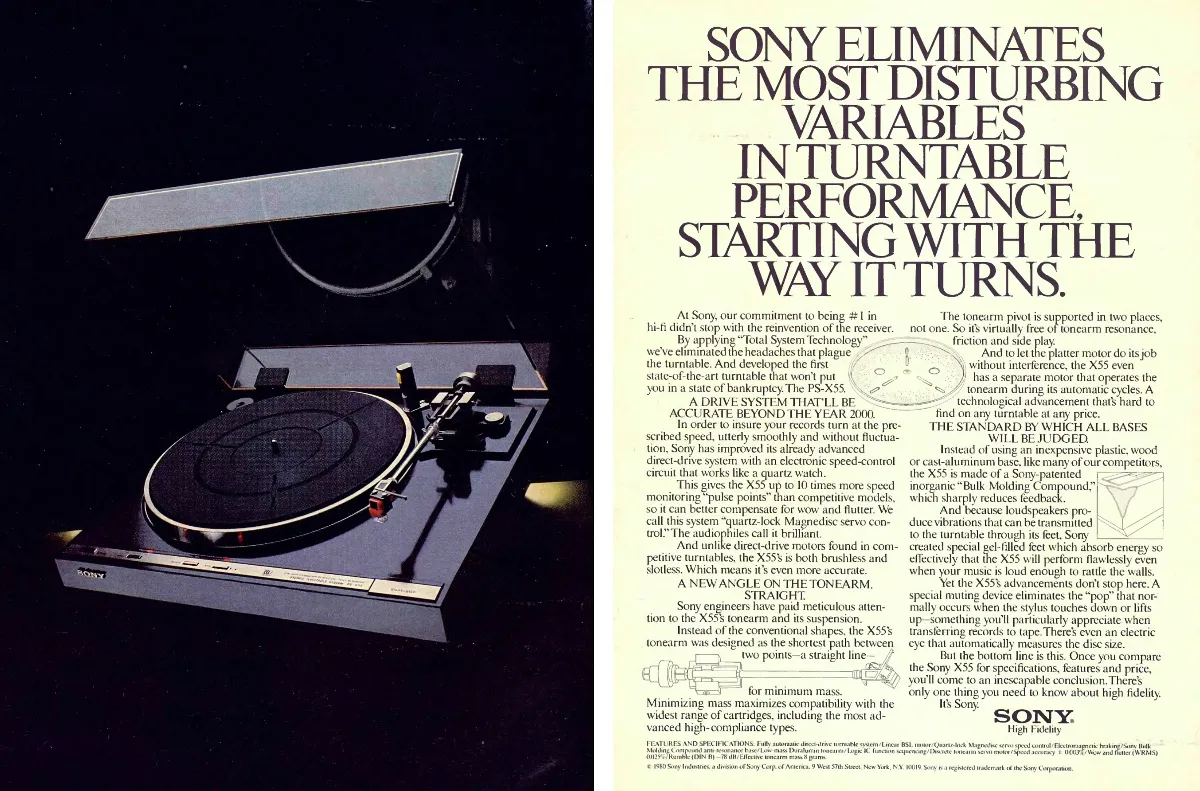
FROM THE PRINTED PAGEOriginal ad copy
OCR transcription from the archived page. Scanning and reading-order errors may remain.
SONY ELIMINATES THE MOST DISTURBING VARIABLES IN TURNTABLE PERFORMANCE, STARTING WITH THE WAY IT TURNS. At Sony, our commitment to being #1 in hi-fi didn't stop with the reinvention of the receiver. By applying “Total System Technology” we've eliminated the headaches that plague the turntable. And developed the first state-of-the-art turntable that won't put you in a state of bankruptcy. The PS-X55. A DRIVE SYSTEM THAT'LL BE ACCURATE BEYOND THE YEAR 2000. In order to insure your records turn at the prescribed speed, utterly smoothly and without fluctuation, Sony has improved its already advanced direct-drive system with an electronic speed-control circuit that works like a quartz watch. This gives the X55 up to 10 times more speed monitoring “pulse points” than competitive models, so it can better compensate for wow and flutter. We call this system “quartz-lock Magnedisc servo control.” The audiophiles call it brilliant. And unlike direct-drive motors found in competitive turntables, the X55's is both brushless and slotless. Which means it's even more accurate. A NEW ANGLE ON THE TONEARM. STRAIGHT. Sony engineers have paid meticulous attention to the X55's tonearm and its suspension. Instead of the conventional shapes, the X55's tonearm was designed as the shortest path between two points—a straight line—for minimum mass. Minimizing mass maximizes compatibility with the widest range of cartridges, including the most advanced high-compliance types. The tonearm pivot is supported in two places, not one. So it's virtually free of tonearm resonance, friction and side play. And to let the platter motor do its job without interference, the X55 even has a separate motor that operates the tonearm during its automatic cycles. A technological advancement that's hard to find on any turntable at any price. THE STANDARD BY WHICH ALL BASES WILL BE JUDGED. Instead of using an inexpensive plastic, wood or cast-aluminum base, like many of our competitors, the X55 is made of a Sony-patented inorganic “Bulk Molding Compound,” which sharply reduces feedback. And because loudspeakers produce vibrations that can be transmitted to the turntable through its feet, Sony created special gel-filled feet which absorb energy so effectively that the X55 will perform flawlessly even when your music is loud enough to rattle the walls. Yet the X55's advancements don't stop here. A special muting device eliminates the “pop” that normally occurs when the stylus touches down or lifts up—something you'll particularly appreciate when transferring records to tape. There's even an electric eye that automatically measures the disc size. But the bottom line is this. Once you compare the Sony X55 for specifications, features and price, you'll come to an inescapable conclusion. There's only one thing you need to know about high fidelity. It's Sony. SONY. High Fidelity FEATURES AND SPECIFICATIONS: Fully automatic direct-drive turntable; Linear DC motor; [illegible] Bulk Molding Compound anti-resonance base; low-mass tonearm; [illegible] speed control accuracy; [illegible] wow and flutter; [illegible] hum and noise; effective tonearm mass 8 grams. © 1980 Sony Industries, a division of Sony Corp. of America, 9 West 57th Street, New York, N.Y. 10019. Sony is a registered trademark of the Sony Corporation.
Commentary
I begin on the left, where the turntable sits alone in darkness. Its open lid and straight tonearm are illuminated just enough to make the machine look inspectable. The right page then behaves almost like a technical hearing: claim, diagram, mechanism, claim again. The headline promises to remove “the most disturbing variables,” a phrase that makes mechanical instability sound like an unwelcome guest at a listening session.
The copy works down the physical path of a record. Quartz-like speed control addresses rotation; the short straight tonearm and two-point pivot address tracking; the molded base and gel-filled feet address vibration; muting addresses the pop when a stylus lands. Small diagrams sit inside the copy where an engineer might expect them. “Up to 10 times more speed monitoring pulse points” is a comparative claim from the ad, not independently established here. The piece asks a serious buyer to understand why each part exists before accepting its closing “It’s Sony.”
The promise “accurate beyond the year 2000” now reads as an artifact in its own right. For the 1980 reader it projected durability beyond a distant threshold. The transfer-to-tape line records another everyday workflow: an owner could copy a record and wanted the recording free of the stylus pop. Today records remain in use, but that specific home copying problem is no longer a central consumer-electronics pitch.
For a young copywriter, notice how the subheads make engineering arguments memorable without hiding their subject. “A new angle on the tonearm. Straight.” puts the punch word after a pause; “all bases will be judged” turns a component into a verbal hook. The headline’s broad “variables” creates room for several distinct proofs. The lesson is to give dense evidence a readable sequence and let each subhead name the benefit of the next piece of detail.
Sony’s corporate history begins in 1946 and documents its long consumer-electronics development. Its current business overview spans entertainment and electronics, far beyond this single hi-fi component.
The wish for faithful playback and a machine that solves audible annoyances remains. The PS-X55’s specific mechanisms and the year-2000 horizon are period details; the ad’s lasting design lesson is how to make a complex system legible one source of disturbance at a time.