Consumer Goods 1992
Jack Daniel's
All Goods Worth Price Charged
FROM THE PRINTED PAGEOriginal ad copy
OCR transcription from the archived page. Scanning and reading-order errors may remain.
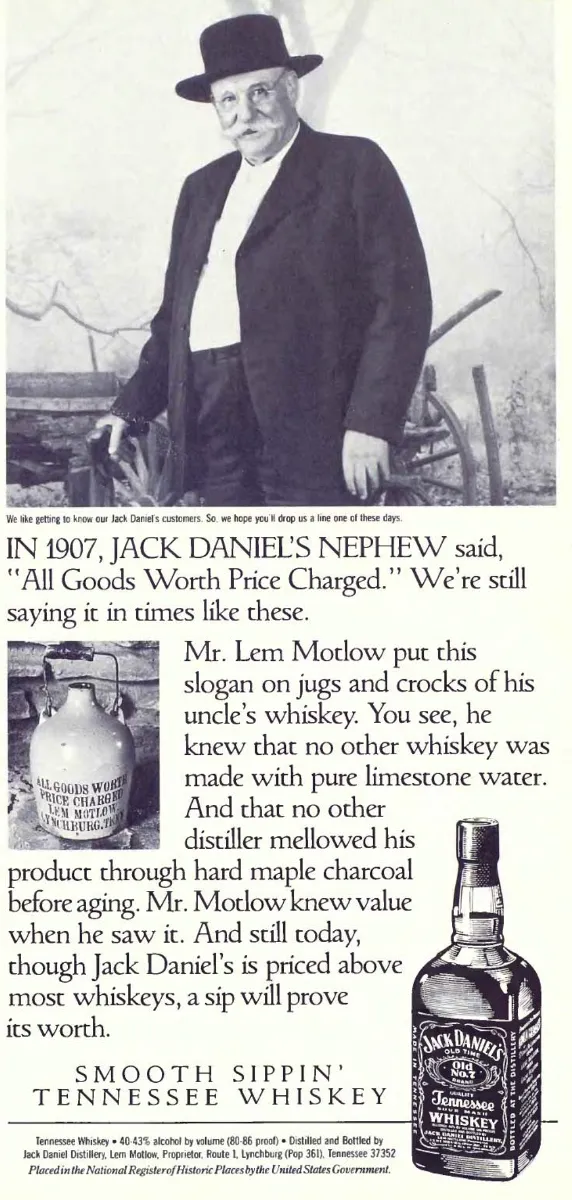
We like getting to know our Jack Daniel's customers. So, we hope you'll drop us a line one of these days. IN 1907, JACK DANIEL'S NEPHEW said, “All Goods Worth Price Charged.” We're still saying it in times like these. Mr. Lem Motlow put this slogan on jugs and crocks of his uncle's whiskey. You see, he knew that no other whiskey was made with pure limestone water. And that no other distiller mellowed his product through hard maple charcoal before aging. Mr. Motlow knew value when he saw it. And still today, though Jack Daniel's is priced above most whiskeys, a sip will prove its worth. ALL GOODS WORTH PRICE CHARGED LEM MOTLOW LYNCHBURG, TENN. SMOOTH SIPPIN' TENNESSEE WHISKEY Tennessee Whiskey • 40-43% alcohol by volume (80-86 proof) • Distilled and Bottled by Jack Daniel Distillery, Lem Motlow, Proprietor, Route 1, Lynchburg (Pop 361), Tennessee 37352 Placed in the National Register of Historic Places by the United States Government.
Commentary
I first read this as a price defense disguised as a family photograph. Lem Motlow stands above the copy in formal dark clothes, while a battered jug at the left carries the line “All Goods Worth Price Charged.” The small jug is important: the slogan appears as something once put on packaging, not a phrase coined to answer a modern advertising brief. The current bottle at the lower right then becomes the descendant of that earlier container.
The headline does two jobs. It dates the saying to 1907, giving it inherited authority, and adds “in times like these,” a deliberate invitation to think about money without naming a recession or quoting a price. The body admits that Jack Daniel’s costs more than most whiskeys. That admission gives the claim a problem to solve. Limestone water and hard maple charcoal supply the reasons; “a sip will prove its worth” asks the customer to complete the argument. The photograph and jug make this feel like testimony from a family business, although the ad itself offers no comparison of production costs or blind tasting.
The invitation to “drop us a line” places the customer inside the story. I read it as a promise of personal access made through a mass printed page. A letter had to travel to Lynchburg and wait for a reply; today a brand can solicit a response instantly. The older delay may have helped the invitation sound more intimate, because correspondence took effort on both sides.
For a new copywriter, the compactness of “All Goods Worth Price Charged” is the lesson. Its slightly old-fashioned, almost ledger-like word order sounds like a principle rather than a sales slogan. “Worth” bridges the explicit price admission and the sensory closing challenge. Set in large type beside an actual marked jug, those words borrow credibility from an object the reader can inspect.
Jack Daniel’s history of Lem Motlow says Jack transferred the distillery to Lem and Dick Daniel in 1907 and describes the Lynchburg spring and charcoal process. The brand still sells Tennessee whiskey, including Old No. 7, under Brown-Forman ownership, as its company history explains.
The price argument remains recognizable: show the extra work, then ask whether the experience justifies the premium. The letter-writing invitation and the unqualified claim that “no other” distiller used the process belong to the ad’s own rhetoric; its most durable evidence is the specific account of water, charcoal, and the preserved jug.