Fashion & Accessories 1980
Citizen
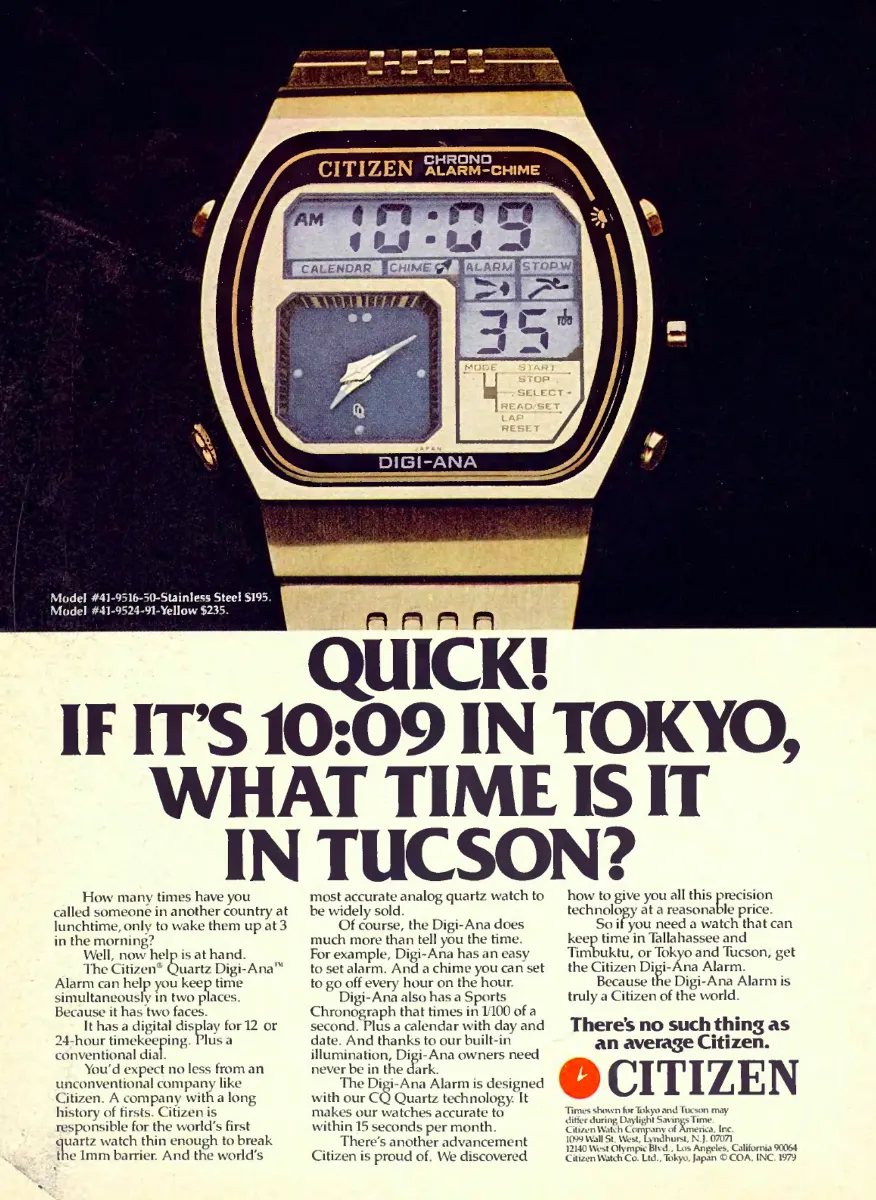
Quick! If it's 10:09 in Tokyo, what time is it in Tucson?
FROM THE PRINTED PAGEOriginal ad copy
OCR transcription from the archived page. Scanning and reading-order errors may remain.
CITIZEN CHRONO ALARM-CHIME DIGI-ANA Model #41-9516-50—Stainless Steel $195. Model #41-9524-91—Yellow $235. QUICK! IF IT'S 10:09 IN TOKYO, WHAT TIME IS IT IN TUCSON? How many times have you called someone in another country at lunchtime, only to wake them up at 3 in the morning? Well, now help is at hand. The Citizen® Quartz Digi-Ana™ Alarm can help you keep time simultaneously in two places. Because it has two faces. It has a digital display for 12 or 24-hour timekeeping. Plus a conventional dial. You'd expect no less from an unconventional company like Citizen. A company with a long history of firsts. Citizen is responsible for the world's first quartz watch thin enough to break the 1mm barrier. And the world's most accurate analog quartz watch to be widely sold. Of course, the Digi-Ana does much more than tell you the time. For example, Digi-Ana has an easy to set alarm. And a chime you can set to go off every hour on the hour. Digi-Ana also has a Sports Chronograph that times in 1/100 of a second. Plus a calendar with day and date. And thanks to our built-in illumination, Digi-Ana owners need never be in the dark. The Digi-Ana Alarm is designed with our CQ Quartz technology. It makes our watches accurate to within 15 seconds per month. There's another advancement Citizen is proud of. We discovered how to give you all this precision technology at a reasonable price. So if you need a watch that can keep time in Tallahassee and Timbuktu, or Tokyo and Tucson, get the Citizen Digi-Ana Alarm. Because the Digi-Ana Alarm is truly a Citizen of the world. There's no such thing as an average Citizen. CITIZEN Times shown for Tokyo and Tucson may differ during Daylight Savings Time. © Citizen Watch Company of America, Inc. 1979.
Commentary
The large watch face initially seems to offer too much information: an analog dial, digital numerals, calendar, alarm, chime and chronograph labels all crowd into one square. The headline gives that density a purpose. “Quick!” asks for the time in Tucson when Tokyo reads 10:09. The answer is not printed. Instead the ad lets a small moment of uncertainty demonstrate why two displays might be useful.
The body turns that uncertainty into a social mishap: a lunchtime international call that wakes someone at 3 a.m. This is a feature demonstration disguised as courtesy. Citizen then lists the alarm, hourly chime, hundredth-second chronograph, calendar and illumination, but those functions follow a problem the reader can picture. The stainless-steel and yellow versions, priced at $195 and $235, make the technology an actual purchase decision rather than a futuristic curiosity. The small daylight-saving note is a reminder that even two clocks do not remove every complication.
I find the old call scenario particularly revealing. Knowing another city’s time is now usually a search or phone-screen glance, and messaging often lets the recipient answer later. The ad assumes a live call, made with imperfect information, could intrude on someone’s sleep. Its promise is as much about avoiding embarrassment as about keeping precise time.
For a new copywriter, the command “Quick!” and the unanswered question create a short test the product can pass. The paired place names, “Tokyo and Tucson” and “Tallahassee and Timbuktu,” make distance rhythmic and memorable. “Two faces” then gives a plain visual explanation of analog plus digital. The lesson is to lead a crowded feature list with one situation that makes its complexity useful.
Citizen’s history describes a watchmaking business dating to 1918; its design archive dates the Digi-Ana concept to 1978. Citizen continues to develop and sell watches, including light-powered models.
The wish to manage time across places remains. The particular solution—a dense wrist display for a live long-distance call—belongs to a less connected moment, while the ad’s strongest move is still current: make precision matter to another person.