Electronics 1980
Sony
Set your life to music.
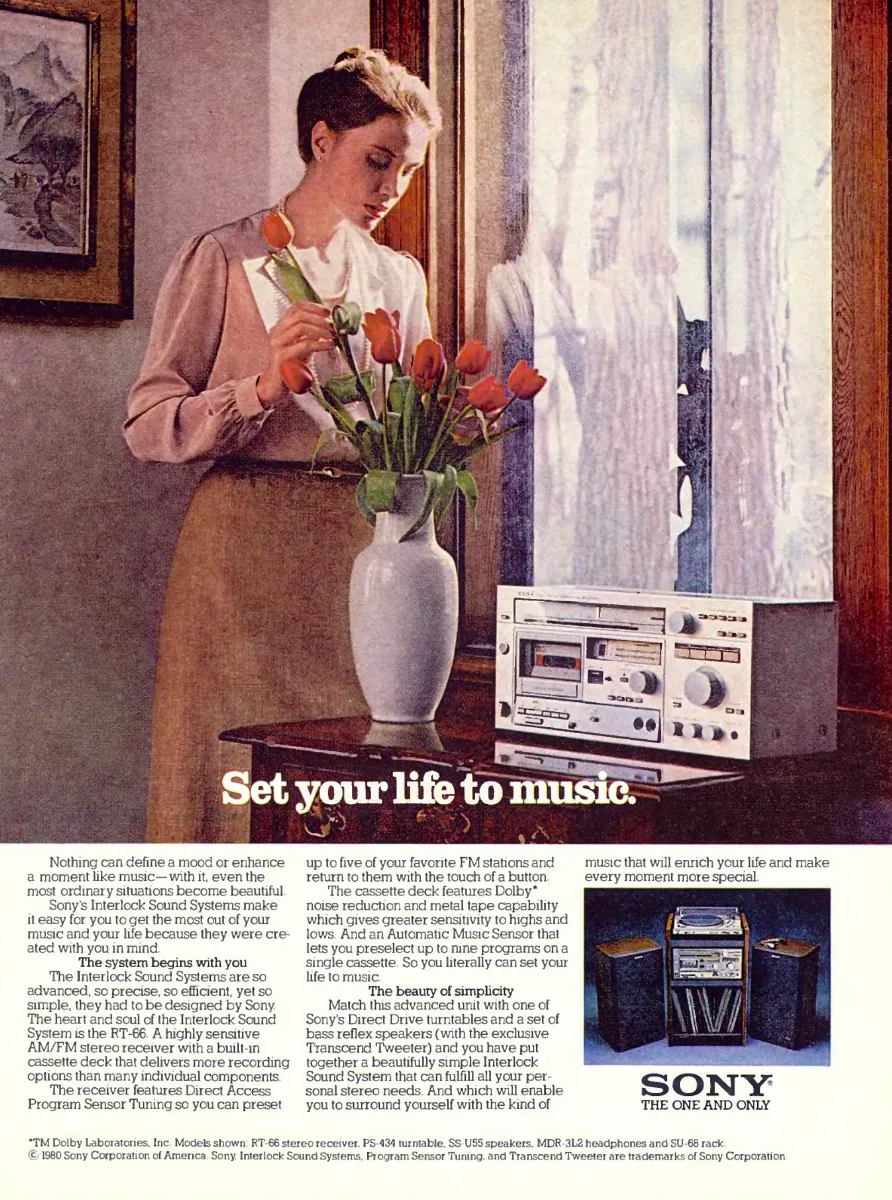
FROM THE PRINTED PAGEOriginal ad copy
OCR transcription from the archived page. Scanning and reading-order errors may remain.
Set your life to music. Nothing can define a mood or enhance a moment like music—with it, even the most ordinary situations become beautiful. Sony's Interlock Sound Systems make it easy for you to get the most out of your music and your life because they were created with you in mind. The system begins with you The Interlock Sound Systems are so advanced, so precise, so efficient, yet so simple, they had to be designed by Sony. The heart and soul of the Interlock Sound System is the RT-66. A highly sensitive AM/FM stereo receiver with a built-in cassette deck that delivers more recording options than many individual components. The receiver features Direct Access Program Sensor Tuning so you can preset up to five of your favorite FM stations and return to them with the touch of a button. The cassette deck features Dolby* noise reduction and metal tape capability which gives greater sensitivity to highs and lows. And an Automatic Music Sensor that lets you preselect up to nine programs on a single cassette. So you literally can set your life to music. The beauty of simplicity Match this advanced unit with one of Sony's Direct Drive turntables and a set of bass reflex speakers (with the exclusive Transcend Tweeter) and you have put together a beautifully simple Interlock Sound System that can fulfill all your personal stereo needs. And which will enable you to surround yourself with the kind of music that will enrich your life and make every moment more special. SONY THE ONE AND ONLY *TM Dolby Laboratories, Inc. Models shown: RT-66 stereo receiver, PS-434 turntable, SS-U55 speakers, MDR-3L2 headphones and SU-68 rack. © 1980 Sony Corporation of America. Sony Interlock Sound Systems, Program Sensor Tuning, and Transcend Tweeter are trademarks of Sony Corporation.
Commentary
The stereo sits beside a vase of tulips, but the woman in the photograph is tending the flowers rather than operating the machine. I find that small displacement more telling than a hand on a volume knob. “Set your life to music” asks the reader to think of sound as part of an ordinary room and ordinary time. The product photograph below makes clear what is being sold; the large lifestyle scene supplies the reason to care.
The copy tries to reconcile complexity with ease. The RT-66 combines a receiver and cassette deck. Five preset FM stations, Dolby noise reduction, metal-tape capability and a sensor for selecting programs on a cassette are presented as ways to control listening without assembling many separate components. Sony also proposes a turntable, speakers, headphones and rack. These are product claims in the ad, not a test of performance. The headings “The system begins with you” and “The beauty of simplicity” keep bringing the reader back from specifications to use.
The scene assumes that music will be selected, stored and played from devices placed visibly in the home. A listener today may make the same kind of mood choice from a phone and a streaming library, with far less equipment in view. The desire to shape a moment with music persists, while the hardware’s role as a piece of domestic furniture has changed. The photograph records that older relationship without needing to state it.
For a new copywriter, the headline is a compact promise built on a double meaning of “set”: establish a mood, and set a device. The phrase returns after the cassette features, where it becomes almost literal. The subheads use direct address and “simplicity” to keep a technical paragraph from becoming a parts list. The lesson is to give features an organizing human purpose, then return to that purpose after the details.
Sony’s history traces its development from a small postwar electronics company. Sony Group now spans electronics and entertainment, as its corporate profile describes.
The idea of music shaping daily life still resonates. This ad’s presets, cassette program selection, separate turntable and speaker stack belong to a particular home-audio setup; the promise of easy access to chosen music survives in different devices.