Automotive 1980
Porsche
Optimization of Vehicle Aerodynamic Form
FROM THE PRINTED PAGEOriginal ad copy
OCR transcription from the archived page. Scanning and reading-order errors may remain.
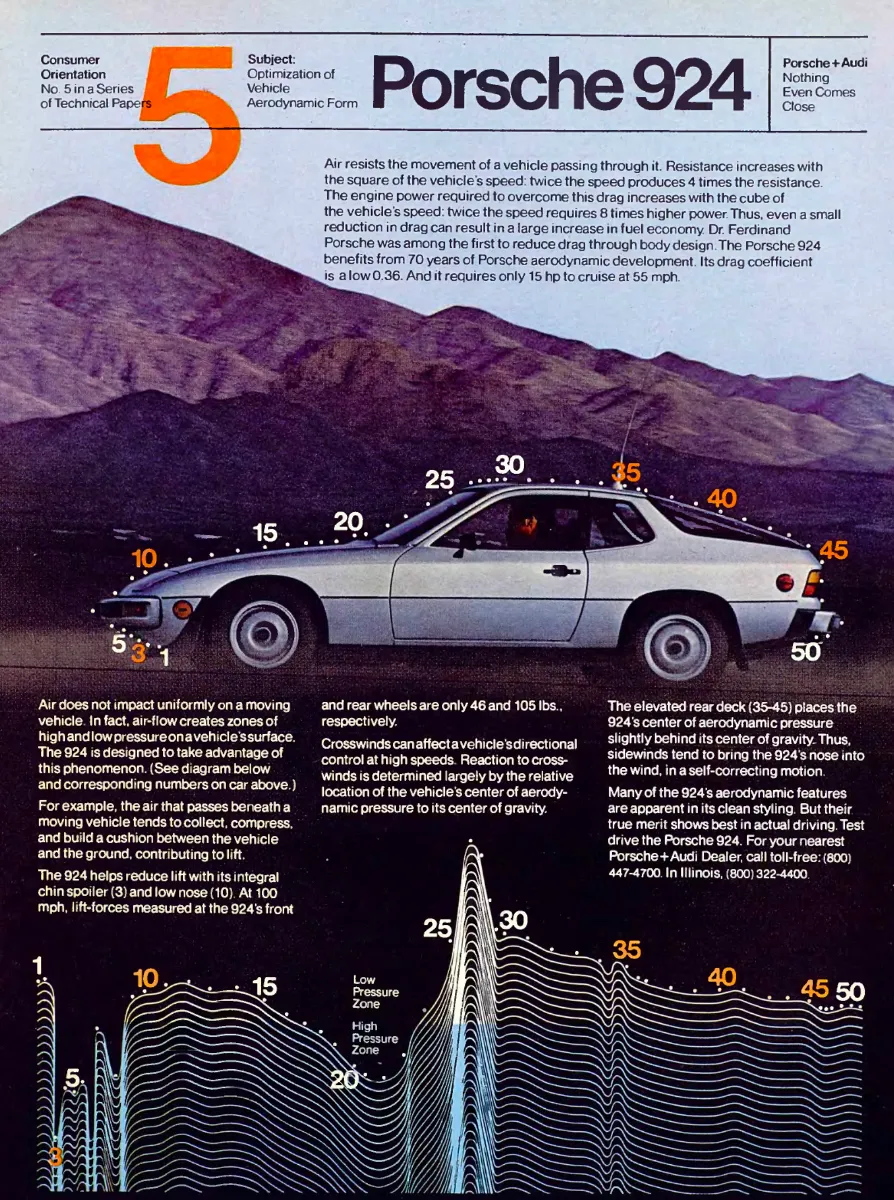
Consumer Orientation No. 5 in a Series of Technical Papers Subject: Optimization of Vehicle Aerodynamic Form Porsche 924 Porsche + Audi Nothing Even Comes Close Air resists the movement of a vehicle passing through it. Resistance increases with the square of the vehicle's speed: twice the speed produces 4 times the resistance. The engine power required to overcome this drag increases with the cube of the vehicle's speed: twice the speed requires 8 times higher power. Thus, even a small reduction in drag can result in a large increase in fuel economy. Dr. Ferdinand Porsche was among the first to reduce drag through body design. The Porsche 924 benefits from 70 years of Porsche aerodynamic development. Its drag coefficient is a low 0.36. And it requires only 15 hp to cruise at 55 mph. Air does not impact uniformly on a moving vehicle. In fact, air-flow creates zones of high and low pressure on a vehicle's surface. The 924 is designed to take advantage of this phenomenon. (See diagram below and corresponding numbers on car above.) For example, the air that passes beneath a moving vehicle tends to collect, compress, and build a cushion between the vehicle and the ground, contributing to lift. The 924 helps reduce lift with its integral chin spoiler (3) and low nose (10). At 100 mph, lift-forces measured at the 924's front and rear wheels are only 46 and 105 lbs., respectively. Crosswinds can affect a vehicle's directional control at high speeds. Reaction to crosswinds is determined largely by the relative location of the vehicle's center of aerodynamic pressure to its center of gravity. The elevated rear deck (35–45) places the 924's center of aerodynamic pressure slightly behind its center of gravity. Thus, sidewinds tend to bring the 924's nose into the wind, in a self-correcting motion. Many of the 924's aerodynamic features are apparent in its clean styling. But their true merit shows best in actual driving. Test drive the Porsche 924. For your nearest Porsche + Audi Dealer, call toll-free: (800) 447-4700. In Illinois, (800) 322-4400. Diagram labels: Low Pressure Zone; High Pressure Zone. Numbered locations shown on the vehicle and diagram include 1, 3, 5, 10, 15, 20, 25, 30, 35, 40, 45 and 50.
Commentary
This looks less like a usual car advertisement than a page torn from a lesson. The header calls it “Consumer Orientation,” names a technical subject, and marks it number five in a series. A side-on Porsche 924 carries numbered points along its body; below, fine lines rise and fall around pressure zones. The image teaches me where to look before the text asks me to admire the car. The mountain road and moving wheels keep the diagram tied to driving rather than a classroom alone.
The opening paragraph gives a short physics argument: air resistance rises with the square of speed, and the power needed to overcome drag rises with the cube. It then claims a drag coefficient of 0.36 and only 15 horsepower to cruise at 55 mph. The copy later explains lift under the car, the role of the chin spoiler and low nose, and the effect of the elevated rear deck in crosswinds. Those numbers and effects are the advertiser’s technical claims; the scan supplies a diagram and explanation, not an independent test. Their persuasive job is to turn a smooth silhouette into measurable engineering.
I notice the final turn from instruction to action. After the airflow lesson, the reader is told to test drive and given two toll-free dealer numbers, one for Illinois. A prospective buyer had to carry the printed argument into a showroom or make a call for the next step. Today wind-tunnel animations, road tests and configurators can follow the same line of inquiry on a screen. The 1980 page compresses explanation, evidence and lead generation into one sheet.
For a new copywriter, “Optimization of Vehicle Aerodynamic Form” works because the layout really behaves like a technical paper. The ratios “4 times” and “8 times” turn a dry principle into a memorable escalation. The repeated references to numbered points send the eye between prose, car and diagram. A technical tone earns trust when the visual gives readers a way to follow the reasoning, even while the underlying claims still need verification.
Porsche’s history of the 924 places its arrival in the mid-1970s and describes the front-engine transaxle layout. Porsche continues to make sports cars and other vehicles; the 924 is no longer produced.
Aerodynamic efficiency and high-speed stability remain useful ways to explain design. The specific 924 figures, printed pressure diagram and toll-free dealer path belong to this car and this sales moment.