Consumer Goods 1980
Bausch & Lomb
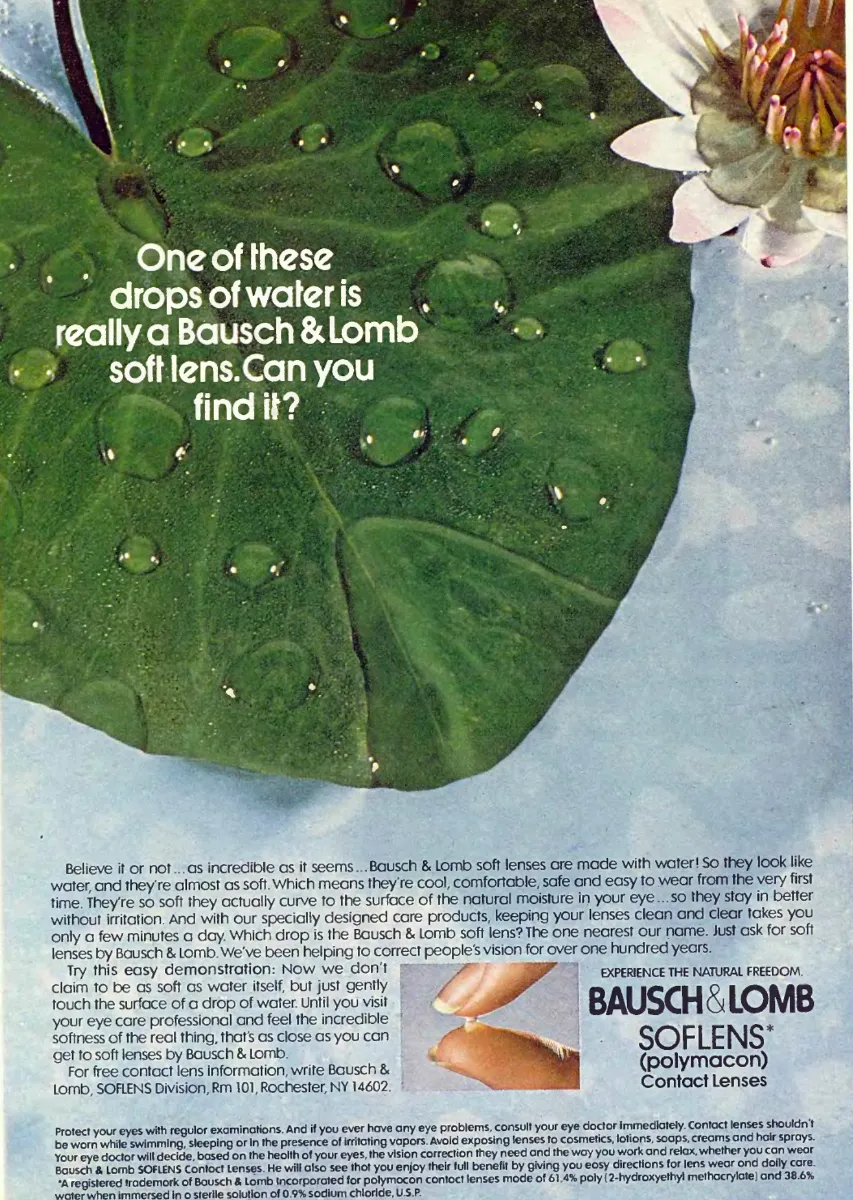
One of these drops of water is really a Bausch & Lomb soft lens. Can you find it?
FROM THE PRINTED PAGEOriginal ad copy
OCR transcription from the archived page. Scanning and reading-order errors may remain.
One of these drops of water is really a Bausch & Lomb soft lens. Can you find it? Believe it or not ... as incredible as it seems ... Bausch & Lomb soft lenses are made with water! So they look like water, and they're almost as soft. Which means they're cool, comfortable, safe and easy to wear from the very first time. They're so soft they actually curve to the surface of the natural moisture in your eye ... so they stay in better without irritation. And with our specially designed care products, keeping your lenses clean and clear takes you only a few minutes a day. Which drop is the Bausch & Lomb soft lens? The one nearest our name. Just ask for soft lenses by Bausch & Lomb. We've been helping to correct people's vision for over one hundred years. Try this easy demonstration: Now we don't claim to be as soft as water itself, but just gently touch the surface of a drop of water. Until you visit your eye care professional and feel the incredible softness of the real thing, that's as close as you can get to soft lenses by Bausch & Lomb. For free contact lens information, write Bausch & Lomb, SOFLENS Division, Rm 101, Rochester, NY 14602. EXPERIENCE THE NATURAL FREEDOM. BAUSCH & LOMB SOFLENS* (polymacon) Contact Lenses Protect your eyes with regular examinations. And if you ever have any eye problems, consult your eye doctor immediately. Contact lenses shouldn't be worn while swimming, sleeping or in the presence of irritating vapors. Avoid exposing lenses to cosmetics, lotions, soaps, creams and hair sprays. Your eye doctor will decide, based on the health of your eyes, the vision correction they need and the way you work and relax, whether you can wear Bausch & Lomb SOFLENS Contact Lenses. He will also see that you enjoy their full benefit by giving you easy directions for lens wear and daily care. *A registered trademark of Bausch & Lomb Incorporated for polymacon contact lenses made of 61.4% poly (2-hydroxyethyl methacrylate) and 38.6% water when immersed in a sterile solution of 0.9% sodium chloride, U.S.P.
Commentary
At first the page looks like a nature photograph: beads of water on a green leaf, a pale flower at the edge. The headline turns looking into a test. One drop is actually a soft contact lens, and the reader is asked to find it. The answer comes much later—“the one nearest our name”—after the picture has already made similarity to water feel plausible. The lens is sold by disappearing into its surroundings.
The body copy turns the visual trick into a comfort claim. It says the lenses are made with water, are almost as soft as water, and conform to moisture on the eye. A small photograph of fingertips and a drop offers a tactile substitute for trying a lens. The ad also promises easy care, then grounds its promise in a substantial caution block: regular examinations, restrictions on wearing lenses while swimming or sleeping, and an eye doctor’s role in deciding suitability. Those are statements from this 1980 advertisement, not current wear instructions. The fine print is part of the persuasion because it locates an intimate product within professional supervision.
The path to purchase is visible too. The reader can write to a Rochester address for free information, then visit an eye-care professional. The photograph courts curiosity; the care copy and address turn it into a slower, supervised decision. Today product information is much easier to retrieve, but a contact lens still has to fit a particular eye and care routine. The page’s tension between effortless feeling and careful use remains instructive.
For a new copywriter, “Can you find it?” is doing more than posing a puzzle. It makes the reader spend time looking for evidence of the promised softness. Repeated “water” connects headline, photograph, body copy and material specification. The answer is delayed until the product explanation has begun, so the reveal feels earned. The practical lesson is to make a visual demonstration carry one clear claim, then give the reader the qualifications that claim needs.
Bausch + Lomb’s history traces the company to an 1853 optical shop and its later work in contact lenses. It still sells SofLens contact lenses alongside other eye-care products.
Comfort and natural-feeling wear remain relevant promises for a lens. This ad’s exact material description, postal inquiry route and 1980 care wording belong to the historical product and should not be treated as directions for a current lens.