Electronics 1981
Sony
Come in, Planet Earth.
FROM THE PRINTED PAGEOriginal ad copy
OCR transcription from the archived page. Scanning and reading-order errors may remain.
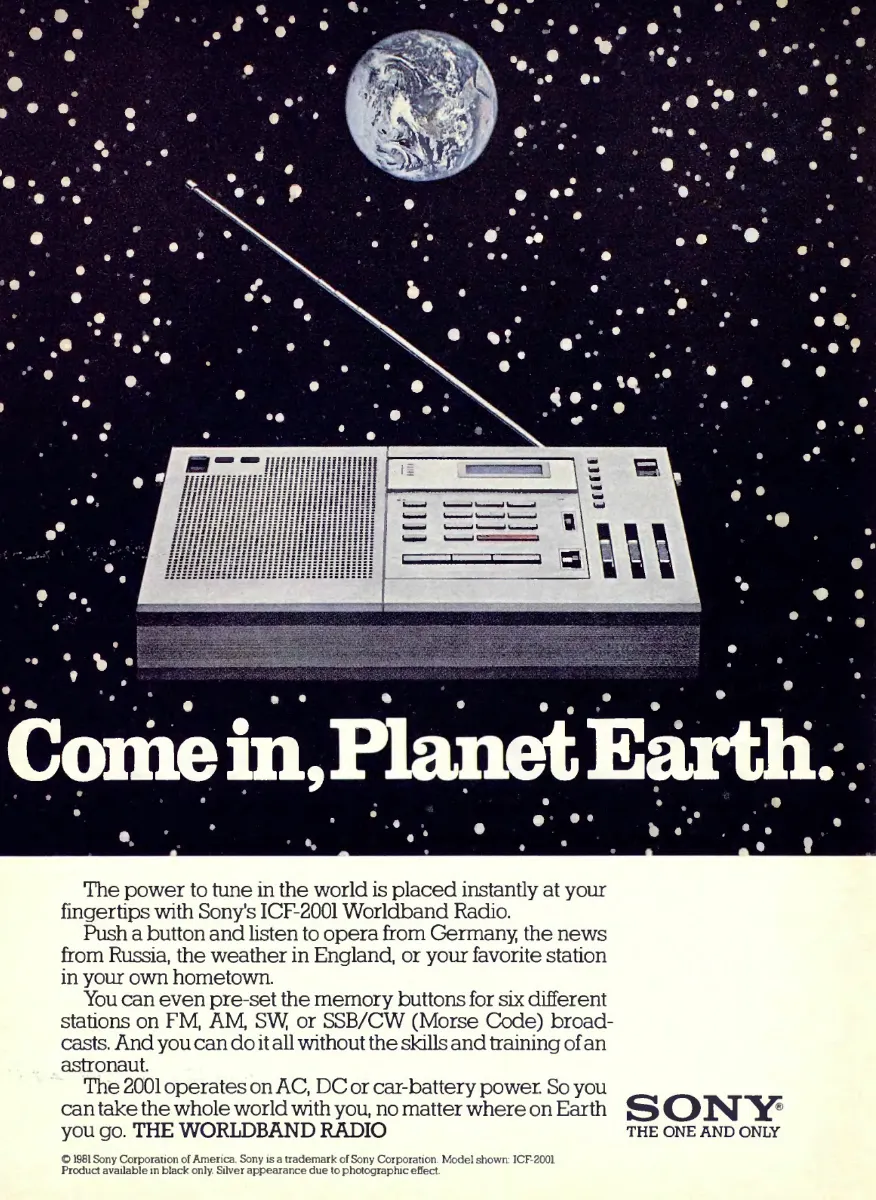
Come in, Planet Earth. The power to tune in the world is placed instantly at your fingertips with Sony’s ICF-2001 Worldband Radio. Push a button and listen to opera from Germany, the news from Russia, the weather in England, or your favorite station in your own hometown. You can even pre-set the memory buttons for six different stations on FM, AM, SW, or SSB/CW (Morse Code) broadcasts. And you can do it all without the skills and training of an astronaut. The 2001 operates on AC, DC or car-battery power. So you can take the whole world with you, no matter where on Earth you go. THE WORLDBAND RADIO SONY® THE ONE AND ONLY ©1981 Sony Corporation of America. Sony is a trademark of Sony Corporation. Model shown: ICF-2001 Product available in black only. Silver appearance due to photographic effect.
Commentary
I looked at the Earth before the radio and found myself occupying the astronaut’s position. The planet hangs above a star field; below it, the receiver’s long antenna stretches diagonally through space. “Come in, Planet Earth” makes the reader the one calling home. Sony reverses the scale of an ordinary listening activity so that finding a station becomes contact with a world.
The body brings that cosmic invitation down to six memory buttons. Opera from Germany, news from Russia, weather in England, and the hometown station make the capability imaginable through different kinds of listening. The list of FM, AM, SW, and SSB/CW then gives the fantasy a technical inventory. AC, DC, and car-battery operation extend it into movement: the owner can take the means of access along. The machine offers reception; the space scene supplies the feeling of reach.
One footnote prevents the photograph from becoming an inaccurate product description. The set was available in black only; the silver appearance is attributed to a photographic effect. I read that qualification as part of the page’s workings. A dramatically lit object can support a visual fiction while the sales copy must still identify what arrives in the box.
The international itinerary reflects an information habit whose mechanics have changed. To hear a place, the owner finds a broadcast, learns its schedule, and deals with reception. A networked listener may instead search a station name and start a stream. Both promise access beyond one’s locality; Sony’s page makes the acquisition of that access feel like acquiring a scientific instrument, then insists that ordinary fingers can operate it.
For young copywriters, “Come in” is effective because it belongs to radio speech and to the astronaut scene at once. The body repeats the idea of easy control through “fingertips,” “Push a button,” and “without the skills and training.” Each phrase answers the intimidation created by the elaborate photograph and band names. The practical lesson is to let ambitious imagery establish the benefit while simple verbs explain how the customer reaches it.
Sony’s history dates its foundation to 1946. The group now spans electronics and entertainment through its business portfolio; its ICF-2001 support page preserves documentation for this historical receiver.
The persistent promise is a larger listening world made manageable. Six presets, the stated power options, and the radio’s band coverage belong to this model. The continuing creative lesson is the marriage of extraordinary reach with an ordinary action: press a button and listen.