Electronics 1981
Panasonic
Panasonic Stereo-to-Go: More ways than anyone to fill the room inside your head.
FROM THE PRINTED PAGEOriginal ad copy
OCR transcription from the archived page. Scanning and reading-order errors may remain.
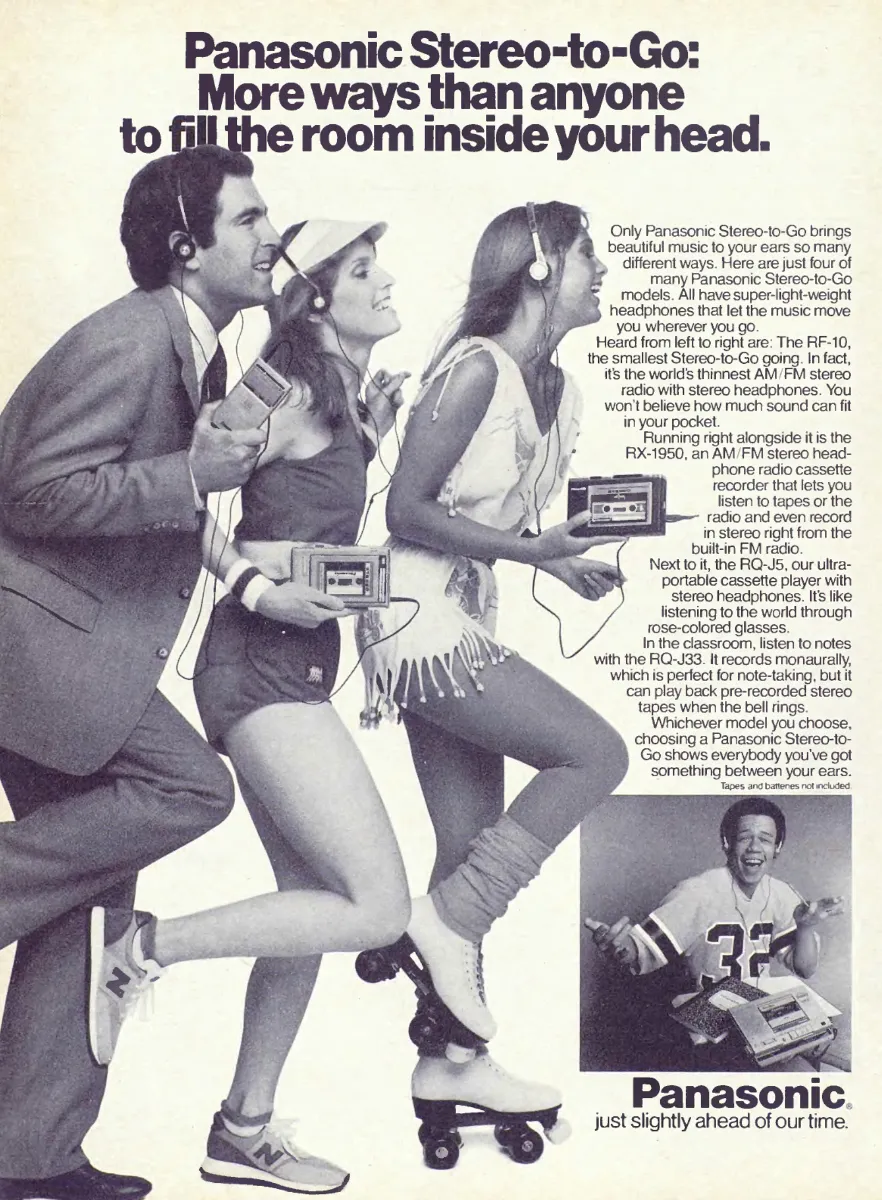
Panasonic Stereo-to-Go: More ways than anyone to fill the room inside your head. Only Panasonic Stereo-to-Go brings beautiful music to your ears so many different ways. Here are just four of many Panasonic Stereo-to-Go models. All have super-light-weight headphones that let the music move you wherever you go. Heard from left to right are: The RF-10, the smallest Stereo-to-Go going. In fact, it’s the world’s thinnest AM/FM stereo radio with stereo headphones. You won’t believe how much sound can fit in your pocket. Running right alongside it is the RX-1950, an AM/FM stereo headphone radio cassette recorder that lets you listen to tapes or the radio and even record in stereo right from the built-in FM radio. Next to it, the RQ-J5, our ultra-portable cassette player with stereo headphones. It’s like listening to the world through rose-colored glasses. In the classroom, listen to notes with the RQ-J33. It records monaurally, which is perfect for note-taking, but it can play back pre-recorded stereo tapes when the bell rings. Whichever model you choose, choosing a Panasonic Stereo-to-Go shows everybody you’ve got something between your ears. Tapes and batteries not included. Panasonic® just slightly ahead of our time.
Commentary
I started with the man in the suit. He is moving in the same direction as a runner in shorts and a woman on roller skates, all three wearing headphones and carrying small machines. The business clothes make him the useful anomaly. Panasonic wants personal stereo to fit several kinds of day, rather than belong exclusively to sport. The classroom inset adds a fourth occasion without interrupting the forward movement of the main photograph.
The text is a guided tour of that range, introduced as “Heard from left to right.” The RF-10 supplies radio in a pocket; the RX-1950 adds cassette playback and recording from FM; the RQ-J5 offers portable cassette listening; the RQ-J33 records notes in mono but plays prerecorded tapes in stereo. That last distinction prevents the family portrait from dissolving into a vague claim that every machine does everything. Choice is the argument, and the different uses are its evidence. The superlatives about thinness and range remain Panasonic’s claims in this ad.
“The room inside your head” gives the equipment a more interesting destination than the pocket. A private listening space can travel with the body. Yet the closing line makes that interior experience publicly legible: choosing one supposedly shows everyone that the owner has “something between your ears.” I read the models’ conspicuous headphones and hand-carried players as part of that tension. Music is private; the adoption of the new listening habit is visible.
The classroom example records another expectation. A student might use the same portable object for recording a lecture and listening after the bell. A phone can now combine those tasks with many others, but the ad has to explain the combination carefully, including the difference between mono recording and stereo playback. Convenience was being assembled one specific capability at a time.
For young copywriters, “fill the room” turns an abstract experience into a spatial image. “Heard from left to right” adapts the language of a picture caption to an audio product, while “Running right alongside” links the model list to the moving bodies. The lesson is to let the words navigate the photograph and explain the range at the same time.
Panasonic traces its foundation to Konosuke Matsushita in 1918. Its present business portfolio includes consumer electronics alongside professional systems and energy products.
The continuing promise is fitting music around a person’s activities. The cassette mechanisms, wired headphones, and four-model buying decision belong to 1981. The durable strategy is to make technical variety meaningful through recognizable occasions of use.