Electronics 1972
Sony
Beware of good looking stereos.
FROM THE PRINTED PAGEOriginal ad copy
OCR transcription from the archived page. Scanning and reading-order errors may remain.
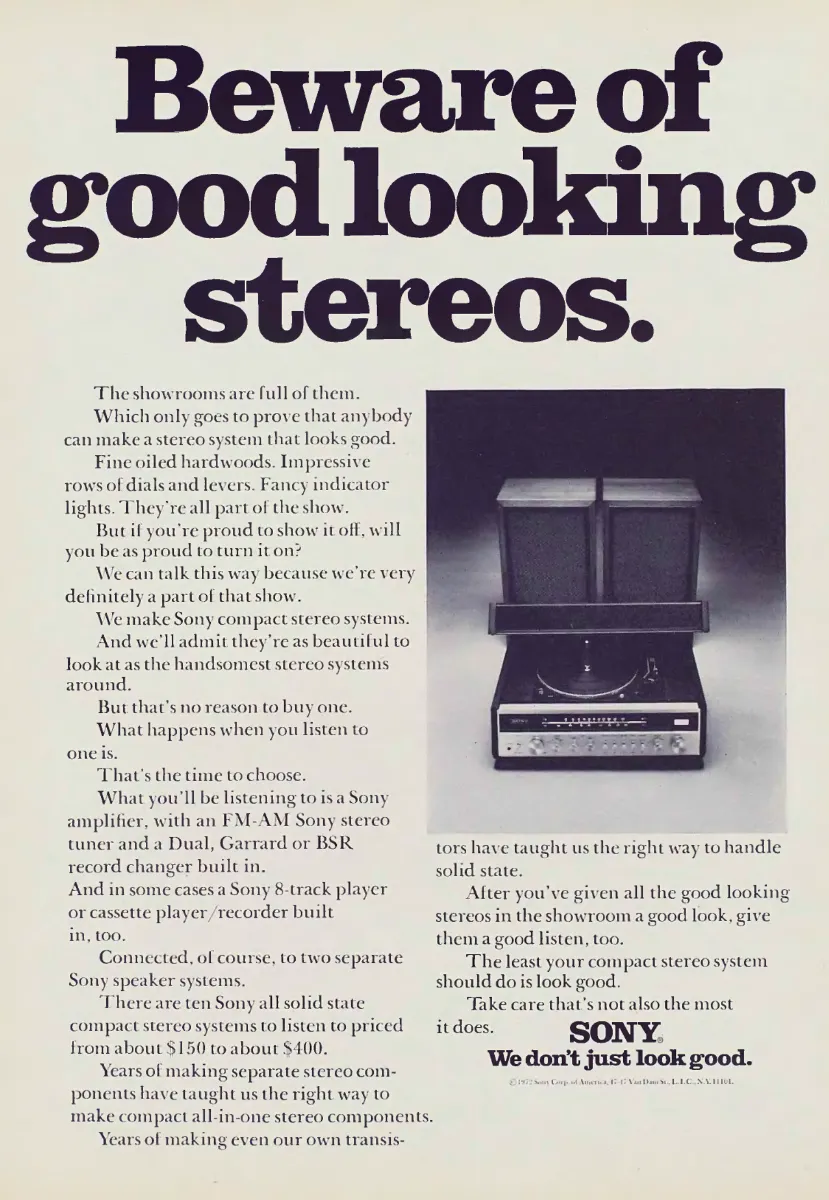
Beware of good looking stereos. The showrooms are full of them. Which only goes to prove that anybody can make a stereo system that looks good. Fine oiled hardwoods. Impressive rows of dials and levers. Fancy indicator lights. They're all part of the show. But if you're proud to show it off, will you be as proud to turn it on? We can talk this way because we're very definitely a part of that show. We make Sony compact stereo systems. And we'll admit they're as beautiful to look at as the handsomest stereo systems around. But that's no reason to buy one. What happens when you listen to one is. That's the time to choose. What you'll be listening to is a Sony amplifier, with an FM-AM Sony stereo tuner and a Dual, Garrard or BSR record changer built in. And in some cases a Sony 8-track player or cassette player/recorder built in, too. Connected, of course, to two separate Sony speaker systems. There are ten Sony all solid state compact stereo systems to listen to priced from about $150 to about $400. Years of making separate stereo components have taught us the right way to make compact all-in-one stereo components. Years of making even our own transistors have taught us the right way to handle solid state. After you've given all the good looking stereos in the showroom a good look, give them a good listen, too. The least your compact stereo system should do is look good. Take care that's not also the most it does. SONY We don't just look good. ©1972 Sony Corp. of America, 47-47 Van Dam St., L.I.C., N.Y. 11101.
Commentary
I looked at the stereo after reading the warning, which is precisely the uncomfortable sequence Sony has arranged. The enormous headline makes attractive equipment sound suspect. Then the photograph offers an attractive example: two orderly speaker cabinets above a compact unit with its lid raised. The advertisement has implicated its own image before making its defence.
That admission is the hinge. Sony concedes that it belongs to the showroom’s visual performance, then asks whether the pleasure of showing a system off survives switching it on. The proof shifts inward, to amplifier, tuner, record changer and transistor experience. Naming Dual, Garrard and BSR also makes the product less mysterious: the compact cabinet contains recognisable functional parts, rather than merely a handsome face.
The range of roughly $150 to $400 and ten systems gives the reader room to shop without abandoning the principle. What is missing is an actual sonic demonstration. Print cannot supply one, so the page tries to change the reader’s behaviour in the showroom. That limitation is productive: the call to action becomes listening. In a shopping environment where a product can arrive after being seen only on a screen, the distinction between visual confidence and tested experience remains useful.
For new copywriters, the final contrast between “least” and “most” is especially economical. The wording grants good looks as a minimum, then warns against treating them as the whole offer. Earlier, the fragments about hardwoods, dials and lights imitate a quick tour of surfaces. The lesson is to concede an appealing attribute before explaining why it is insufficient; that makes the argument less brittle than simply dismissing what buyers like.
Sony’s corporate history begins in 1946 and includes early tape recorders and transistor radios. Its present businesses span entertainment, electronics and imaging technology. The appeal to component experience therefore has a documented company background, without proving the ad’s claims for every pictured system.
Record changers and optional 8-track players locate this particular offer in its period. The larger buying principle survives: appearance can invite attention, but the product’s intended use must justify the purchase. Sony makes that principle memorable by putting its own good-looking machine under suspicion first.