Electronics 1972
GTE Sylvania
Don't spend $1000 until you hear $760.
FROM THE PRINTED PAGEOriginal ad copy
OCR transcription from the archived page. Scanning and reading-order errors may remain.
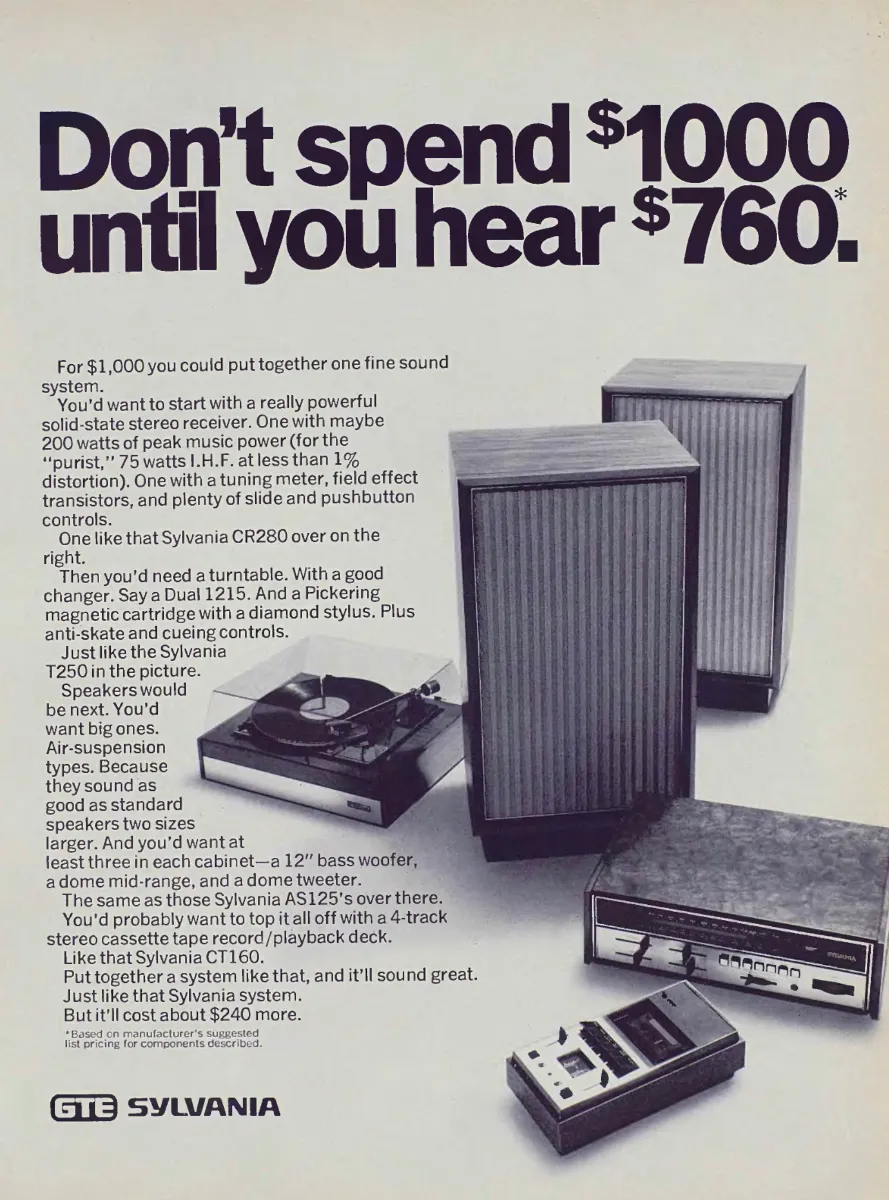
Don't spend $1000 until you hear $760.* For $1,000 you could put together one fine sound system. You'd want to start with a really powerful solid-state stereo receiver. One with maybe 200 watts of peak music power (for the “purist,” 75 watts I.H.F. at less than 1% distortion). One with a tuning meter, field effect transistors, and plenty of slide and pushbutton controls. One like that Sylvania CR280 over on the right. Then you'd need a turntable. With a good changer. Say a Dual 1215. And a Pickering magnetic cartridge with a diamond stylus. Plus anti-skate and cueing controls. Just like the Sylvania T250 in the picture. Speakers would be next. You'd want big ones. Air-suspension types. Because they sound as good as standard speakers two sizes larger. And you'd want at least three in each cabinet—a 12” bass woofer, a dome mid-range, and a dome tweeter. The same as those Sylvania AS125's over there. You'd probably want to top it all off with a 4-track stereo cassette tape record/playback deck. Like that Sylvania CT160. Put together a system like that, and it'll sound great. Just like that Sylvania system. But it'll cost about $240 more. *Based on manufacturer's suggested list pricing for components described. GTE SYLVANIA
Commentary
I read the price before I looked at the equipment. The headline makes that unavoidable, but its verb immediately changes the task: the smaller amount is something to “hear.” Below it, a receiver, turntable, tape deck and two substantial speakers occupy the page like pieces waiting to be installed. The savings are given weight and dimensions before the copy explains them.
The writer builds an imaginary thousand-dollar system one component at a time. Each desirable specification is followed by a quiet revelation that Sylvania already supplies it. Dual and Pickering names add recognisable specialist parts to the argument, while the speaker description distinguishes the woofer, mid-range and tweeter. This is an education in what to ask for, arranged so that every answer points back to the photograph.
The price comparison has limits worth keeping visible. The footnote bases it on suggested list pricing for the described components; no rival system is identified. Likewise, the two power figures are presented under different measurement labels. I would read the page as a guided value claim, not as evidence that any thousand-dollar combination must sound identical. Its persuasion depends on the reader accepting the proposed specification list as the right shopping list.
For beginning copywriters, the repeated “like,” “just like” and “the same as” provide the rhythm. The reader is allowed to imagine choosing independently, then shown that the desired object is already present. “Hear $760” compresses price and experience into two words. The useful lesson is to let a repeated sentence pattern carry a complex comparison, while keeping its qualifications legible.
LEDVANCE’s Sylvania history records the 1959 merger with General Telephone and the later separation of the North American lighting business from GTE. The name continues in lighting, including today’s Sylvania Group; this should not be read as continuity of the particular stereo manufacturer or system pictured here.
The page assumes that a household might assemble listening around several substantial boxes and audition them before buying. Today’s interfaces and formats can alter that ritual, but the question persists: which specifications buy an experience someone can actually notice? Sylvania’s answer is to put the listening invitation before the saving.