Electronics 1980
Sears
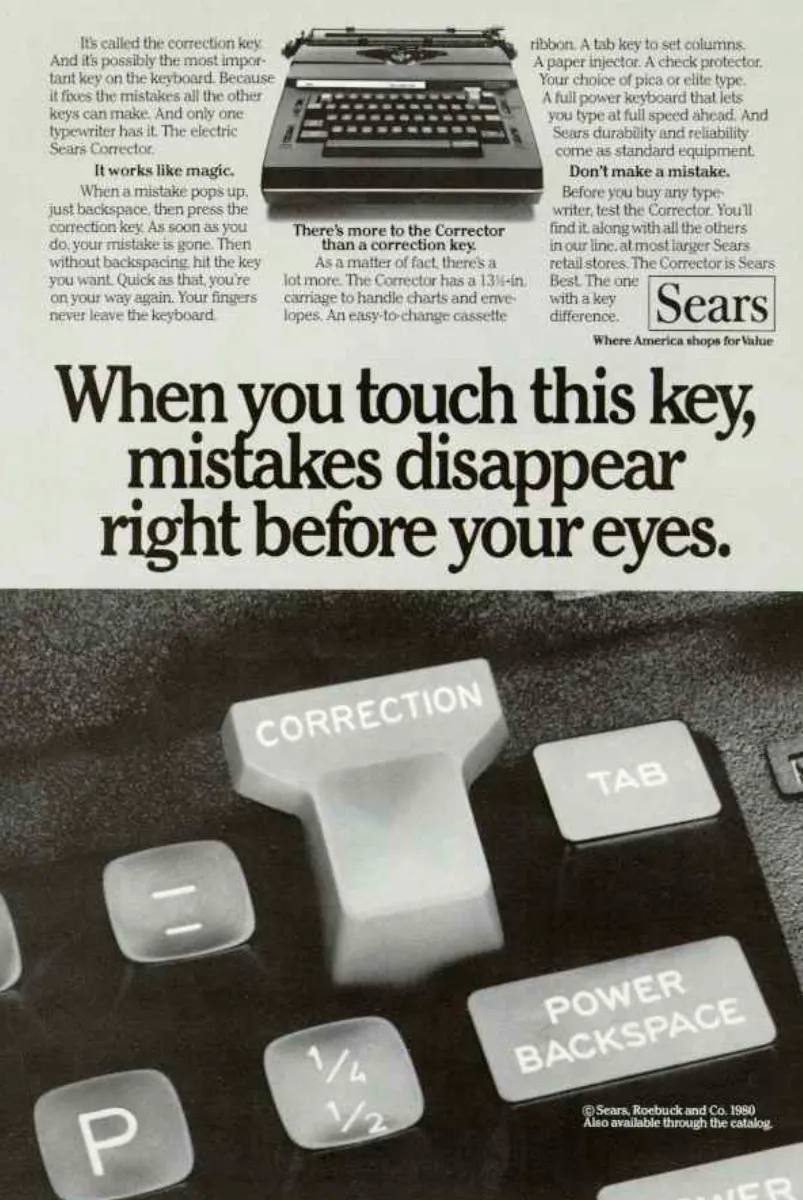
When you touch this key, mistakes disappear right before your eyes.
FROM THE PRINTED PAGEOriginal ad copy
OCR transcription from the archived page. Scanning and reading-order errors may remain.
It's called the correction key. And it's possibly the most important key on the keyboard. Because it fixes the mistakes all the other keys can make. And only one typewriter has it. The electric Sears Corrector. It works like magic. When a mistake pops up, just backspace, then press the correction key. As soon as you do, your mistake is gone. Then without backspacing, hit the key you want. Quick as that, you're on your way again. Your fingers never leave the keyboard. There's more to the Corrector than a correction key. As a matter of fact, there's a lot more. The Corrector has a 13¼-in. carriage to handle charts and envelopes. An easy-to-change cassette ribbon. A tab key to set columns. A paper injector. A check protector. Your choice of pica or elite type. A full power keyboard that lets you type at full speed ahead. And Sears durability and reliability come as standard equipment. Don't make a mistake. Before you buy any typewriter, test the Corrector. You'll find it, along with all the others in our line, at most larger Sears retail stores. The Corrector is Sears Best. The one with a key difference. Sears Where America shops for Value When you touch this key, mistakes disappear right before your eyes. CORRECTION TAB — _ P ¼ ½ POWER BACKSPACE ©Sears, Roebuck and Co. 1980 Also available through the catalog.
Commentary
I went looking for the machine and found a single key occupying most of the lower photograph. The complete typewriter is much smaller, tucked into the copy above. Sears has reversed the usual hierarchy of the product portrait: the whole machine establishes what is for sale, while one enlarged control explains why anyone should care.
The correction key is also an admission. The typist will make mistakes. Rather than praising flawless performance, the opening argues that the most important key may be the one that repairs what every other key can get wrong. The operating sequence is unusually useful advertising copy: backspace, press correction, type the intended character. “Your fingers never leave the keyboard” makes the benefit a continuity of work, not simply a cleaner sheet.
Only after that demonstration does the page introduce carriage width, ribbon changes, column setting and type styles. Those details make the machine look capable without displacing the central relief. The invitation to test it at a larger Sears store gives the disappearance a place to be witnessed; the small catalog line offers another route to purchase. This is a feature presented as something the customer can verify.
The oversized key makes a familiar digital action look newly physical. In a word processor, text can be revised before it reaches paper. Here the mistake has already become a mark, and the machine must undo it. That difference helps explain the emotional force of a modest control: revision is being sold as permission to continue rather than start over.
For new copywriters, notice how “Don’t make a mistake” shifts meaning. After several paragraphs about typing errors, it becomes advice about choosing a typewriter. “A key difference” closes the same loop through a literal part of the product. The practical lesson is to earn a double meaning through demonstration first; the phrase then recalls the benefit instead of merely decorating it.
The Library of Congress traces Sears’s mail-order origins to 1886. Sears now describes its business as primarily online retail under TransformCo, including appliances, home goods and marketplace merchandise.
The catalog and typewriter belong to an earlier buying and working routine. The underlying promise still has force: a useful tool should make recovery from an ordinary error quick enough that the user can keep thinking about the work.