Electronics 1987
Blaupunkt
A car stereo designed for people with ears. And something between them.
FROM THE PRINTED PAGEOriginal ad copy
OCR transcription from the archived page. Scanning and reading-order errors may remain.
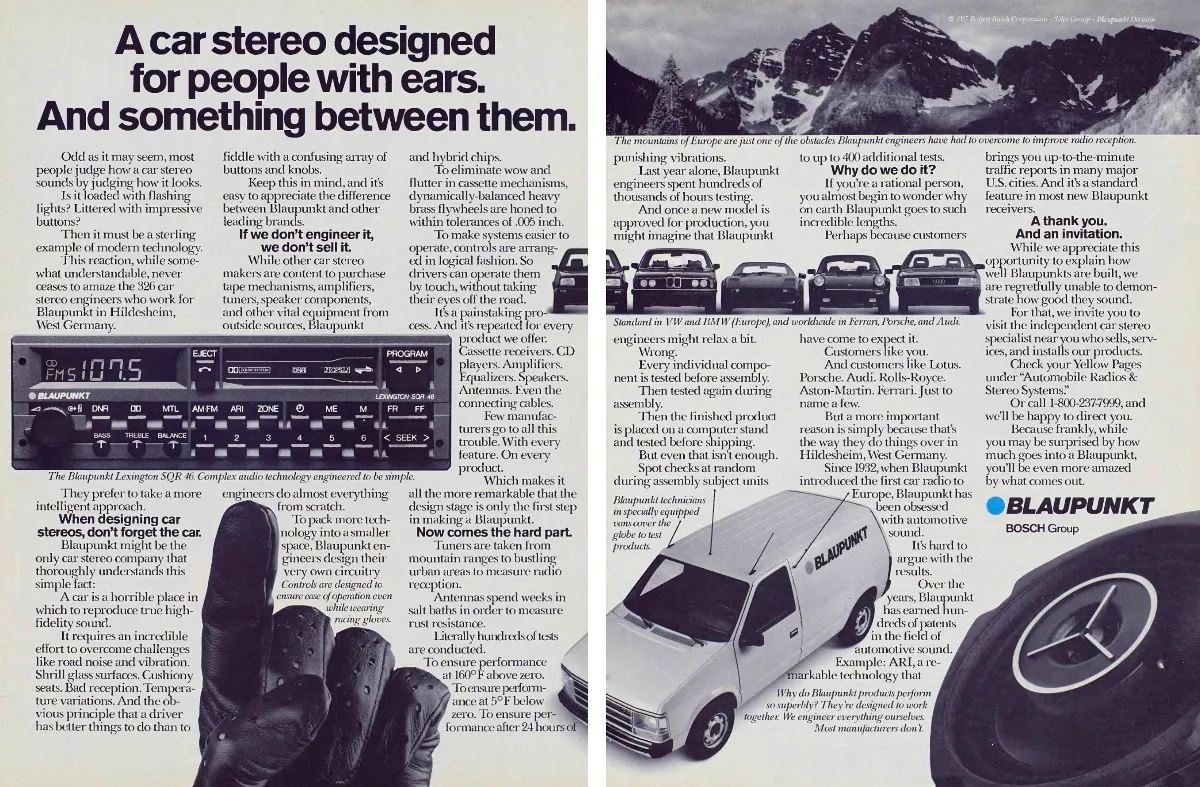
A car stereo designed for people with ears. And something between them. Odd as it may seem, most people judge how a car stereo sounds by judging how it looks. Is it loaded with flashing lights? Littered with impressive buttons? Then it must be a sterling example of modern technology. This reaction, while somewhat understandable, never ceases to amaze the 326 car stereo engineers who work for Blaupunkt in Hildesheim, West Germany. They prefer to take a more intelligent approach. When designing car stereos, don't forget the car. Blaupunkt might be the only car stereo company that thoroughly understands this simple fact: A car is a horrible place in which to reproduce true high-fidelity sound. It requires an incredible effort to overcome challenges like road noise and vibration. Shrill glass surfaces. Cushiony seats. Bad reception. Temperature variations. And the obvious principle that a driver has better things to do than to fiddle with a confusing array of buttons and knobs. Keep this in mind, and it's easy to appreciate the difference between Blaupunkt and other leading brands. If we don't engineer it, we don't sell it. While other car stereo makers are content to purchase tape mechanisms, amplifiers, tuners, speaker components, and other vital equipment from outside sources, Blaupunkt engineers do almost everything from scratch. To pack more technology into a smaller space, Blaupunkt engineers design their very own circuitry and hybrid chips. To eliminate wow and flutter in cassette mechanisms, dynamically-balanced heavy brass flywheels are honed to within tolerances of .005 inch. To make systems easier to operate, controls are arranged in logical fashion. So drivers can operate them by touch, without taking their eyes off the road. It's a painstaking process. And it's repeated for every product we offer. Cassette receivers. CD players. Amplifiers. Equalizers. Speakers. Antennas. Even the connecting cables. Few manufacturers go to all this trouble. With every feature. On every product. Which makes it all the more remarkable that the design stage is only the first step in making a Blaupunkt. Now comes the hard part. Tuners are taken from mountain ranges to bustling urban areas to measure radio reception. Antennas spend weeks in salt baths in order to measure rust resistance. Literally hundreds of tests are conducted. To ensure performance at 160°F above zero. To ensure performance at 5°F below zero. To ensure performance after 24 hours of punishing vibrations. Last year alone, Blaupunkt engineers spent hundreds of thousands of hours testing. And once a new model is approved for production, you might imagine that Blaupunkt engineers might relax a bit. Wrong. Every individual component is tested before assembly. Then tested again during assembly. Then the finished product is placed on a computer stand and tested before shipping. But even that isn't enough. Spot checks at random during assembly subject units to up to 400 additional tests. Why do we do it? If you're a rational person, you almost begin to wonder why on earth Blaupunkt goes to such incredible lengths. Perhaps because customers have come to expect it. Customers like you. And customers like Lotus. Porsche. Audi. Rolls-Royce. Aston-Martin. Ferrari. Just to name a few. But a more important reason is simply because that's the way they do things over in Hildesheim, West Germany. Since 1932, when Blaupunkt introduced the first car radio to Europe, Blaupunkt has been obsessed with automotive sound. It's hard to argue with the results. Over the years, Blaupunkt has earned hundreds of patents in the field of automotive sound. Example: ARI, a remarkable technology that brings you up-to-the-minute traffic reports in many major U.S. cities. And it's a standard feature in most new Blaupunkt receivers. A thank you. And an invitation. While we appreciate this opportunity to explain how well Blaupunkts are built, we are regretfully unable to demonstrate how good they sound. For that, we invite you to visit the independent car stereo specialist near you who sells, services, and installs our products. Check your Yellow Pages under “Automobile Radios & Stereo Systems.” Or call 1-800-237-7999, and we'll be happy to direct you. Because frankly, while you may be surprised by how much goes into a Blaupunkt, you'll be even more amazed by what comes out. The Blaupunkt Lexington SQR 46. Complex audio technology engineered to be simple. Controls are designed to ensure ease of operation even while wearing racing gloves. The mountains of Europe are just one of the obstacles Blaupunkt engineers have had to overcome to improve radio reception. Standard in VW and BMW (Europe), and worldwide in Ferrari, Porsche, and Audi. Blaupunkt technicians in specially equipped vans cover the globe to test products. Why do Blaupunkt products perform so superbly? They're designed to work together. We engineer everything ourselves. Most manufacturers don't. FM 107.5 EJECT PROGRAM BLAUPUNKT LEXINGTON SQR 48 ON • FM • ON • MTL • AM-FM • ARI • ZONE • ME • M • FR • FF BASS • TREBLE • BALANCE 1 • 2 • 3 • 4 • 5 • 6 • SEEK BLAUPUNKT BOSCH Group © 1987 Robert Bosch Corporation · Sales Group · Blaupunkt Division
Commentary
I began with the racing gloves. They seem an odd ornament for a car-stereo advertisement until the nearby caption explains that the controls can be operated while wearing them. Suddenly the mountains, test van and crowded dashboard unit become parts of the same argument. Blaupunkt wants the reader to judge a stereo in the circumstances where it will actually be used.
The headline flatters our intelligence by insulting a different buyer: the person impressed by lights and buttons. But the spread must then earn its own attention. It supplies 326 engineers, a named German town, brass flywheels with .005-inch tolerances, salt baths and temperature tests. These are the advertiser’s assertions, not measurements I can verify from the photograph. Their rhetorical purpose is clear: turn invisible work into visible reasons for paying attention. The page makes engineering feel almost exhausting before suggesting that this is precisely the point.
There is an interesting contradiction in the display. The pictured receiver has plenty of buttons, despite the complaint about impressive buttons. The distinction the copy needs is therefore between display for its own sake and controls arranged for use. “Without taking their eyes off the road” supplies the human consequence. The gloves do more explanatory work than another superlative could.
Near the end, this very talkative ad concedes that print cannot demonstrate sound. It directs the reader to a specialist through the Yellow Pages or a telephone number. Buying requires a local encounter: someone will demonstrate, install and service the equipment. Against today’s searchable specifications and online demonstrations, that admission records a sales model built around the shop’s ears as well as the buyer’s.
For new copywriters, study how the long argument renews itself. “Now comes the hard part” makes completed engineering merely a prelude to testing. “Wrong” interrupts an imagined conclusion. The final contrast between what “goes into” the product and what “comes out” translates the entire inventory of effort back into sound. Each turn gives the next column a reason to exist; length needs that sequence of renewed questions and answers.
Blaupunkt’s licensing history traces the brand to Berlin in 1924. The Bosch identification in this scan belongs to its earlier industrial organisation. Today the licensing programme assigns product design, manufacturing, distribution and sales to independent partners across defined categories and territories.
Ease of operation and credible testing remain useful promises. The ad’s insistence that “we engineer everything ourselves” cannot simply be carried over to today’s licensed brand structure. That change makes this spread especially instructive: the meaning of a familiar badge can shift even when its visual identity continues to suggest the same assurance.