Electronics 1987
Sony
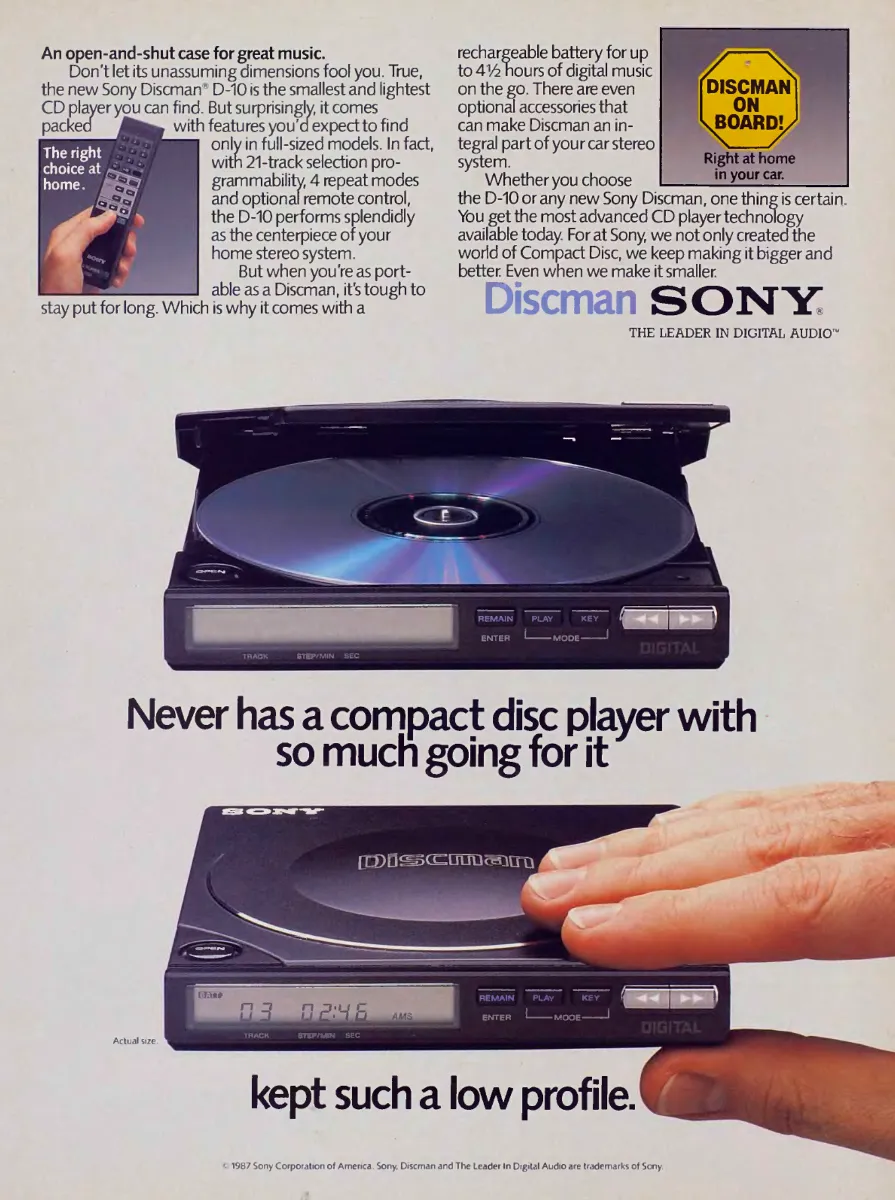
Never has a compact disc player with so much going for it kept such a low profile.
FROM THE PRINTED PAGEOriginal ad copy
OCR transcription from the archived page. Scanning and reading-order errors may remain.
An open-and-shut case for great music. Don't let its unassuming dimensions fool you. True, the new Sony Discman® D-10 is the smallest and lightest CD player you can find. But surprisingly, it comes packed with features you'd expect to find only in full-sized models. In fact, with 21-track selection programmability, 4 repeat modes and optional remote control, the D-10 performs splendidly as the centerpiece of your home stereo system. But when you're as portable as a Discman, it's tough to stay put for long. Which is why it comes with a rechargeable battery for up to 4½ hours of digital music on the go. There are even optional accessories that can make Discman an integral part of your car stereo system. Whether you choose the D-10 or any new Sony Discman, one thing is certain. You get the most advanced CD player technology available today. For at Sony, we not only created the world of Compact Disc, we keep making it bigger and better. Even when we make it smaller. The right choice at home. DISCMAN ON BOARD! Right at home in your car. Discman SONY® THE LEADER IN DIGITAL AUDIO™ OPEN REMAIN • PLAY • KEY ENTER • MODE TRACK • STEP/MIN • SEC DIGITAL Never has a compact disc player with so much going for it SONY Discman 03 02:46 AMS REMAIN • PLAY • KEY ENTER • MODE TRACK • STEP/MIN • SEC DIGITAL Actual size. kept such a low profile. © 1987 Sony Corporation of America. Sony, Discman and The Leader In Digital Audio are trademarks of Sony.
Commentary
I read the headline in two instalments because Sony has put the proof between them. First comes the claim that this player has much going for it; then a hand closes around the thin black machine; only below does “kept such a low profile” complete the sentence. The page makes its reader perform the comparison. There is no need to translate millimetres into an imagined object when fingers provide the scale.
The open player above serves another purpose. Its disc shows how little room the mechanism seems to need beyond the medium itself. Yet the copy anticipates a suspicion that small means compromised. It answers with 21-track programming, four repeat modes, an optional remote and a rechargeable battery promising up to four and a half hours. The small car sign and remote photograph extend the machine into three settings: home, travel and car. Accessories are optional; the freedom is being sold with conditions.
That miniaturisation was part of an established project. Sony’s history of digital audio describes the earlier D-50’s 1984 development around a wooden model roughly the size of four CD cases. The D-10 advertisement continues that habit of making size understandable through objects. The same history credits joint CD development with Philips, a useful qualification beside this ad’s expansive claim to have created the world of Compact Disc.
The hand also dates an assumption about convenience. Music travels here because its dedicated machine and a chosen disc travel together. A phone listener can carry a much larger selection without carrying the discs, but still knows the negotiation between dimensions, features and battery life. What has changed most is the amount of music expected to fit inside the gesture.
For a young copywriter, the language lesson is unusually visible. “Open-and-shut case” describes both an easily won argument and the hinged object. “Low profile” links modest appearance to physical thinness. Finally, “bigger and better” meets “smaller,” converting a familiar growth cliché into a product-specific contrast. These jokes work because the photographs verify their literal meanings. Start with a demonstrable feature, then find the phrase it can make newly concrete.
Sony helped establish both home and portable CD playback and continues to sell personal audio. Its current headphones range includes wireless and noise-cancelling models; the company behind the old Discman remains active in shaping how people listen outside a fixed stereo system.
The promise of capable technology in a manageable object still resonates. What no longer carries the same novelty is four and a half hours of playback or programmable access to 21 tracks. The ad endures as a study in showing reduced bulk without making the product seem diminished.