Consumer Goods 1987
Jack Daniel's
At Jack Daniel's Distillery we're a hard-working bunch who believe in doing a job right.
FROM THE PRINTED PAGEOriginal ad copy
OCR transcription from the archived page. Scanning and reading-order errors may remain.
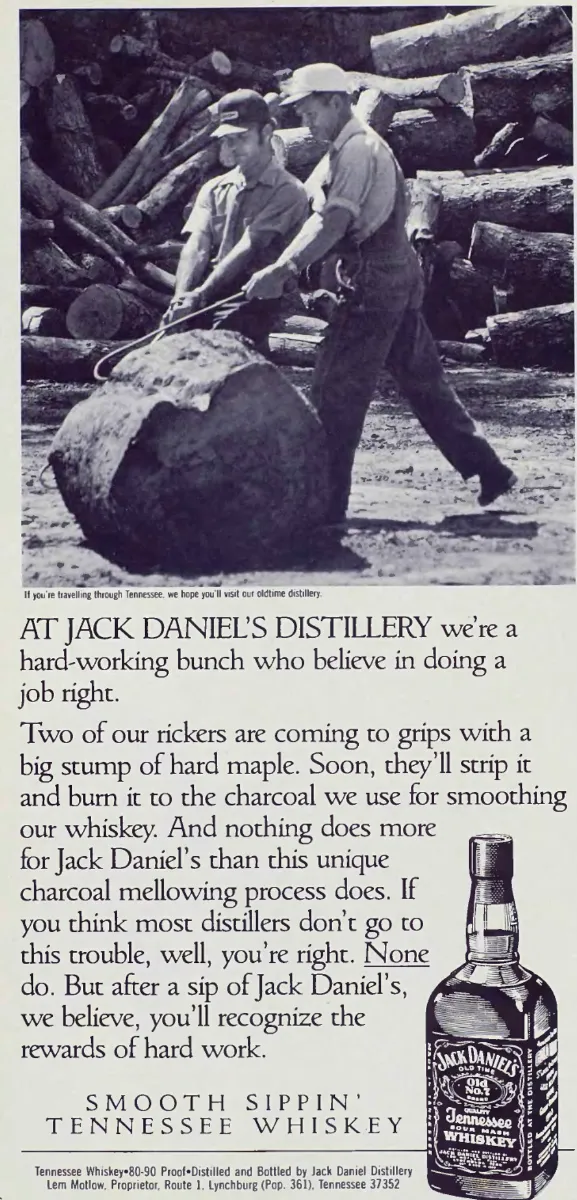
If you're travelling through Tennessee, we hope you'll visit our oldtime distillery. AT JACK DANIEL'S DISTILLERY we're a hard-working bunch who believe in doing a job right. Two of our rickers are coming to grips with a big stump of hard maple. Soon, they'll strip it and burn it to the charcoal we use for smoothing our whiskey. And nothing does more for Jack Daniel's than this unique charcoal mellowing process does. If you think most distillers don't go to this trouble, well, you're right. None do. But after a sip of Jack Daniel's, we believe, you'll recognize the rewards of hard work. SMOOTH SIPPIN' TENNESSEE WHISKEY JACK DANIEL'S OLD TIME Old No. 7 BRAND QUALITY Tennessee SOUR MASH WHISKEY DISTILLED AND BOTTLED BY JACK DANIEL DISTILLERY [illegible] Tennessee Whiskey • 80-90 Proof • Distilled and Bottled by Jack Daniel Distillery Lem Motlow, Proprietor, Route 1, Lynchburg (Pop. 361), Tennessee 37352
Commentary
I looked for the whiskey and found a stump. It occupies the foreground like an obstinate third worker, while two men lean into the business of moving it. The bottle is smaller and lower down, almost a footnote to the labour. Before Jack Daniel’s asks us to imagine smoothness, it makes us contemplate something awkward, heavy and rough.
The copy supplies the connection: this hard maple will become charcoal for mellowing the whiskey. The workers are called “rickers,” a word left unexplained, as though we have wandered into a workplace where everyone already knows the jobs. Their effort becomes evidence of the maker’s character. The monochrome photograph and the invitation to visit the “oldtime distillery” reinforce that impression, but it is the physical task, rather than antique decoration alone, that carries the argument.
I followed the process claim into the brand’s own conversation with then-master distiller Jeff Arnett. He explains that charcoal changes flavour by removing compounds, rather than by giving the spirit maple sweetness. That makes the image more precise: these men are preparing a filtering material, not a flavouring ingredient or barrel wood. The historical copy’s “None do” remains an advertising claim; the photograph cannot establish what every competing distiller did.
The page also puts a value on trouble. A difficult job becomes a benefit the buyer can receive as ease. For a present-day reader accustomed to products advertised through saved time and reduced effort, it is a useful reversal: efficiency would spoil this particular story. The work must remain visible because the promised reward depends on believing somebody cared enough to undertake it.
For beginning copywriters, “coming to grips” is worth slowing down for. It describes the photographed struggle while carrying the familiar sense of tackling a problem. “Hard” moves from working people to maple to the final “hard work,” holding the paragraph together. Then the short “None do” interrupts a leisurely voice with competitive swagger. The practical lesson is to let concrete verbs and recurring words make a process memorable before adding abstract claims about quality.
Brown-Forman’s Jack Daniel’s profile dates the whiskey business to 1866 and presents its continuing family of products. The distillery’s historical account records the 1956 transfer from the Motlow family to the Brown family; Jack Daniel’s remains a Brown-Forman brand.
Charcoal mellowing and Lynchburg still connect the modern business to this labour scene. What the page leaves outside its frame is the scale and variety of today’s portfolio. Its lasting design lesson is narrower and stronger than a claim of unchanged times: show the particular work that makes a product’s promise believable.