Consumer Goods 1985
Jack Daniel's
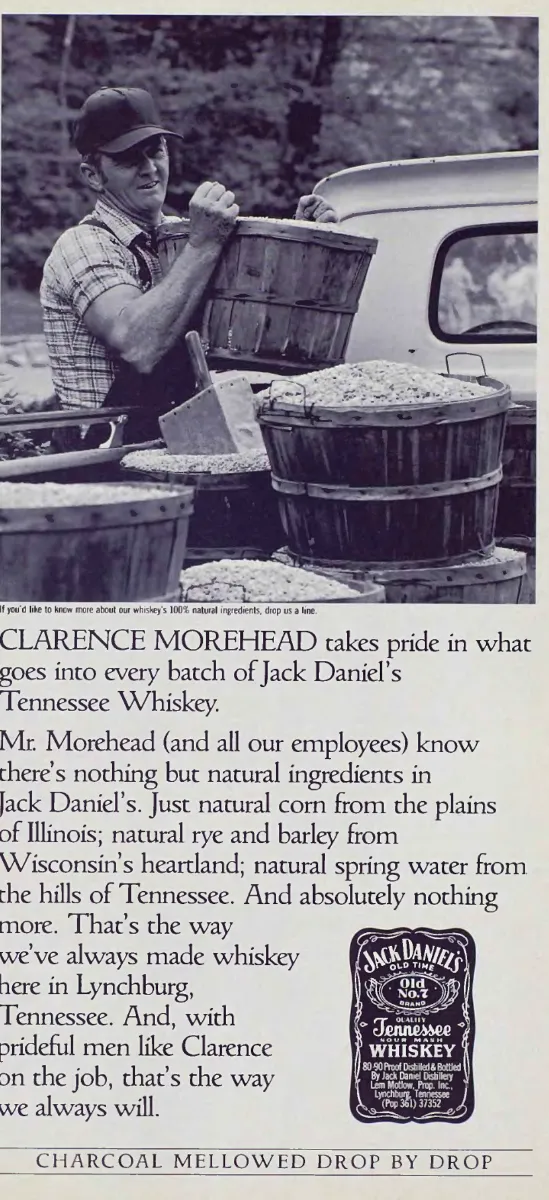
Clarence Morehead takes pride in what goes into every batch of Jack Daniel’s Tennessee Whiskey.
FROM THE PRINTED PAGEOriginal ad copy
OCR transcription from the archived page. Scanning and reading-order errors may remain.
If you'd like to know more about our whiskey's 100% natural ingredients, drop us a line. CLARENCE MOREHEAD takes pride in what goes into every batch of Jack Daniel’s Tennessee Whiskey. Mr. Morehead (and all our employees) know there’s nothing but natural ingredients in Jack Daniel’s. Just natural corn from the plains of Illinois; natural rye and barley from Wisconsin’s heartland; natural spring water from the hills of Tennessee. And absolutely nothing more. That’s the way we’ve always made whiskey here in Lynchburg, Tennessee. And, with prideful men like Clarence on the job, that’s the way we always will. JACK DANIEL’S OLD TIME Old No. 7 BRAND QUALITY Tennessee SOUR MASH WHISKEY 80-90 Proof Distilled & Bottled By Jack Daniel Distillery Lem Motlow, Prop., Inc., Lynchburg, Tennessee (Pop. 361) 37352 CHARCOAL MELLOWED DROP BY DROP
Commentary
I started with the baskets. Their rough wooden sides, heaped grain and metal hoops occupy more of this advertisement than the whiskey label. Clarence Morehead lifts one beside a truck, dressed for a working day rather than a tasting room. Before the copy supplies his name, the photograph has supplied a proposition: somebody takes responsibility for what goes into the drink.
Then I followed the ingredients. Illinois corn, Wisconsin rye and barley, Tennessee spring water: the list gives “natural” a small American geography. It also complicates the seemingly self-contained world of Lynchburg. Ingredients arrive from elsewhere; local pride resides in choosing and making. The photograph cannot verify the formula or Morehead’s employment history, but it gives the advertiser’s assurances a face, a task and a weight to carry.
The invitation beneath the photograph asks readers to “drop us a line” for ingredient information. That little sentence makes curiosity a correspondence. Compared with opening a product page, writing to a distillery required time and an address; the brand turns that slower exchange into another suggestion of personal acquaintance. Even the population on the label makes the business sound like somewhere a letter would find its way to a person.
For a beginning copywriter, watch the repetition of “natural.” Each return attaches the adjective to a named ingredient and place, building a rhythm of reassurance. “And absolutely nothing more” closes the list with a verbal doorstop. The later movement from “always made” to “always will” converts a description into a pledge. Notice, too, the courteous “Mr. Morehead”: the employee receives the dignity usually reserved for the customer.
Jack Daniel’s traces its registered Lynchburg distillery to 1866. Brown-Forman acquired it in 1956 and today lists Old No. 7, Gentleman Jack, Single Barrel and other expressions in its portfolio. Its current brand account still emphasizes cave spring water and charcoal mellowing; the acquisition appears in Brown-Forman’s history.
The enduring idea is that an ingredient claim becomes more persuasive when someone appears accountable for it. The narrower assumption is that one rural portrait can stand for the entire business. Today’s wider product family makes that distinction useful: this is a promise made for the whiskey pictured in 1985, not an ingredient specification for everything now bearing the name.