Automotive 1969
Shelby
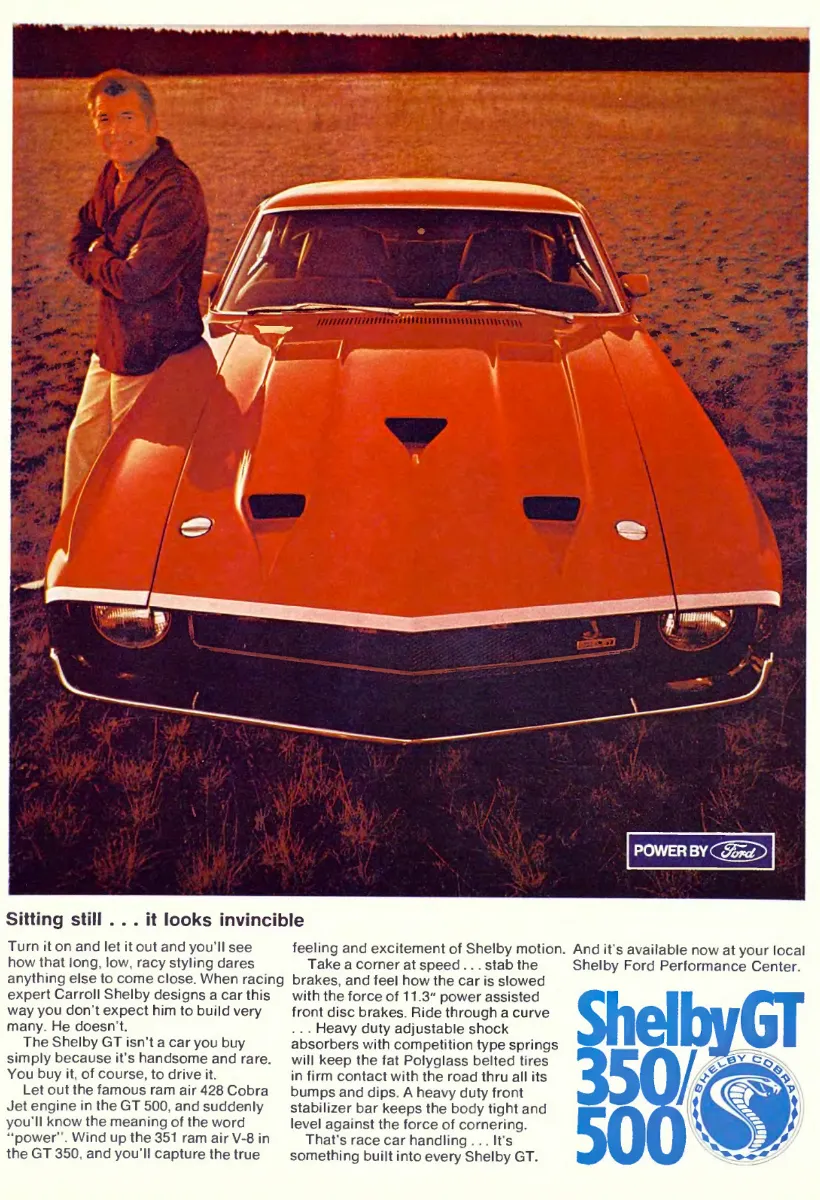
Sitting still . . . it looks invincible
FROM THE PRINTED PAGEOriginal ad copy
OCR transcription from the archived page. Scanning and reading-order errors may remain.
POWER BY Ford Sitting still . . . it looks invincible Turn it on and let it out and you'll see how that long, low, racy styling dares anything else to come close. When racing expert Carroll Shelby designs a car this way you don't expect him to build very many. He doesn't. The Shelby GT isn't a car you buy simply because it's handsome and rare. You buy it, of course, to drive it. Let out the famous ram air 428 Cobra Jet engine in the GT 500, and suddenly you'll know the meaning of the word “power”. Wind up the 351 ram air V-8 in the GT 350, and you'll capture the true feeling and excitement of Shelby motion. Take a corner at speed . . . stab the brakes, and feel how the car is slowed with the force of 11.3” power assisted front disc brakes. Ride through a curve . . . Heavy duty adjustable shock absorbers with competition type springs will keep the fat Polyglass belted tires in firm contact with the road thru all its bumps and dips. A heavy duty front stabilizer bar keeps the body tight and level against the force of cornering. That's race car handling . . . It's something built into every Shelby GT. And it's available now at your local Shelby Ford Performance Center. Shelby GT 350/500
Commentary
The orange hood occupies almost the whole page. Carroll Shelby stands to one side with folded arms, but the car’s broad nose does most of the posing. “Sitting still . . . it looks invincible” describes exactly the view we have. It also creates a problem for the copy to solve: if the photograph can only show stillness, the text must make the reader feel motion.
The first paragraph uses Shelby’s racing identity to explain rarity, then refuses to let rarity be the reason to buy. “You buy it, of course, to drive it.” From there, the advertisement moves through two engines, the GT 500’s 428 Cobra Jet and the GT 350’s 351 V-8, before taking an imagined corner. The braking and suspension details are unusually concrete: 11.3-inch power-assisted front discs, adjustable shocks, competition-type springs, Polyglass belted tires and a front stabilizer bar. These are the advertisement’s specifications and handling claims, not independent measurements. The car’s visual mass and the passage through a curve work together to make a stationary image feel forceful.
The Ford mark and the Shelby name share the page, but in different roles. “POWER BY Ford” is small and boxed; “Shelby GT 350/500” is enormous and blue. The arrangement borrows factory scale while keeping the driver’s attention on a specialist performance identity. A reader today can find instrumented reviews and video drives quickly. This printed page has to compress a visual impression, a famous name and a mechanical argument into one encounter.
For a new copywriter, the hinge is the sentence about driving. The opening grants the car’s looks and scarcity, then “of course” makes using it seem like the only sensible response. Active verbs—“let out,” “wind up,” “stab,” “ride”—carry the reader from hood to road. A practical lesson is to move from the photograph’s visible fact to the experience it cannot show, and support that move with details rather than adjectives alone.
Shelby American’s history places the GT350’s debut in 1965 and the GT500’s arrival in 1967. Shelby American continues to offer performance vehicles and related products, including a contemporary GT350.
The connection between racing identity and road-car excitement remains recognizable. The named engines, tires, local Performance Center and this page’s rarity claim belong to the 1969 offer; they should not be read as specifications of a present Shelby.