Automotive 1969
Triumph
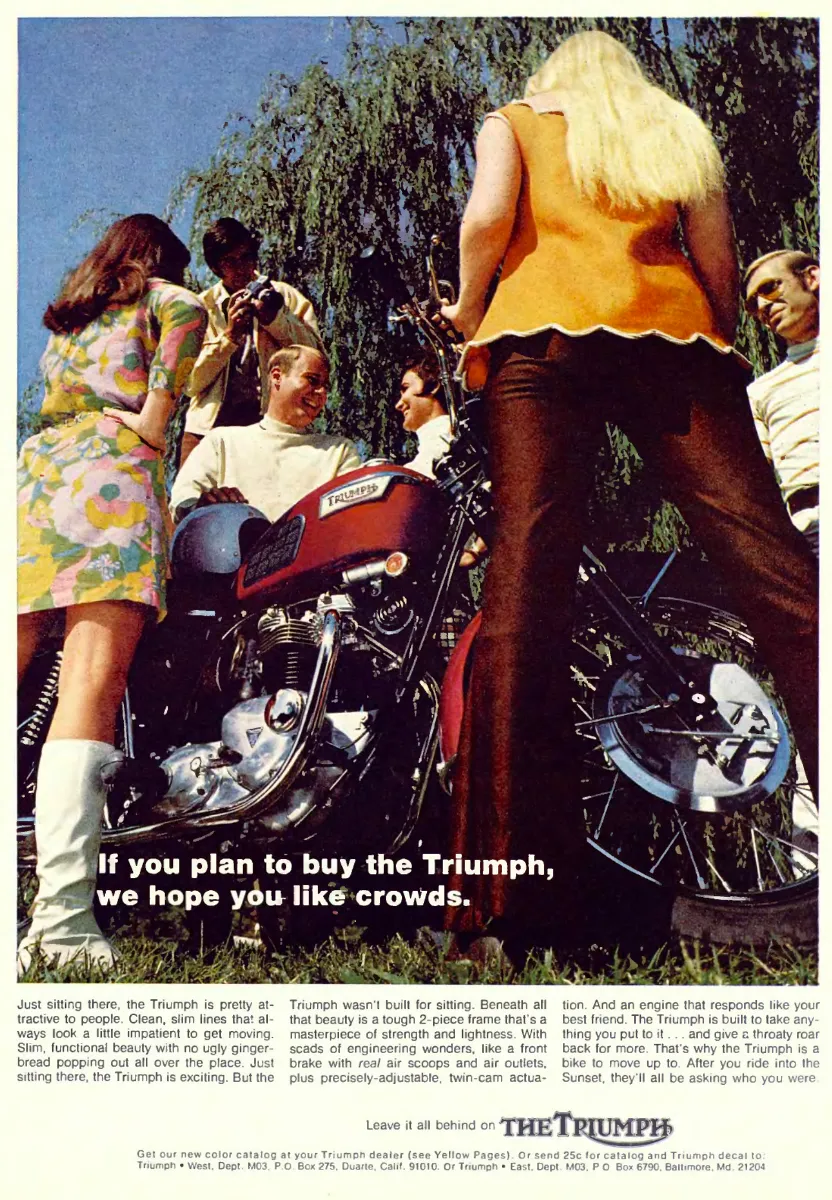
If you plan to buy the Triumph, we hope you like crowds.
FROM THE PRINTED PAGEOriginal ad copy
OCR transcription from the archived page. Scanning and reading-order errors may remain.
If you plan to buy the Triumph, we hope you like crowds. Just sitting there, the Triumph is pretty attractive to people. Clean, slim lines that always look a little impatient to get moving. Slim, functional beauty with no ugly gingerbread popping out all over the place. Just sitting there, the Triumph is exciting. But the Triumph wasn't built for sitting. Beneath all that beauty is a tough 2-piece frame that's a masterpiece of strength and lightness. With scads of engineering wonders, like a front brake with real air scoops and air outlets, plus precisely-adjustable, twin-cam actuation. And an engine that responds like your best friend. The Triumph is built to take anything you put to it . . . and give a throaty roar back for more. That's why the Triumph is a bike to move up to. After you ride into the Sunset, they'll all be asking who you were. Leave it all behind on THE TRIUMPH Get our new color catalog at your Triumph dealer (see Yellow Pages). Or send 25¢ for catalog and Triumph decal to: Triumph • West, Dept. M03, P.O. Box 275, Duarte, Calif. 91010. Or Triumph • East, Dept. M03, P.O. Box 6790, Baltimore, Md. 21204.
Commentary
The motorcycle is almost difficult to see for all the people around it. One person holds a camera; others bend or look toward the red tank. The headline across the lower photograph says the buyer had better like crowds. Only after that social proof does the copy describe the frame, brake and engine. The picture first establishes a consequence of ownership: attention.
I read the opening twice because it turns a static display into anticipation. The clean, slim lines look “a little impatient to get moving.” Then comes the corrective: “the Triumph wasn’t built for sitting.” The ad moves from an observed gathering to a promised ride. It cites a two-piece frame, front brake air scoops and outlets, twin-cam actuation and an engine that responds “like your best friend.” Those technical claims are embedded in friendly, figurative language; the scan offers no test results. Its promise is less a measured specification than a feeling of command that other people will notice.
At the bottom, the invitation to get a color catalog routes the reader to a dealer, the Yellow Pages, or a mailed 25-cent request. That detail makes the era’s information path visible. The interested rider cannot tap through a product gallery; the ad must create enough appetite for a separate catalog or visit. The crowd in the photograph is therefore also a kind of demonstration that can be carried in one printed page.
For a new copywriter, the headline is an indirect benefit claim. It never says “admired” or “popular”; “we hope you like crowds” lets the reader infer both from the image. The repeated “sitting” sets up the turn to motion, while “a throaty roar” gives the engine a sound without printing a number. The useful lesson is to let a scene imply a benefit, then give the reader concrete features to inspect after the first impression.
Triumph’s brand timeline dates its first motorcycle to 1902 and records the marque’s later changes. The present company builds a broad range of motorcycles, including modern classics, roadsters and adventure bikes.
Looks, handling and the wish to enjoy a ride still animate motorcycle advertising. The 25-cent catalog, Yellow Pages instruction and particular brake language describe this ad’s sales path and machine, not a current Triumph offer.