Telecommunications 1969
AT&T
Mr. Moss, what do you like best about our country?
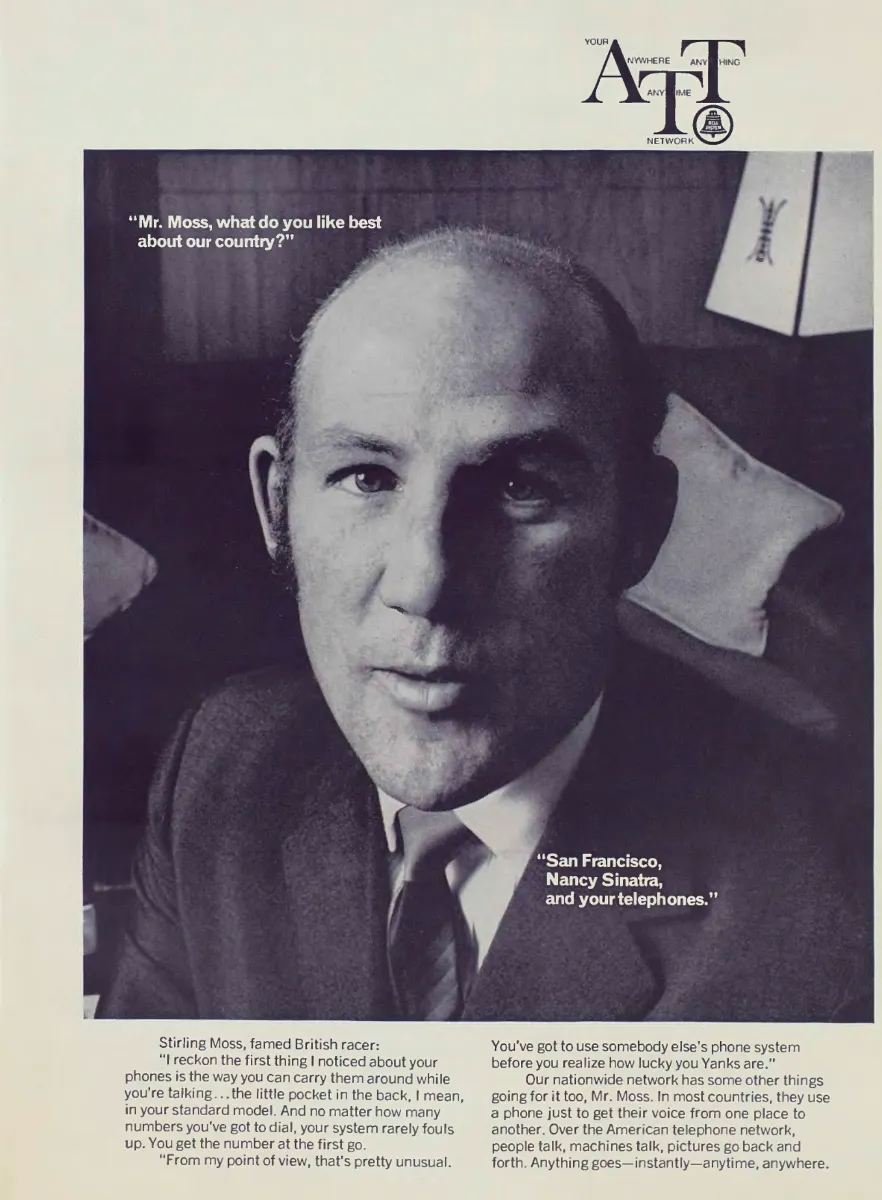
FROM THE PRINTED PAGEOriginal ad copy
OCR transcription from the archived page. Scanning and reading-order errors may remain.
YOUR ANYWHERE ANYTIME ANYTHING NETWORK AT&T “Mr. Moss, what do you like best about our country?” “San Francisco, Nancy Sinatra, and your telephones.” Stirling Moss, famed British racer: “I reckon the first thing I noticed about your phones is the way you can carry them around while you're talking . . . the little pocket in the back, I mean, in your standard model. And no matter how many numbers you've got to dial, your system rarely fouls up. You get the number at the first go. “From my point of view, that's pretty unusual. You've got to use somebody else's phone system before you realize how lucky you Yanks are.” Our nationwide network has some other things going for it too, Mr. Moss. In most countries, they use a phone just to get their voice from one place to another. Over the American telephone network, people talk, machines talk, pictures go back and forth. Anything goes—instantly—anytime, anywhere.
Commentary
The portrait comes close enough to make Stirling Moss’s face the whole argument. AT&T asks what the British racer likes best about America, and the printed answer gives the network third place after San Francisco and Nancy Sinatra. That placement makes the praise sound offhand rather than ceremonial. The photograph’s dark tones and the small white quotations let the answer emerge as though from an interview.
The body copy clarifies what Moss admires. He describes a desk telephone with a little carrying pocket, successful dialing and a system that “rarely fouls up.” The ad then widens his personal observation into a claim about a nationwide network where voices, machines and pictures move. It compares American service with “most countries” without providing evidence or defining the comparison. Moss’s status as a famous British racer supplies the outsider’s testimony; the scan establishes his quoted words as advertising copy, not an independently recorded interview.
I am struck by the idea of carrying the phone “around while you’re talking.” Moss means moving a wired handset within a room, aided by the pocket on the set. To a reader accustomed to a mobile phone, that is a small radius of freedom. The copy’s other ambition—moving data and images across a network—has proved more durable than its domestic-phone image. The ad captures a moment when portability and instant communication referred to different scales of movement.
For a new copywriter, the answer’s list is the hook. “San Francisco, Nancy Sinatra, and your telephones” mixes place, celebrity and infrastructure in a rhythm that makes the last item surprising. The repeated “talk” in the final paragraph and the closing “instantly—anytime, anywhere” expand a personal remark into a network promise. The lesson is to make a testimonial specific enough to sound observed, then show exactly how the product claim grows from it.
AT&T’s account of its history connects today’s company with the Bell telephone business and describes its current fiber and 5G services. The 1969 page belongs to the earlier American telephone-network era, before later corporate reorganizations.
The desire for a dependable connection remains central. The standard desk phone, dialed numbers and the claim that American users are uniquely “lucky” describe this ad’s technology and rhetoric; today’s network promise operates on mobile devices and broadband as well as voice.