Electronics 1980
Maxell
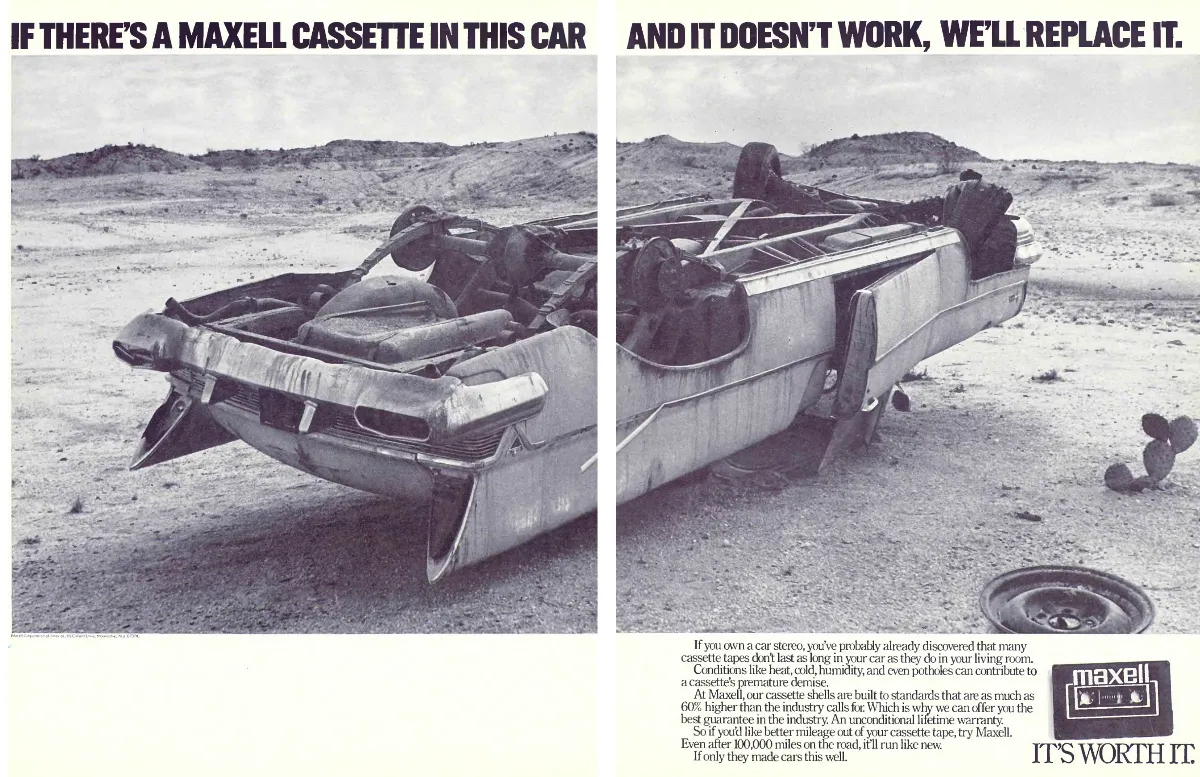
If there's a Maxell cassette in this car and it doesn't work, we'll replace it.
FROM THE PRINTED PAGEOriginal ad copy
OCR transcription from the archived page. Scanning and reading-order errors may remain.
IF THERE'S A MAXELL CASSETTE IN THIS CAR AND IT DOESN'T WORK, WE'LL REPLACE IT. If you own a car stereo, you've probably already discovered that many cassette tapes don't last as long in your car as they do in your living room. Conditions like heat, cold, humidity, and even potholes can contribute to a cassette's premature demise. At Maxell, our cassette shells are built to standards that are as much as 60% higher than the industry calls for. Which is why we can offer you the best guarantee in the industry. An unconditional lifetime warranty. So if you'd like better mileage out of your cassette tape, try Maxell. Even after 100,000 miles on the road, it'll run like new. If only they made cars this well. maxell IT'S WORTH IT.
Commentary
An overturned car lies in open, empty ground. The two panels make the reader travel across the wreck before the headline finishes its sentence: if a Maxell cassette is in this car and fails, the company will replace it. The proposition is absurdly calm beside the wreckage. I look for the cassette, but the ad does not show one. The unseen product is presumed to be the most durable thing in the scene.
The small copy narrows the drama to ordinary wear. A car cassette meets heat, cold, humidity and potholes; its shell may fail before the tape does. Maxell says its shells are built to standards up to 60 percent above industry requirements and offers an unconditional lifetime warranty. The scan does not identify the standard or test method, so these remain advertiser claims. The photograph nevertheless gives the guarantee a memorable extreme case. The reader can imagine less catastrophic trips without another demonstration.
The closing lines borrow automotive language: “better mileage,” “100,000 miles,” then “If only they made cars this well.” They turn the cassette into a traveler and the car into the less reliable accessory. This reversal matters because the product was meant to spend time in a vehicle, not just on a shelf at home. Today a music file has no shell to warp or crack in a glove compartment. The old promise shows how much of audio ownership once depended on a physical carrier surviving its environment.
For a beginning copywriter, the headline is a conditional guarantee with its punch line postponed across a page break. The copy later swaps the category language of cars and tapes, keeping the image and argument in the same world. The lesson is to choose one vivid failure scenario, state the remedy plainly, and let the visual stretch the reader’s sense of what the promise covers.
Maxell’s company history records its early magnetic-tape business and the commercialization of audio cassettes in Japan in the 1960s. The company now lists batteries, industrial tapes and other materials among its current products.
Trust in a maker’s durability promise remains valuable. The cassette shell, car stereo and lifetime replacement offer belong to the physical-media sale shown here; the general need for a product to survive its expected conditions does not.