Electronics 1973
Phone-mate
Introducing the home appliance that answers your phone.
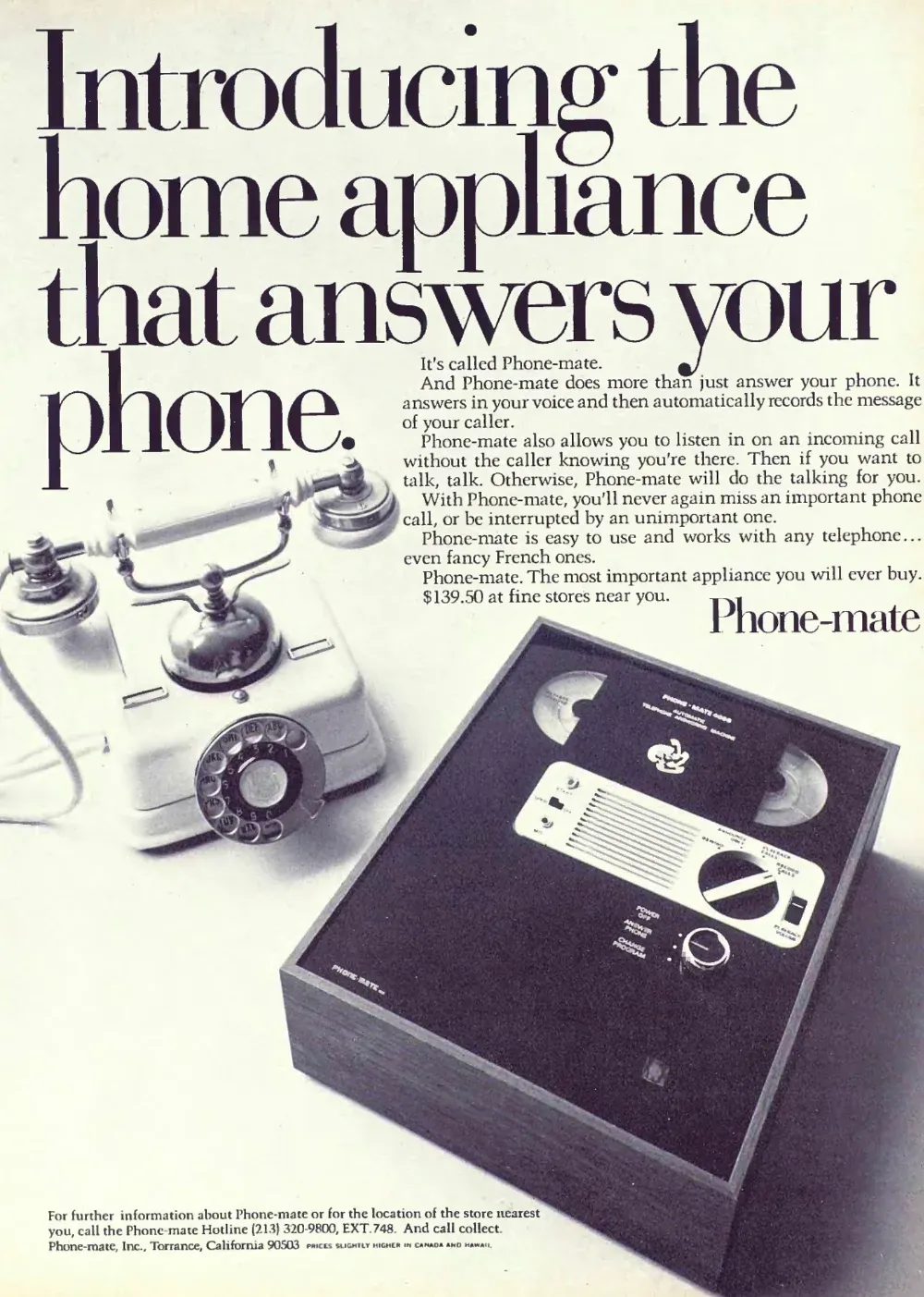
FROM THE PRINTED PAGEOriginal ad copy
OCR transcription from the archived page. Scanning and reading-order errors may remain.
Introducing the home appliance that answers your phone. It's called Phone-mate. And Phone-mate does more than just answer your phone. It answers in your voice and then automatically records the message of your caller. Phone-mate also allows you to listen in on an incoming call without the caller knowing you're there. Then if you want to talk, talk. Otherwise, Phone-mate will do the talking for you. With Phone-mate, you'll never again miss an important phone call, or be interrupted by an unimportant one. Phone-mate is easy to use and works with any telephone... even fancy French ones. Phone-mate. The most important appliance you will ever buy. $139.50 at fine stores near you. Phone-mate For further information about Phone-mate or for the location of the store nearest you, call the Phone-mate Hotline (213) 320-9800, EXT.748. And call collect. Phone-mate, Inc., Torrance, California 90503. Prices slightly higher in Canada and Hawaii.
Commentary
I first read the headline as a small act of category-making. “Home appliance” normally suggests something in a kitchen or laundry room; here the object sits beside an ornate rotary telephone. The machine’s open reel and broad control panel make the promise physical. A voice will be stored on that tape while its owner is elsewhere. The enormous serif headline takes four lines to complete a single sentence, giving the reader time to absorb a domestic job that had previously belonged to a person.
The sales argument then moves from absence to choice. The box answers in the owner’s voice, records a caller, and allows the owner to listen before deciding whether to speak. “You’ll never again miss an important phone call, or be interrupted by an unimportant one” is the real promise; recording is the method. The ad even places a theatrical phone beside the machine to substantiate “works with any telephone… even fancy French ones.” The $139.50 price and “fine stores near you” position it as a considered purchase. A collect-call hotline supplies the rest of the sales channel: the prospective buyer must use the very medium the machine proposes to manage.
Today, screening and saving messages are ordinary parts of a phone or network service. What feels historically revealing is the ad’s definition of control. It invites the owner to hear a caller without being heard, then either enter the conversation or let the machine continue. The argument is about protecting attention before that became a standard pitch for digital tools.
For new copywriters, the repeated “Phone-mate” is worth studying. It appears as the answer immediately after the vast headline and again at the start of the feature paragraphs. The copy alternates short instructions, “Then if you want to talk, talk,” with longer explanations of what the device does. That rhythm turns an unfamiliar mechanism into a sequence of simple decisions. Repetition helps when the audience must learn both a name and a new behavior at once.
The Smithsonian’s collection record dates PhoneMate’s Model 400 to 1971 and describes its reel-to-reel message storage. An IEEE history traces the company to 1968 and reports its acquisition by supplier Asahi in 1989. Phone-mate is no longer an independent consumer brand.
The need to decide when to answer remains familiar. The tape reels, collect-call hotline and store locator have disappeared from that decision, but the ad’s unusually clear framing still applies: a technology becomes valuable when it gives its user time back.