Consumer Goods 1973
Bacardi
You can get to the bottom of it and never have the same drink twice.
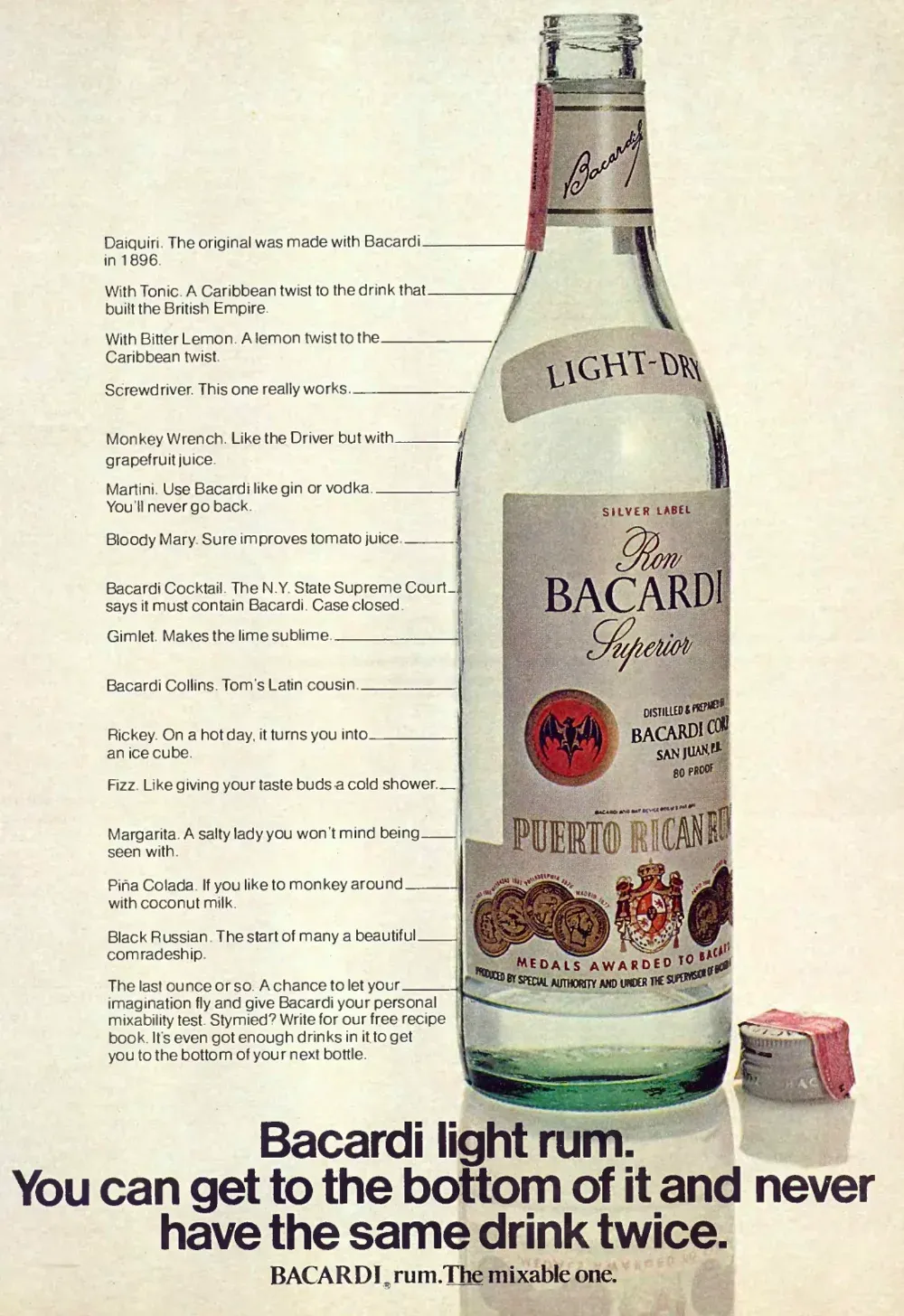
FROM THE PRINTED PAGEOriginal ad copy
OCR transcription from the archived page. Scanning and reading-order errors may remain.
Daiquiri. The original was made with Bacardi in 1896. With Tonic. A Caribbean twist to the drink that built the British Empire. With Bitter Lemon. A lemon twist to the Caribbean twist. Screwdriver. This one really works. Monkey Wrench. Like the Driver but with grapefruit juice. Martini. Use Bacardi like gin or vodka. You'll never go back. Bloody Mary. Sure improves tomato juice. Bacardi Cocktail. The N.Y. State Supreme Court says it must contain Bacardi. Case closed. Gimlet. Makes the lime sublime. Bacardi Collins. Tom's Latin cousin. Rickey. On a hot day, it turns you into an ice cube. Fizz. Like giving your taste buds a cold shower. Margarita. A salty lady you won't mind being seen with. Piña Colada. If you like to monkey around with coconut milk. Black Russian. The start of many a beautiful comradeship. The last ounce or so. A chance to let your imagination fly and give Bacardi your personal mixability test. Stymied? Write for our free recipe book. It's even got enough drinks in it to get you to the bottom of your next bottle. Bacardi light rum. You can get to the bottom of it and never have the same drink twice. BACARDI rum. The mixable one. LIGHT-DRY; SILVER LABEL; Ron BACARDI Superior; BACARDI CORP.; SAN JUAN, P.R.; 80 PROOF; PUERTO RICAN RUM; MEDALS AWARDED TO BACARDI. [illegible]
Commentary
The first thing I follow is a series of rules drawn across the page. Each cocktail name begins at the left and points toward the same bottle. The Daiquiri, Martini and Bloody Mary do not require a separate product photograph or a prepared drink. The bottle is the visual answer to every line. A full, pale rum bottle also lets the copy make a playful claim about its eventual emptiness: finishing it would be evidence of variety, not repetition.
The list is doing more than naming recipes. It starts with a dated origin claim for the Daiquiri, then ranges across tonic, citrus, tomato juice and coconut milk. Some suggestions are established drinks; others are small verbal substitutions, such as the “Monkey Wrench” with grapefruit juice. The broad span tries to make rum feel like the one bottle that can take the place of several spirits in a household drinks cabinet. The ad supplies neither measures nor methods. Its invitation is to imagine possibilities, with a free recipe book available by post when imagination runs out. The Supreme Court line is the advertiser’s own legal claim, presented here as a joke with a gavel’s finality, not independent evidence of the ruling.
For a new copywriter, notice the short labels followed by one quick turn of language: “Gimlet. Makes the lime sublime.” The rhyme gives a familiar drink a Bacardi-specific nudge without slowing the long list. “You can get to the bottom of it” then converts a common idiom into a literal journey down the pictured bottle. The lesson is to make the verbal device answer the visual one; the punch line has been prepared by all those horizontal paths to the glass.
Bacardi’s history dates the rum business to Don Facundo Bacardí Massó’s Santiago de Cuba distillery in 1862. Bacardi Limited still sells a range of lighter and aged rums, and its current brand description still connects the lighter styles to cocktails such as the Daiquiri.
The durable proposition is versatility: one purchase promises many occasions. The postal recipe book and the idea that drink ideas are scarce now feel distant from a world with recipes instantly available. The ad’s sharper insight survives that change: showing many specific uses can make an ordinary bottle feel unusually capable.