Automotive 1973
Fiat
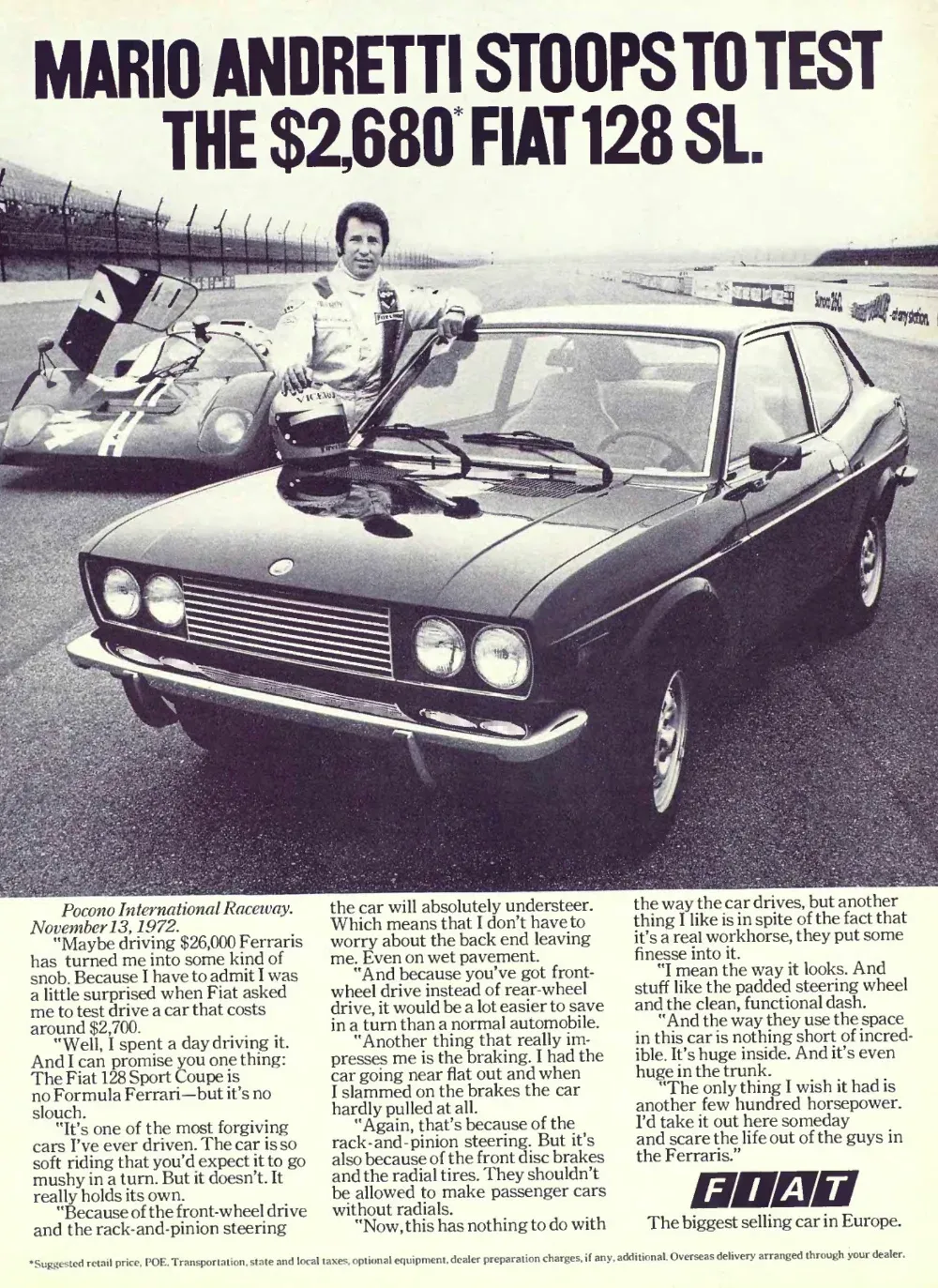
Mario Andretti stoops to test the $2,680 Fiat 128 SL.
FROM THE PRINTED PAGEOriginal ad copy
OCR transcription from the archived page. Scanning and reading-order errors may remain.
MARIO ANDRETTI STOOPS TO TEST THE $2,680* FIAT 128 SL. Pocono International Raceway. November 13, 1972. “Maybe driving $26,000 Ferraris has turned me into some kind of snob. Because I have to admit I was a little surprised when Fiat asked me to test drive a car that costs around $2,700. “Well, I spent a day driving it. And I can promise you one thing: The Fiat 128 Sport Coupe is no Formula Ferrari—but it's no slouch. “It's one of the most forgiving cars I've ever driven. The car is so soft riding that you'd expect it to go mushy in a turn. But it doesn't. It really holds its own. “Because of the front-wheel drive and the rack-and-pinion steering the car will absolutely understeer. Which means that I don't have to worry about the back end leaving me. Even on wet pavement. “And because you've got front-wheel drive instead of rear-wheel drive, it would be a lot easier to save in a turn than a normal automobile. “Another thing that really impresses me is the braking. I had the car going near flat out and when I slammed on the brakes the car hardly pulled at all. “Again, that's because of the rack-and-pinion steering. But it's also because of the front disc brakes and the radial tires. They shouldn't be allowed to make passenger cars without radials. “Now, this has nothing to do with the way the car drives, but another thing I like is in spite of the fact that it's a real workhorse, they put some finesse into it. “I mean the way it looks. And stuff like the padded steering wheel and the clean, functional dash. “And the way they use the space in this car is nothing short of incredible. It's huge inside. And it's even huge in the trunk. “The only thing I wish it had is another few hundred horsepower. I'd take it out here someday and scare the life out of the guys in the Ferraris.” FIAT The biggest selling car in Europe. *Suggested retail price, POE. Transportation, state and local taxes, optional equipment, dealer preparation charges, if any, additional. Overseas delivery arranged through your dealer.
Commentary
The headline makes me look twice at the verb. Mario Andretti “stoops” to test a $2,680 Fiat: the joke assumes a racing driver accustomed to $26,000 Ferraris should consider an ordinary coupe beneath him. The photograph sets up the same hierarchy. Andretti stands at the driver’s door of the road car; a race car and empty track sit behind. The Fiat takes up most of the page, while racing supplies the borrowed authority.
Then the ad spends three dense columns reversing the joke. Dated “Pocono International Raceway. November 13, 1972,” the text gives Andretti a long first-person account of handling, braking, interior space and finish. The price comparison opens the door, but the testimony keeps returning to practical advantages: predictable understeer, front-wheel drive, radial tires, front disc brakes, a padded steering wheel and a large trunk. The voice occasionally sounds like an enthusiast unable to stop assessing machinery. It is also clearly advertising copy attributed to Andretti, so its technical explanations and reported driving impressions are claims in the ad, not independent road-test results.
The physical layout gives the buyer two speeds of reading. At a glance: famous driver, racetrack, affordable coupe. At leisure: a detailed attempt to make everyday driving feel engineered rather than compromised. The footnote reins in the headline’s price with taxes, transport, options and preparation charges. That small print matters because the main line uses the dollar figure to create the entire status reversal.
For a young copywriter, “stoops” is doing unusually heavy work. It acknowledges the buyer’s possible fear that a cheap car cannot be interesting, then lets the endorser overturn that expectation. “No Formula Ferrari—but it’s no slouch” keeps the comparison honest enough to sound conversational. A useful lesson is to let a credible speaker admit the objection before presenting features; the concession gives the later praise something to push against.
The Fiat heritage account dates the 128 to 1969 and describes its transverse-engine, front-wheel-drive layout. Fiat remains an active Stellantis car brand, though the 128 is long out of production.
The promise that a modestly priced car can be enjoyable and useful still travels well. What belongs to this page is the particular bridge between racing authority and a family-sized trunk, plus a fixed price whose actual cost depends on a line of charges at the very bottom.