Back to the collection91 / 189
Automotive 1970
Chevrolet
Walk in, America.
FROM THE PRINTED PAGEOriginal ad copy
OCR transcription from the archived page. Scanning and reading-order errors may remain.
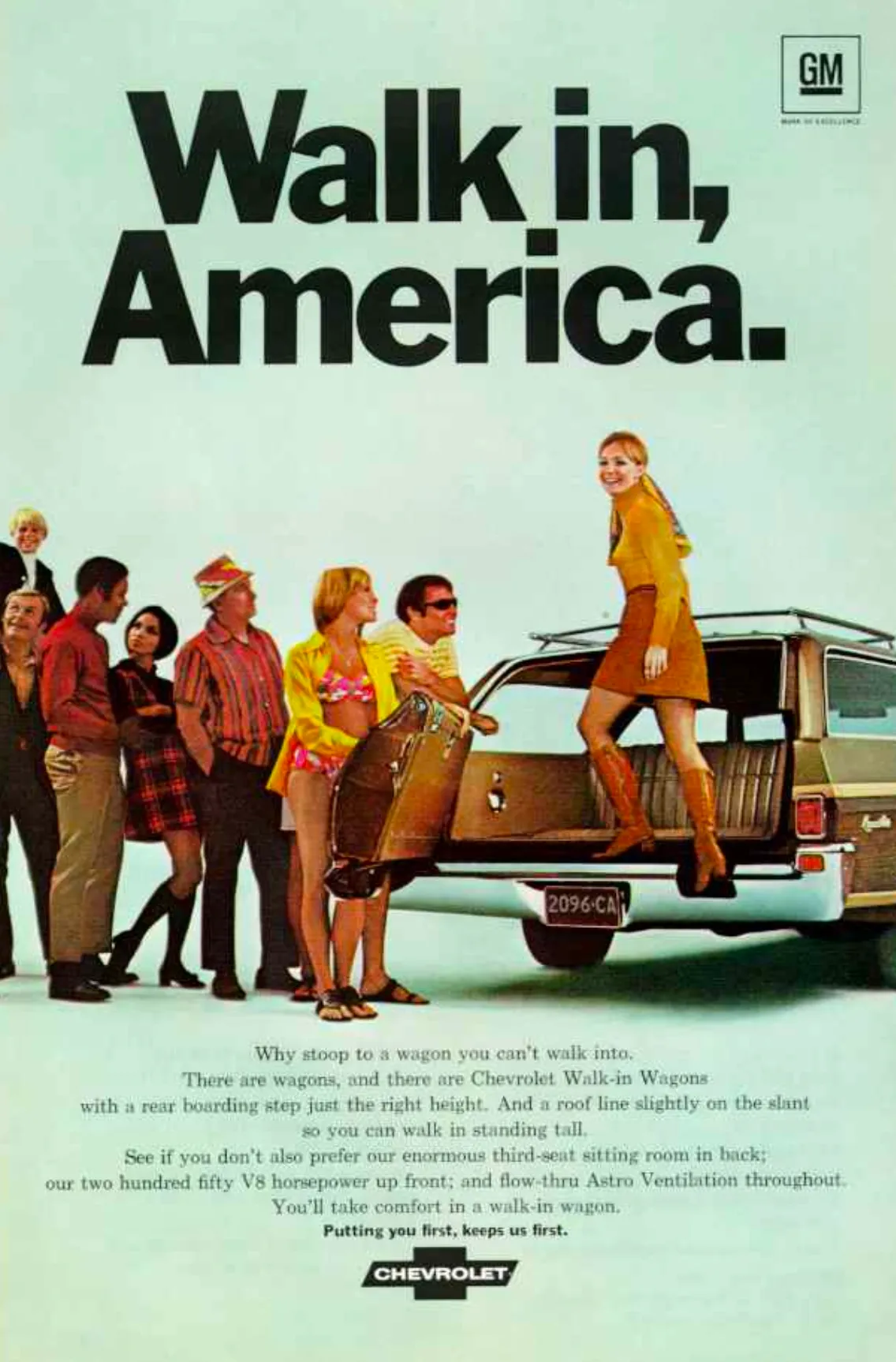
GM MARK OF EXCELLENCE Walk in, America. Why stoop to a wagon you can't walk into. There are wagons, and there are Chevrolet Walk-in Wagons with a rear boarding step just the right height. And a roof line slightly on the slant so you can walk in standing tall. See if you don't also prefer our enormous third-seat sitting room in back; our two hundred fifty V8 horsepower up front; and flow-thru Astro Ventilation throughout. You'll take comfort in a walk-in wagon. Putting you first, keeps us first. CHEVROLET
Commentary
The headline is huge enough to behave like an invitation painted on a building: “Walk in, America.” Only after looking below do we learn where to walk. The rear of a Chevrolet wagon stands open, with a woman stepping into it upright while a small crowd looks on. The scene gives a mundane measure of room—whether a person must stoop—the scale of a public demonstration. The photograph sells a bodily experience before the copy names dimensions.
Chevrolet’s explanation is unusually specific. A rear boarding step of the right height and a roofline “slightly on the slant” produce the advertised maneuver. Then the copy expands from entry to occupancy: third-seat space, 250 V8 horsepower, and flow-thru Astro Ventilation. The step is the memorable feature, but the car is also asked to transport a group in comfort and with abundant power. The onlookers, mixed in dress and age, make that promise feel social rather than technical.
The phrase “Walk-in Wagon” now sounds like a cousin of the “walk-in” room or closet, transferring domestic spaciousness to a vehicle. Today’s larger family vehicles are often sold with door access, cargo flexibility, and cabin technology, while the station wagon is a much less central American form. This page captures an era when the height of a tailgate and a third seat could carry a whole story about freedom of movement.
For a new copywriter, the command “Walk in” is stronger because the image immediately makes it literal. “Why stoop” turns a physical annoyance into the comparison; “standing tall” completes the before-and-after without a diagram. The copy uses a simple action that a reader can imagine trying, then reserves the specifications for the paragraph underneath. That order keeps a list of features attached to one clear experience.
Chevrolet began in Detroit in 1911 and remains a General Motors brand. Its current range includes SUVs, trucks, electric vehicles and performance models.
The human measure of usefulness still works: entry, headroom and room for companions remain meaningful ways to judge a vehicle. The wagon silhouette, the 250-horsepower V8 as an uncomplicated virtue, and the promotional crowd belong more clearly to this page’s moment.