Electronics 1981
Atari
Computers for people.
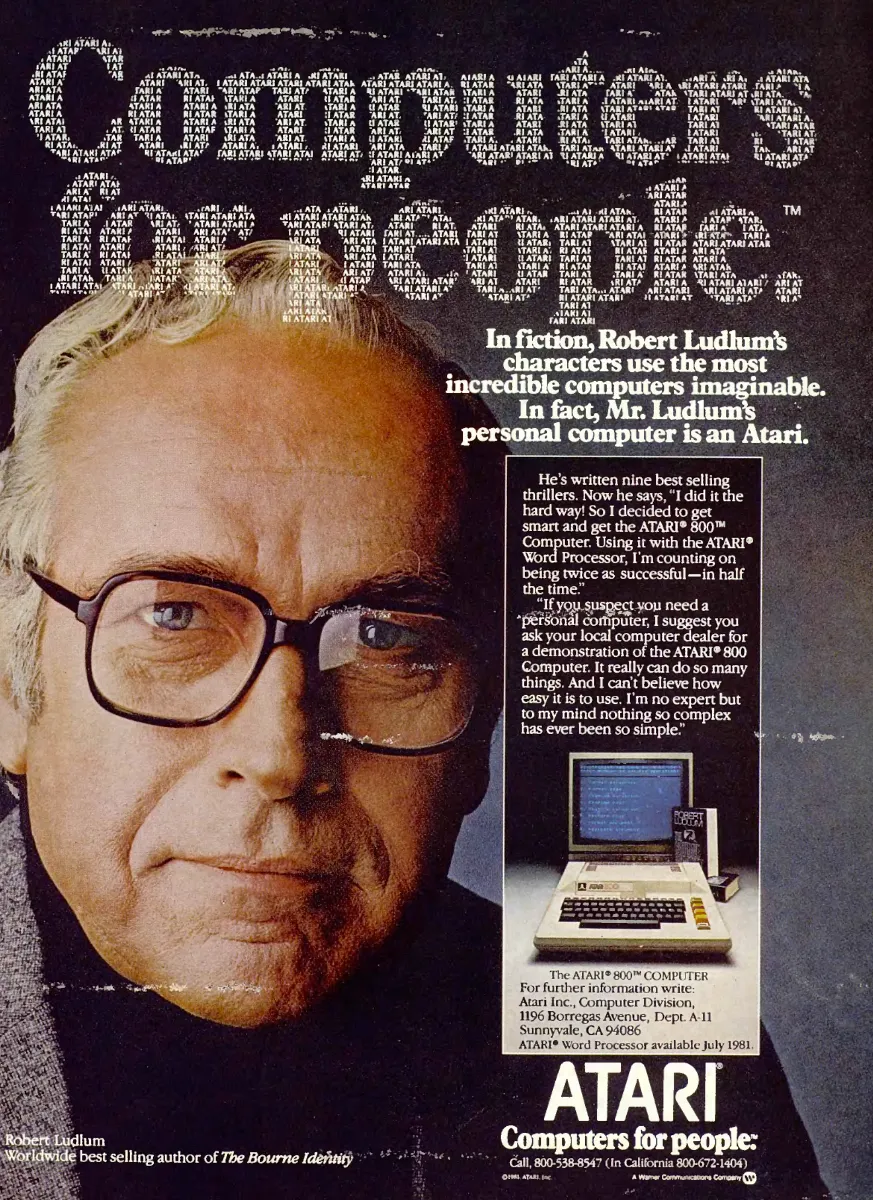
FROM THE PRINTED PAGEOriginal ad copy
OCR transcription from the archived page. Scanning and reading-order errors may remain.
Computers for people.™ In fiction, Robert Ludlum’s characters use the most incredible computers imaginable. In fact, Mr. Ludlum’s personal computer is an Atari. He’s written nine best selling thrillers. Now he says, “I did it the hard way! So I decided to get smart and get the ATARI® 800™ Computer. Using it with the ATARI® Word Processor, I’m counting on being twice as successful—in half the time.” “If you suspect you need a personal computer, I suggest you ask your local computer dealer for a demonstration of the ATARI® 800 Computer. It really can do so many things. And I can’t believe how easy it is to use. I’m no expert but to my mind nothing so complex has ever been so simple.” The ATARI® 800™ COMPUTER For further information write: Atari Inc., Computer Division, 1196 Borregas Avenue, Dept. A-11 Sunnyvale, CA 94086 ATARI® Word Processor available July 1981. Robert Ludlum Worldwide best selling author of The Bourne Identity ATARI® Computers for people. Call, 800-538-8547 (In California 800-672-1404) ©1981, ATARI, Inc. A Warner Communications Company
Commentary
I noticed the face before the computer, and then the small Atari names forming the enormous “Computers for people” headline. The page performs its hierarchy twice. A person occupies most of the photograph; a human-centered promise occupies the typography. The hardware waits in a narrow panel, where Robert Ludlum’s books and the displayed text explain what this particular person might want it to do.
The opening makes an unusually economical move between fantasy and evidence. Ludlum’s fictional characters use extraordinary computers; the author’s actual choice, the ad says, is an Atari. His credentials are literary rather than technical. Nine best sellers establish that he already knows the work; “I’m no expert” lets him share the prospective buyer’s uncertainty about the machine. That combination gives the endorsement its relevance. The reader is being offered a successful user who still remembers the intimidation of beginning.
The productivity claim needs careful handling. Ludlum is “counting on” being twice as successful in half the time. That is an expressed hope in the advertisement, not a measured result. A second qualification appears lower down: the Atari Word Processor is advertised as available in July 1981. The page sells a computer-and-software possibility, with a dealer demonstration as the route to understanding it. The fine print and the invitation matter as much as the famous face.
The demonstration, postal department code, and telephone number place information at the far end of another action. Buying a personal computer could involve first seeing what one did in a shop. Many present-day readers encounter word processing as an already familiar activity. Here the advertiser must establish that a complex machine can belong to ordinary creative work before its specifications become persuasive.
For beginning copywriters, “In fiction” and “In fact” make a clean verbal hinge. The second phrase borrows attention from the first while changing the kind of evidence being offered. “Nothing so complex has ever been so simple” then turns a suspected weakness into the final reassurance. The practical lesson is to choose an endorser whose working problem makes the benefit understandable, rather than relying only on recognizability.
Atari dates its origins to 1972 and identifies arcade games, consoles, and personal computers within its history. Today its businesses include games, consumer hardware, and licensing. The Warner Communications attribution in this scan belongs to its historical corporate setting.
The persistent need is a tool that expands what someone can accomplish without demanding a new professional identity. The Atari 800 and its forthcoming word processor belong to this offer. The continuing argument is that ease becomes credible when a capable person shows why they need it.