Electronics 1988
Panasonic
Now Panasonic makes programming a VCR as simple as drawing a line.
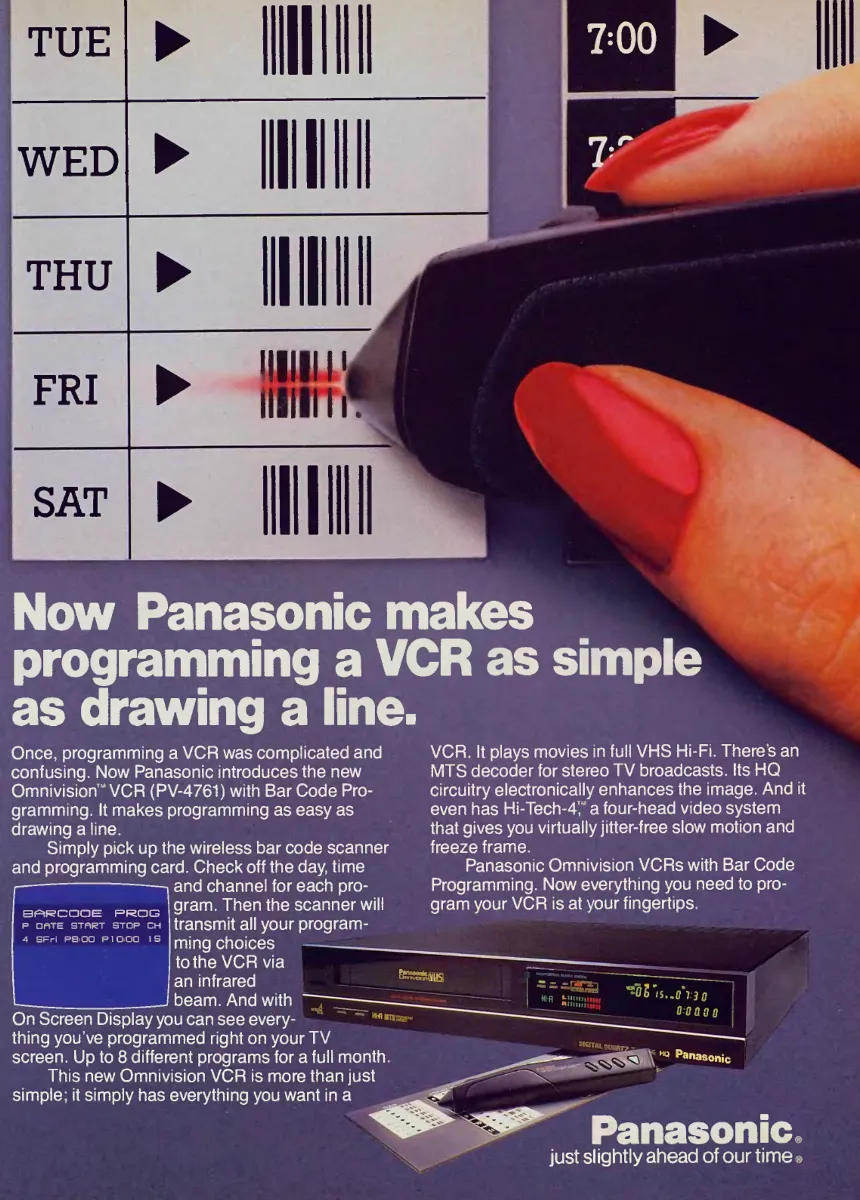
FROM THE PRINTED PAGEOriginal ad copy
OCR transcription from the archived page. Scanning and reading-order errors may remain.
Now Panasonic makes programming a VCR as simple as drawing a line. Once, programming a VCR was complicated and confusing. Now Panasonic introduces the new Omnivision™ VCR (PV-4761) with Bar Code Programming. It makes programming as easy as drawing a line. Simply pick up the wireless bar code scanner and programming card. Check off the day, time and channel for each program. Then the scanner will transmit all your programming choices to the VCR via an infrared beam. And with On Screen Display you can see everything you've programmed right on your TV screen. Up to 8 different programs for a full month. This new Omnivision VCR is more than just simple; it simply has everything you want in a VCR. It plays movies in full VHS Hi-Fi. There's an MTS decoder for stereo TV broadcasts. Its HQ circuitry electronically enhances the image. And it even has Hi-Tech-4,™ a four-head video system that gives you virtually jitter-free slow motion and freeze frame. Panasonic Omnivision VCRs with Bar Code Programming. Now everything you need to program your VCR is at your fingertips. TUE · WED · THU · FRI · SAT 7:00 BARCODE PROG P · DATE · START · STOP · CH [illegible smaller sample programme details and player markings] Panasonic® just slightly ahead of our time®
Commentary
I started with the red line rather than the VCR. It crosses a barcode beside Friday, under the tip of a scanner held by a hand with matching red nails. Most of the picture is a demonstration of an action. The recorder itself waits in the lower corner, where its many buttons and illuminated figures make a quiet argument for needing the simpler method above.
Panasonic begins by acknowledging confusion. The copy then translates the new system into objects and steps: pick up scanner and card, select day, time and channel, transmit by infrared, check the television display. That sequence gives the reader a mental rehearsal. The barcode is technical, but the movement is supposed to be familiar. The picture does not require someone to understand the code before understanding the gesture.
Yet “as simple as drawing a line” compresses a process that the body reveals is longer than one stroke. The viewer still has to know what to record and when, keep the card available, make selections and check the result. I read the ad as a proposal to make the controls more approachable, not proof that scheduling mistakes disappeared. Its commercial strength lies in naming a specific source of resistance; its weakness would be any gap between the effortless headline and the actual routine.
The small schedule also records a different relationship to television time. The viewer prepares for a programme that will arrive at a particular hour and trusts a machine to preserve it. On-demand viewing can remove that appointment, although availability and the effort of finding something remain separate questions. Here the advertised relief is precise: less difficulty arranging to watch later what a broadcaster will show once at the chosen time.
For new copywriters, compare the opening “Once” with the repeated “Now.” They divide the experience into a troublesome past and a proposed present. “More than just simple; it simply has” then uses the same word family to move from usability into the feature list. The useful lesson is the specificity of the first comparison: it gives an unfamiliar interface a familiar action. The body still needs to disclose enough of the process to let the customer judge that comparison.
Panasonic was founded in 1918. Its current business overview describes activities across devices, business solutions and everyday-life products, a broader setting than the home-video recorder pictured here.
Making complicated equipment approachable remains a credible design ambition. The scheduling card, infrared scanner and VHS features belong to this particular solution. The page remains useful because it shows both halves of a usability claim: the reassuring gesture in the photograph and the operational steps in the copy.