Telecommunications 1988
Panasonic
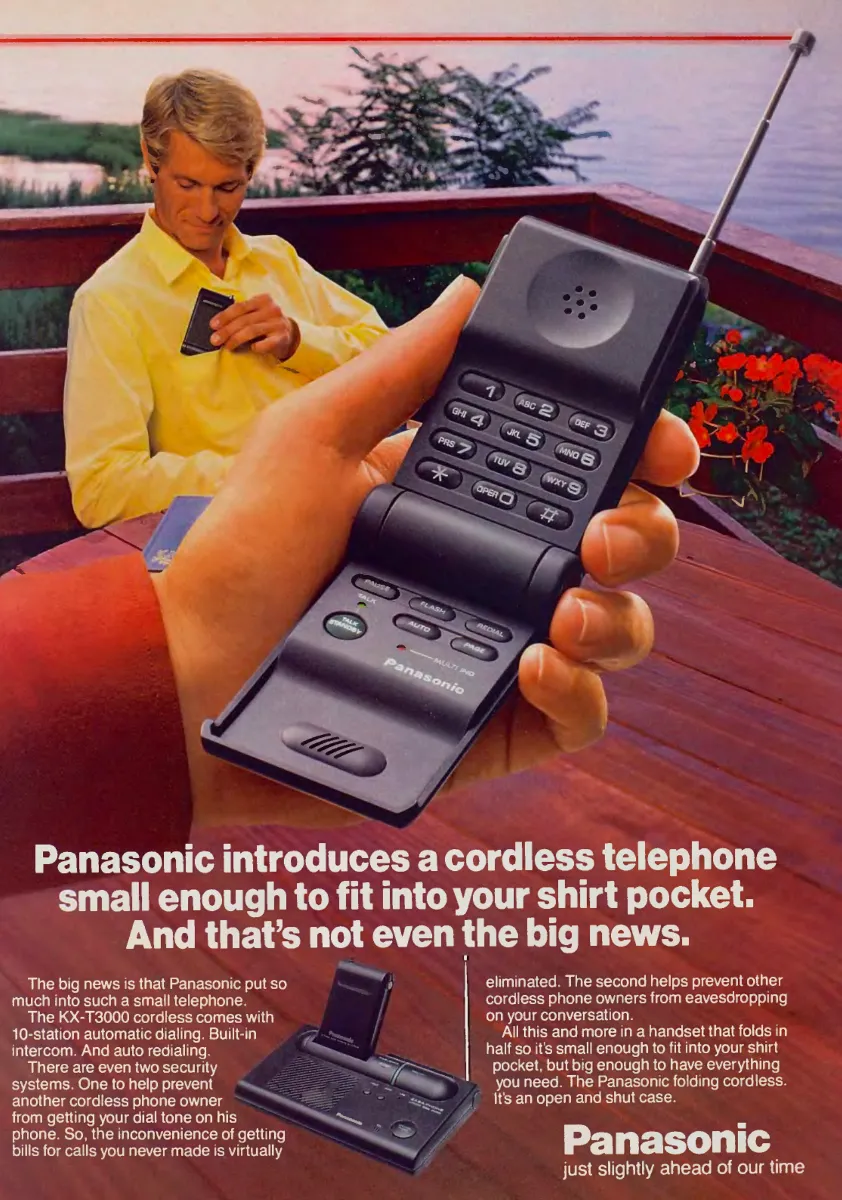
Panasonic introduces a cordless telephone small enough to fit into your shirt pocket. And that’s not even the big news.
FROM THE PRINTED PAGEOriginal ad copy
OCR transcription from the archived page. Scanning and reading-order errors may remain.
Panasonic introduces a cordless telephone small enough to fit into your shirt pocket. And that's not even the big news. The big news is that Panasonic put so much into such a small telephone. The KX-T3000 cordless comes with 10-station automatic dialing. Built-in intercom. And auto redialing. There are even two security systems. One to help prevent another cordless phone owner from getting your dial tone on his phone. So, the inconvenience of getting bills for calls you never made is virtually eliminated. The second helps prevent other cordless phone owners from eavesdropping on your conversation. All this and more in a handset that folds in half so it's small enough to fit into your shirt pocket, but big enough to have everything you need. The Panasonic folding cordless. It's an open and shut case. Panasonic just slightly ahead of our time INTERCOM · FLASH · REDIAL · TALK/STANDBY · AUTO · PROG [illegible smaller handset and base markings]
Commentary
The phone looks enormous until I notice the second demonstration. In the foreground, a hand holds the unfolded handset close enough to inspect its hinge and keypad. Behind it, a man slips the folded version into a shirt pocket. Panasonic uses two scales to answer two questions: what does it look like, and where will it go? The balcony, flowers and water provide a setting for domestic freedom; the small base unit below keeps that freedom attached to a cordless home-telephone system.
Then the headline refuses to stop at smallness. “That’s not even the big news” asks for another stretch of attention after the photograph has already delivered a recognizable benefit. Automatic dialing, intercom and redial follow, but the most revealing material is the pair of security promises. One concerns somebody else making calls through your line; the other concerns somebody hearing your conversation. The ad makes a convenience purchase answer anxieties the photograph never introduces.
That second argument deserves some skepticism. The copy says the systems “help prevent” misuse and eavesdropping, but offers no explanation of their operation or evidence of performance. A researcher can identify reassurance as the tactic without treating the page as a security assessment. The strength of the construction is also its risk: the headline opens a curiosity gap that the subsequent list must be substantial enough to close.
The shirt pocket preserves a changed idea of reachability. Here, carrying the household handset out to a balcony is enough to represent liberation. A contemporary mobile phone makes the same pocket a connection to distant places and many other activities. The old scene feels leisurely because it sells movement away from a fixed telephone, while saying little about the expectation of being reachable everywhere.
For a young copywriter, follow the movement from “small” to “big.” The headline makes size literal, then makes importance figurative; the body repeats that contrast as “so much” inside “so small.” “Open and shut case” finally ties the folding mechanism to the claimed decisiveness of the argument. The wordplay stays coherent because it grows from a physical feature the reader has already seen.
Panasonic’s history begins in 1918 with Konosuke Matsushita’s electrical-products business. The brand still sells cordless telephones, within a much broader group of consumer and business activities.
Compactness and reassurance remain usable promises. This hinge, base station and account of neighboring cordless-phone users locate their expression in 1988. The instructive choice is to show the obvious advantage immediately, then spend the reader’s remaining attention on reasons smallness alone would not supply.