Electronics 1988
Sony
If the Walkman stereo fits, wear it.
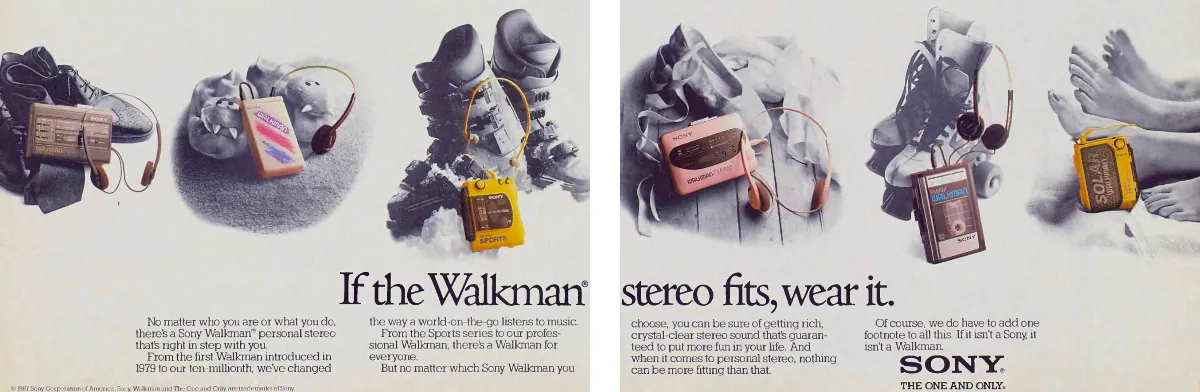
FROM THE PRINTED PAGEOriginal ad copy
OCR transcription from the archived page. Scanning and reading-order errors may remain.
If the Walkman® stereo fits, wear it. No matter who you are or what you do, there's a Sony Walkman™ personal stereo that's right in step with you. From the first Walkman introduced in 1979 to our ten-millionth, we've changed the way a world-on-the-go listens to music. From the Sports series to our professional Walkman, there's a Walkman for everyone. But no matter which Sony Walkman you choose, you can be sure of getting rich, crystal-clear stereo sound that's guaranteed to put more fun in your life. And when it comes to personal stereo, nothing can be more fitting than that. Of course, we do have to add one footnote to all this. If it isn't a Sony, it isn't a Walkman. SONY THE ONE AND ONLY. WALKMAN · SPORTS · SOLAR [illegible smaller product markings] ©1987 Sony Corporation of America. Sony, Walkman and The One and Only are trademarks of Sony.
Commentary
I counted six listening situations without finding a single face. Dress shoes, soft slippers, ski boots, a folded garment, roller skates and bare feet stand in for their owners. A different personal stereo sits beside each. Sony lets the reader supply the missing person, which makes the spread a small exercise in self-selection: where would your feet belong?
The styling does more work than the specifications. Yellow hardware accompanies snow and bare skin; quieter finishes sit beside more formal or domestic objects. The copy names Sports and professional models, but it does not ask the reader to compare their mechanisms. Instead, it organizes a range around circumstances of use. I read the shoes as shorthand for occasions rather than reliable portraits of whole kinds of people; one owner could easily move between several of these scenes.
That distinction exposes a productive tension in “a Walkman for everyone.” The pictured situations suggest variety, but they cannot substantiate a universal claim about affordability, accessibility or every listener’s needs. The page offers a feeling of inclusion within a tightly controlled brand world. Its closing footnote then draws the boundary: whatever the style, the acceptable name remains Sony. Selection is wide inside the range and abruptly narrow outside it.
The spread also catches a period when personalizing music meant choosing a visible piece of hardware. For many listeners today, a shared phone form can contain very different musical lives, with distinction expressed through headphones, software and selections. Here the dedicated player itself must look at home beside the shoes. The continuity is the desire for music to accompany an existing life; the changing part is where that individuality becomes visible.
For a young copywriter, “If the … fits, wear it” adapts a familiar expression by replacing its expected object with the product. “Right in step” and “more fitting” keep that borrowed vocabulary active through the body. This is a useful way to unify a catalogue without repeating the product’s features. Notice, though, that the final line changes its job: “If it isn’t a Sony” uses the same conditional rhythm to assert ownership of the category name.
Sony’s product history records the original Walkman in 1979. Its design retrospective follows subsequent variations, while its present audio range includes headphones and wireless listening products.
The ambition to fit music around the listener remains recognizable. These six players and their wardrobe companions belong to a specific hardware culture. The enduring lesson is how a product range can become understandable through context—provided the marketer remembers that a suggestive collection of scenes is not evidence of serving everyone.