Electronics 1988
Toshiba
Introducing television for people whose sense of hearing is as finely tuned as their sense of sight.
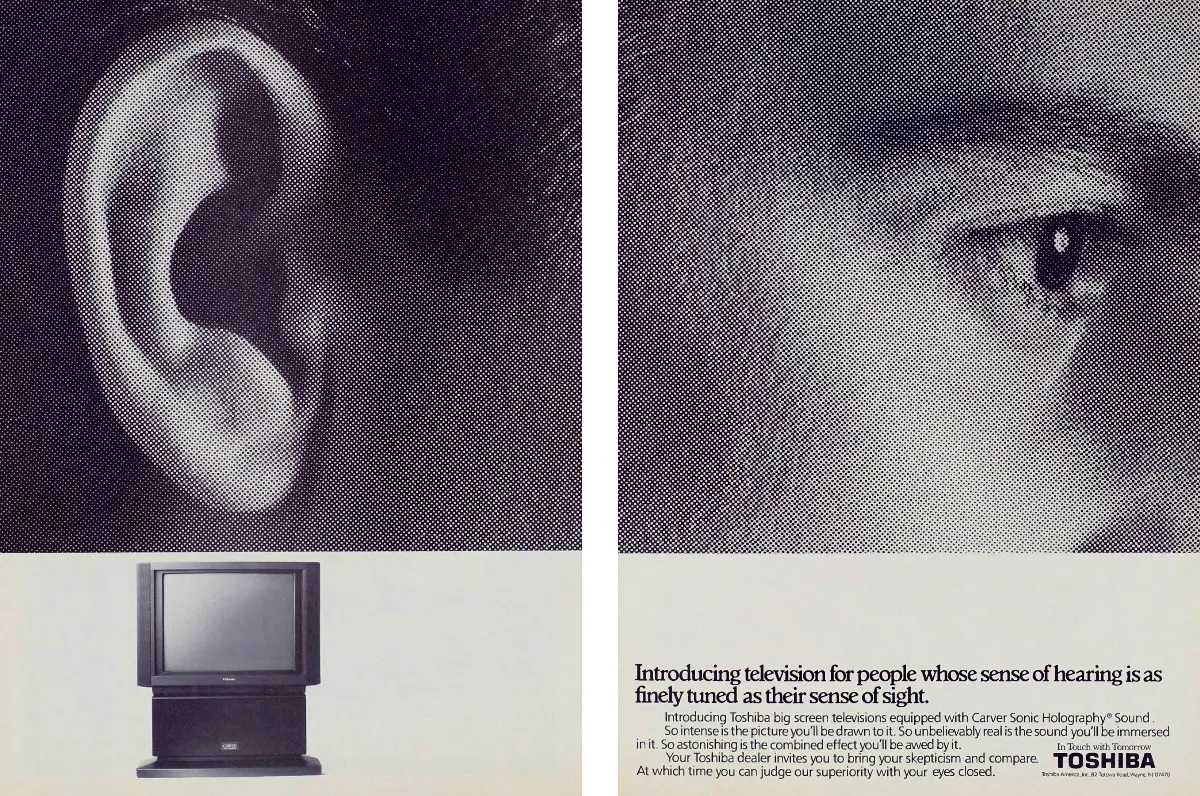
FROM THE PRINTED PAGEOriginal ad copy
OCR transcription from the archived page. Scanning and reading-order errors may remain.
Introducing television for people whose sense of hearing is as finely tuned as their sense of sight. Introducing Toshiba big screen televisions equipped with Carver Sonic Holography® Sound. So intense is the picture you'll be drawn to it. So unbelievably real is the sound you'll be immersed in it. So astonishing is the combined effect you'll be awed by it. Your Toshiba dealer invites you to bring your skepticism and compare. At which time you can judge our superiority with your eyes closed. In Touch with Tomorrow TOSHIBA Toshiba America, Inc., 82 Totowa Road, Wayne, NJ 07470
Commentary
I looked at the eye first, then realized it had been given an equal partner. Across the spread, an enormous ear occupies the other panel. Both are rendered in a coarse photographic halftone; both dwarf the little television below. Toshiba has made the viewer’s equipment more visually important than its own.
The headline explains the unusual allocation of space. This television is for people whose hearing deserves as much attention as their sight. Carver Sonic Holography Sound supplies the named technical distinction, but there is no detailed acoustic account here. Instead, the prose promises that the viewer will be drawn in, immersed and awed. I read the ear-and-eye pairing as a way to make an absent sensation visible: a print advertisement cannot play its sound, but it can persuade a reader that sound belongs in the comparison.
The invitation to bring skepticism is the critical turn. A dealer demonstration is presented as the place where confident adjectives can become an experience. Then the closing line asks the buyer to judge with eyes closed. It is a neat reversal for a television sale, and also a practical reason why the ad does not need to fill the page with screen specifications. The claimed superiority remains the advertiser’s; the scan establishes neither a listening test nor its result.
The page also preserves an older distribution of evidence. The magazine names the feature and makes the appointment seem worthwhile; the showroom must supply the sensory proof. Online reviews and comparison videos can now do some of that preliminary work, yet a recording heard through another device is still an imperfect substitute for a listening demonstration. The sales route has changed more thoroughly than the difficulty of representing sound on a page.
For new copywriters, “So … So … So …” builds three sentences into a rising sequence: picture, sound, combined effect. “Bring your skepticism” gives a doubtful reader a role rather than scolding them for doubting. Finally, “eyes closed” makes the product’s secondary sense the closing argument. When a benefit cannot be directly demonstrated in the medium, write a credible invitation to the place where it can.
Toshiba marketed televisions as part of its consumer-electronics business. Its current corporate notice explains that the television company left the Toshiba group in 2018 and became TVS REGZA in 2021, while support for Toshiba and REGZA video products continued.
The need for convincing sound alongside a compelling picture remains relevant. This console, named sound system and local-dealer comparison belong to the historical offer. The lasting positioning choice is to address the buyer as a whole listener and viewer, rather than reduce the purchase to the screen alone.