Electronics 1972
Panasonic
If you've got the jack, we've got the cassette deck.
FROM THE PRINTED PAGEOriginal ad copy
OCR transcription from the archived page. Scanning and reading-order errors may remain.
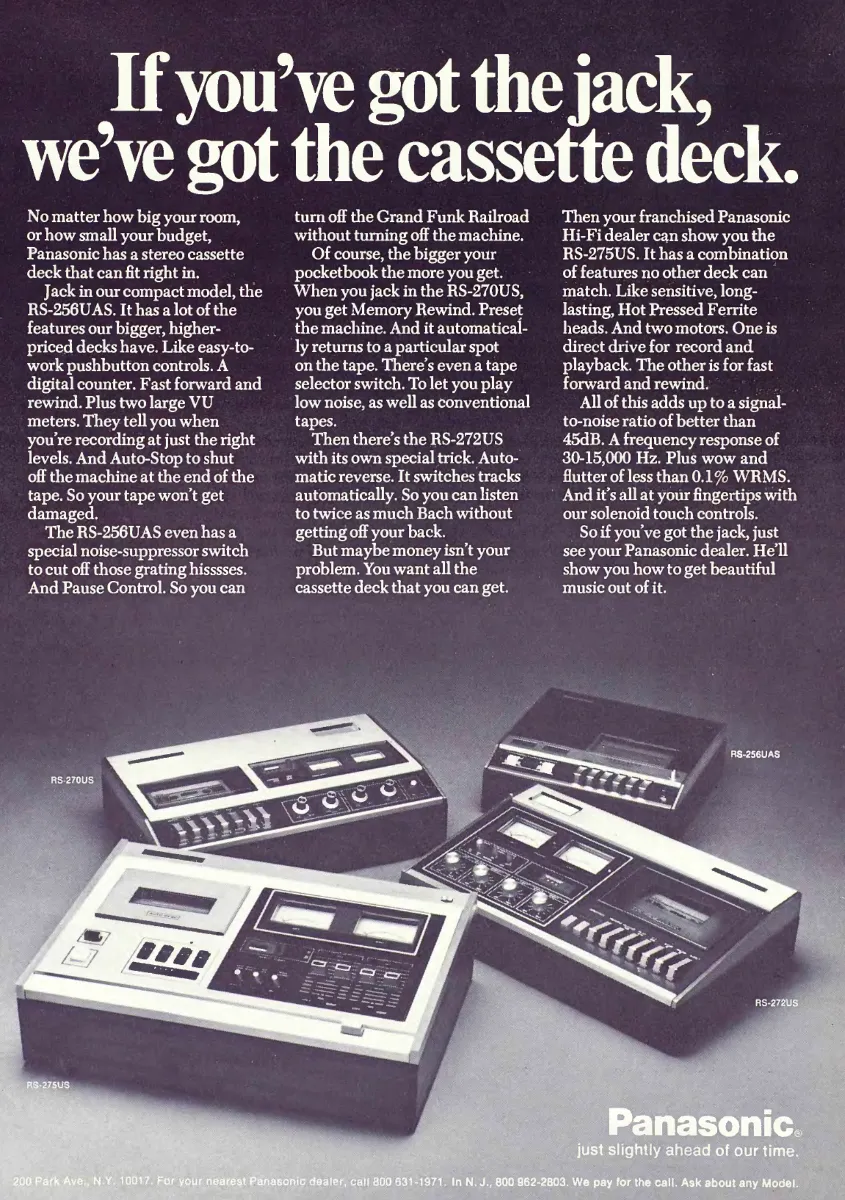
If you've got the jack, we've got the cassette deck. No matter how big your room, or how small your budget, Panasonic has a stereo cassette deck that can fit right in. Jack in our compact model, the RS-256UAS. It has a lot of the features our bigger, higher-priced decks have. Like easy-to-work pushbutton controls. A digital counter. Fast forward and rewind. Plus two large VU meters. They tell you when you're recording at just the right levels. And Auto-Stop to shut off the machine at the end of the tape. So your tape won't get damaged. The RS-256UAS even has a special noise-suppressor switch to cut off those grating hisssses. And Pause Control. So you can turn off the Grand Funk Railroad without turning off the machine. Of course, the bigger your pocketbook the more you get. When you jack in the RS-270US, you get Memory Rewind. Preset the machine. And it automatically returns to a particular spot on the tape. There's even a tape selector switch. To let you play low noise, as well as conventional tapes. Then there's the RS-272US with its own special trick. Automatic reverse. It switches tracks automatically. So you can listen to twice as much Bach without getting off your back. But maybe money isn't your problem. You want all the cassette deck that you can get. Then your franchised Panasonic Hi-Fi dealer can show you the RS-275US. It has a combination of features no other deck can match. Like sensitive, long-lasting, Hot Pressed Ferrite heads. And two motors. One is direct drive for record and playback. The other is for fast forward and rewind. All of this adds up to a signal-to-noise ratio of better than 45dB. A frequency response of 30-15,000 Hz. Plus wow and flutter of less than 0.1% WRMS. And it's all at your fingertips with our solenoid touch controls. So if you've got the jack, just see your Panasonic dealer. He'll show you how to get beautiful music out of it. RS-270US RS-256UAS RS-272US RS-275US Panasonic® just slightly ahead of our time. 200 Park Ave., N.Y. 10017. For your nearest Panasonic dealer, call 800 631-1971. In N. J., 800 962-2803. We pay for the call. Ask about any Model.
Commentary
I followed the model numbers before the jokes. Four machines occupy the lower half of the page, their angled faces turning meters and switches into an inviting display of capability. Above them, three dense columns lead from the compact RS-256UAS to the RS-275US. The composition is effectively a shop counter with a patient salesperson attached.
The cheapest position in the range is protected carefully. Its deck already has pushbuttons, a counter, two VU meters and automatic stopping. Each subsequent model receives a distinct reason to cost more: Memory Rewind, automatic reverse, then the two motors and ferrite heads of the top machine. No prices are printed. Instead, the copy teaches the reader what additional spending might purchase, leaving the dealer to complete the transaction.
The most interesting conveniences are interruptions avoided. A tape need not be damaged at its end; a passage can be found again; Bach can continue without the listener standing up. In a listening interface organised around searchable tracks, those tasks can seem almost invisible. Here they require motors, switches and an explanation. The promise is less labour between the listener and the music.
For a beginning copywriter, “jack” connects money with plugging in, while “Bach” and “back” turn automatic reverse into a bodily benefit. The elongated “hisssses” lets a nuisance intrude into the sentence before the suppressor removes it. These devices work because they attach to specific operations. The lesson is to let wordplay demonstrate a feature, then give the reader the plain explanation needed to understand it.
Panasonic’s history begins in 1918 with Konosuke Matsushita’s electrical-products business. The present group spans consumer electronics, business solutions and energy-related activities, a much broader field than the four decks shown here.
The model ladder still offers a recognisable selling method: establish a useful baseline, then justify each step up. Tape transport specifications and the promise to pay for a dealer-location call are historical particulars. Saving the listener a small piece of effort remains an intelligible benefit.