Financial Services 1972
Master Charge
The second honeymoon.
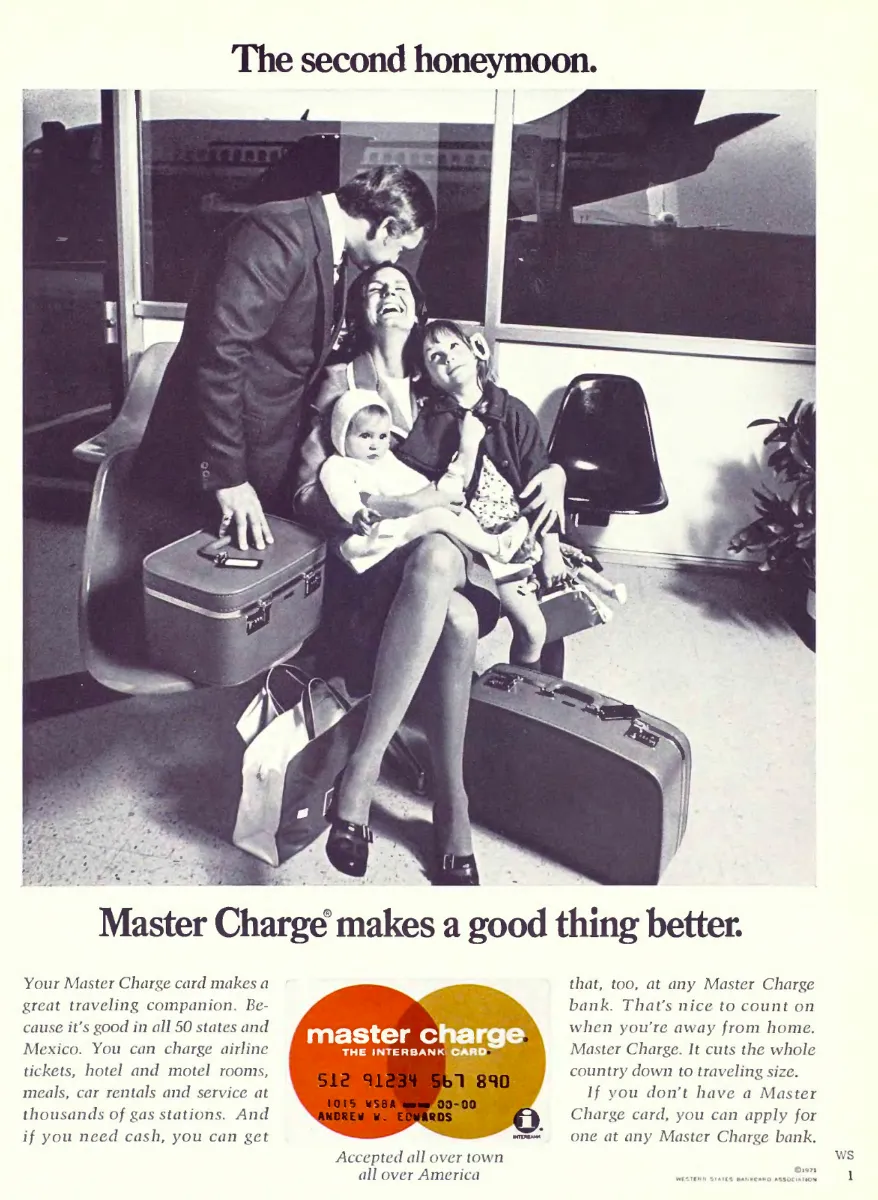
FROM THE PRINTED PAGEOriginal ad copy
OCR transcription from the archived page. Scanning and reading-order errors may remain.
The second honeymoon. Master Charge® makes a good thing better. Your Master Charge card makes a great traveling companion. Because it's good in all 50 states and Mexico. You can charge airline tickets, hotel and motel rooms, meals, car rentals and service at thousands of gas stations. And if you need cash, you can get that, too, at any Master Charge bank. That's nice to count on when you're away from home. Master Charge. It cuts the whole country down to traveling size. If you don't have a Master Charge card, you can apply for one at any Master Charge bank. master charge. THE INTERBANK CARD. 512 91234 567 890 1015 WSBA 03-00 ANDREW W. EDWARDS INTERBANK Accepted all over town all over America ©1971 WESTERN STATES BANKCARD ASSOCIATION WS 1
Commentary
I counted the children before I understood the headline. A second honeymoon usually suggests a couple reclaiming time alone; this photograph supplies a baby, an older child, several pieces of luggage and a terminal seat. The man bends toward the smiling woman, and the older child looks up into their exchange. The joke is affectionate: the first honeymoon’s intimacy is still possible, but its travelling party has expanded.
The card arrives below the photograph, where the otherwise monochrome page breaks into orange and yellow. It is presented as the practical companion to the emotional scene. Flights, rooms, meals, rentals and service stations make a miniature itinerary in the body copy. Access to cash supplies the fallback. The advertisement never explains borrowing costs; its chosen subject is the reassurance of having a recognised means of payment away from home.
“All 50 states and Mexico” makes acceptance a destination-level concern. In this page’s world, knowing where a card will work is part of preparing for a holiday. Digital travel planning can surface payment information before departure, but the underlying anxiety remains legible: a family far from home needs ordinary transactions to go smoothly. The photograph makes that need feel domestic rather than financial.
For young copywriters, the two headlines divide the work neatly. “The second honeymoon” creates the scene’s gentle surprise; “makes a good thing better” gives the brand a supporting role. The card does not claim to create the family’s happiness. “Traveling companion” then carries that role into the practical copy. The lesson is to choose a proportionate part for the product in an emotional story.
Mastercard’s brand history records the Interbank Card Association’s formation in 1966 and the change from Master Charge to MasterCard in 1979. Today Mastercard describes its role as a global payments technology company, connecting participants in the payment system. This scan carries a 1971 copyright notice; the archive year follows the supplied 1972 provenance.
Acceptance and confidence away from home still connect the old card to the present network. The bank-counter application and geography of the printed promise are more specific to the original offer. The most durable choice is giving the service a quiet job: make the family trip easier, then leave the family in the foreground.