Electronics 1978
Nikon
The new classic compact from Nikon. You can take as much pride in its breeding as in its performance.
FROM THE PRINTED PAGEOriginal ad copy
OCR transcription from the archived page. Scanning and reading-order errors may remain.
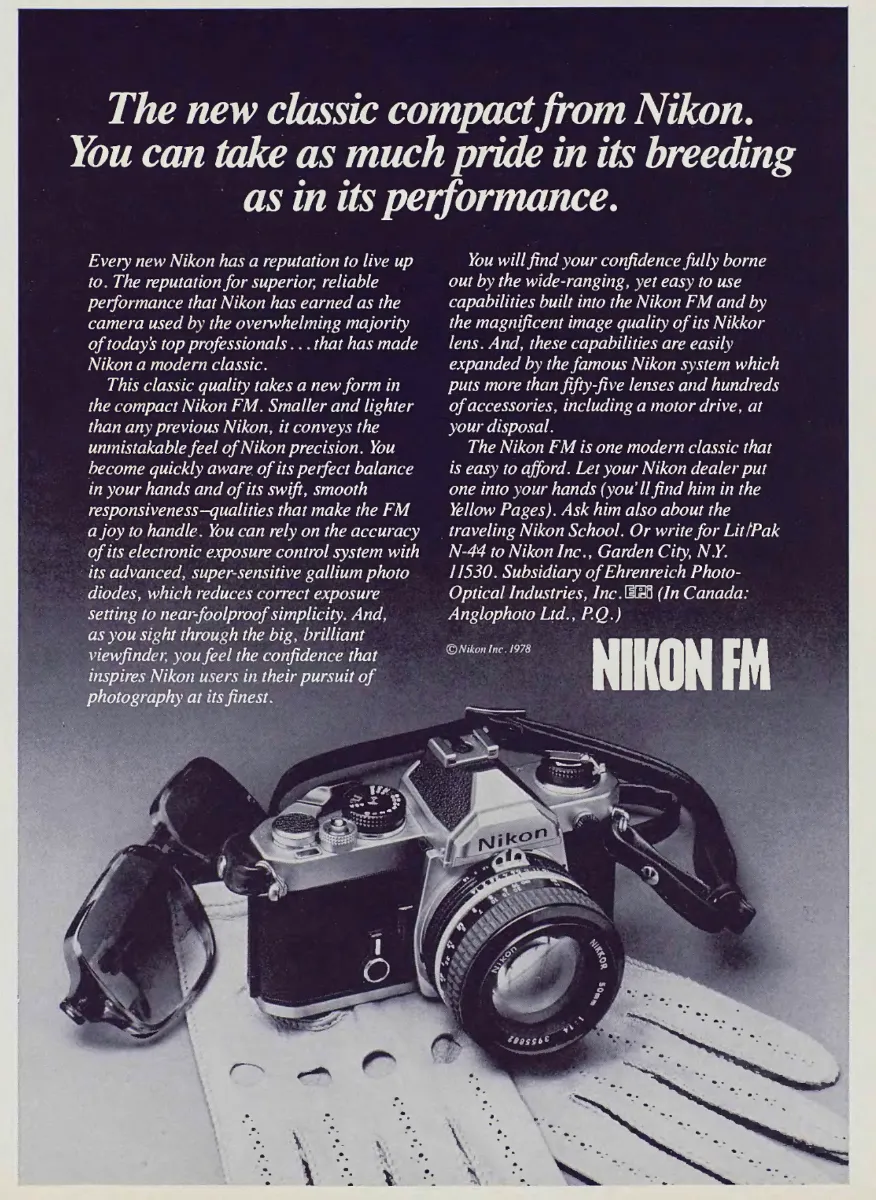
The new classic compact from Nikon. You can take as much pride in its breeding as in its performance. Every new Nikon has a reputation to live up to. The reputation for superior, reliable performance that Nikon has earned as the camera used by the overwhelming majority of today’s top professionals…that has made Nikon a modern classic. This classic quality takes a new form in the compact Nikon FM. Smaller and lighter than any previous Nikon, it conveys the unmistakable feel of Nikon precision. You become quickly aware of its perfect balance in your hands and of its swift, smooth responsiveness—qualities that make the FM a joy to handle. You can rely on the accuracy of its electronic exposure control system with its advanced, super-sensitive gallium photo diodes, which reduces correct exposure setting to near-foolproof simplicity. And, as you sight through the big, brilliant viewfinder, you feel the confidence that inspires Nikon users in their pursuit of photography at its finest. You will find your confidence fully borne out by the wide-ranging, yet easy to use capabilities built into the Nikon FM and by the magnificent image quality of its Nikkor lens. And, these capabilities are easily expanded by the famous Nikon system which puts more than fifty-five lenses and hundreds of accessories, including a motor drive, at your disposal. The Nikon FM is one modern classic that is easy to afford. Let your Nikon dealer put one into your hands (you’ll find him in the Yellow Pages). Ask him also about the traveling Nikon School. Or write for Lit/Pak N-44 to Nikon Inc., Garden City, N.Y. 11530. Subsidiary of Ehrenreich Photo-Optical Industries, Inc. EPOI (In Canada: Anglophoto Ltd., P.Q.) ©Nikon Inc. 1978 NIKON FM
Commentary
I found the gloves an unexpectedly revealing prop. The Nikon FM rests with its strap on pale driving gloves, beneath an italic headline about “breeding.” Before the copy describes a photodiode, the camera has entered a world of well-kept possessions and practiced hands. The arrangement suggests cultivated leisure; the text supplies the professional ancestry that makes owning it feel more consequential.
The first paragraph puts an obligation on every new Nikon: it has a reputation to live up to. That is a clever way to introduce a smaller model without making smallness sound like retreat. The ad moves through balance, responsiveness, the viewfinder, and exposure setting, then opens outward to more than fifty-five lenses and hundreds of accessories. Compactness is the immediate benefit; membership in a larger system is the reassurance. I read the professional-majority statement as the advertiser’s assertion, not a market-share finding established by this scan.
Nikon’s own camera chronicle dates the FM to May 1977 and places it within a move toward smaller, lighter equipment. That makes the 1978 page’s insistence on continuity especially legible: the new form must inherit the old authority. It also cautions against reading “electronic exposure control” as proof of automatic exposure. The ad describes assistance in setting exposure; its wording should remain distinct from a modern feature checklist.
The Yellow Pages, traveling Nikon School, and mailed Lit/Pak make learning part of the ownership journey. The reader is invited to find a person, hold a camera, and acquire instruction. Online demonstrations can change the route, but the page reminds me how much reassurance once traveled through a dealer’s hands.
For a young copywriter, “new classic” deliberately holds novelty and permanence together. “Breeding” gives engineering a pedigree, while “big, brilliant” and “swift, smooth” make technical competence tactile and audible. The lesson is to connect a prestige word to specific sensations and capabilities, so status has something observable underneath it.
Nikon’s corporate history traces its optical business to 1917. Its present imaging business includes Z-series mirrorless cameras and lenses.
The persistent promise is confidence in a manageable camera backed by a capable system. The film body, period lens count, and mail-order information belong to this offer. The deeper positioning—make a smaller instrument feel like access to a serious photographic tradition—still has persuasive force.